A man who preached for years and can no longer travel or stand to teach often asks whether anything is left for him to do. This article answers that question for retired volunteer preachers and for the relatives who love them. Scripture gives a clear answer: how a retired preacher can still serve through prayer is by interceding, by name and with persistence, for the people he once served. The Bible calls this labor, and it is a continuation of the ministry he had before.
Why the Sermon Was Never the Whole of the Ministry
When the apostles were pressed with the daily care of the church, they said, “But we will give ourselves continually to prayer, and to the ministry of the word” (Acts 6:4). Prayer is named first. The apostles did not treat it as something to do after the real work was finished. They counted it as one of the two things they were appointed for.
A sermon reaches the people in the room on the day it is preached. Prayer reaches the same people on every day afterward, and it reaches those who were absent. A preacher whose voice has gone quiet can still ask God to water what was sown, and the Lord has not said that only the preacher’s voice counts.
Preaching also never depended on the preacher’s strength. Paul wrote, “I have planted, Apollos watered; but God gave the increase” (1 Corinthians 3:6). If God gives the increase, then asking Him for it is work done at the source of the harvest.
Epaphras, Samuel and Anna: What Scripture Says About Those Who Labor in Prayer
Paul wrote of Epaphras to the church at Colossae: “Epaphras, who is one of you, a servant of Christ, saluteth you, always labouring fervently for you in prayers, that ye may stand perfect and complete in all the will of God” (Colossians 4:12). The word is labouring. Paul also says Epaphras had “a great zeal” for the believers in Colossae, Laodicea and Hierapolis (Colossians 4:13). His prayer is given as proof of his care for those churches.
Samuel had been the people’s leader, and when they no longer wanted him to lead, he did not stop serving them. He said, “Moreover as for me, God forbid that I should sin against the LORD in ceasing to pray for you: but I will teach you the good and the right way” (1 Samuel 12:23). He treats ceasing to pray as a sin against God. Prayer for the people was a duty that outlasted his office.
Anna, a widow of about eighty-four years, “departed not from the temple, but served God with fastings and prayers night and day” (Luke 2:37). Luke uses the word served for her. She was present when the child Jesus was brought in, and she spoke of Him “to all them that looked for redemption in Jerusalem” (Luke 2:38). An old woman who stayed in prayer was there when the Lord’s promise arrived.
Moses on the Hill: How One Man’s Hands Held Up a Battle He Could Not Fight
In Exodus 17, Israel fought Amalek at Rephidim. Joshua led the men in the valley, while Moses, Aaron and Hur went up to the top of the hill. “And it came to pass, when Moses held up his hand, that Israel prevailed: and when he let down his hand, Amalek prevailed” (Exodus 17:11).
Moses could not fight, and the battle was still decided partly by what he did on the hill. When his hands grew heavy, Aaron and Hur set a stone under him and held up his hands, one on each side, “and his hands were steady until the going down of the sun” (Exodus 17:12).
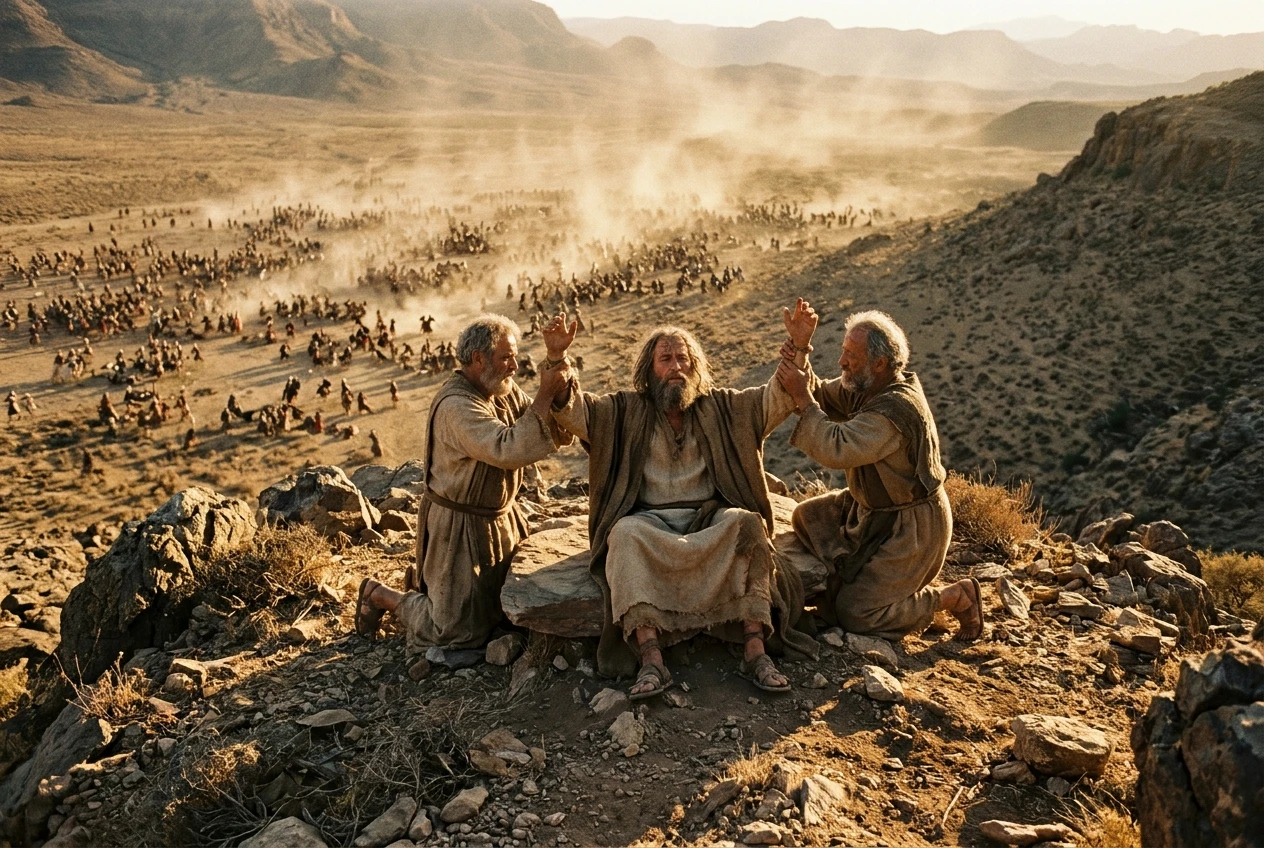
Two points follow for the retired preacher. The work on the hill was real work, and it tired him. Moses also needed others beside him, so a preacher who prays does not need to carry the weight alone, and the family can sit beside him as Aaron and Hur did.
Whom to Pray For by Name: The Churches, the Young Preachers and the Households You Served
Paul prayed by name and by place. He told the Romans, “without ceasing I make mention of you always in my prayers” (Romans 1:9), and he told Timothy, “without ceasing I have remembrance of thee in my prayers night and day” (2 Timothy 1:3). Names make prayer specific, and specific prayer is easier to keep up than a general wish for the church’s good.
Three groups are a sound place to begin:
- The congregations you preached in. Pray for their elders, their unity, their faithfulness to the word, and the people who sit in the back and rarely speak.
- The young preachers you taught or encouraged. Pray that they remain sound in doctrine, that they find provision for their travel and daily needs, and that they do not grow weary. You can read more about what an older volunteer preacher should hand to the young before he lays down the pulpit.
- The households that gave you a meal, a bed or a ride. Pray for their children, their health and their work. These families bore a share of your ministry, and they can be remembered before God now.
Paul’s own requests give a model. He prayed that the Colossians would be “filled with the knowledge of his will in all wisdom and spiritual understanding” (Colossians 1:9). Pray for the same things, that people may know God’s will and walk in it, and add the particular needs you know of.
A Plain Daily Pattern a Pensioner Can Keep Without Strain
A pattern that is too heavy will be dropped within a month, so keep it small. The following can be done sitting down, in about twenty to thirty minutes, and shortened on days of weakness.
- Choose a fixed time. Morning is suitable because the day has not yet crowded in. Daniel prayed at set times (Daniel 6:10), and the psalmist wrote, “My voice shalt thou hear in the morning, O LORD” (Psalm 5:3).
- Open with a short passage. Read a psalm or a portion of one of Paul’s letters, and let it set the words of your prayer.
- Pray through names. Take a few names each day instead of all of them at once. On a short list, name everyone daily. On a longer list, assign certain people to certain days of the week.
- Give thanks for what God has already done. Paul began many letters with thanks for the believers (Philippians 1:3).
- Close with a request for the word to spread. Paul asked the churches to pray for him that “the word of the Lord may have free course, and be glorified” (2 Thessalonians 3:1).
If strength fails in the middle of the prayer, stop and resume later in the day. Christ does not measure the labor by the minutes. A preacher who has lived on God’s daily provision for meals and travel can bring the same dependence to this work, taking each day as it comes.
When Prayer Feels Unseen and Unanswered, Continue
Christ “spake a parable unto them to this end, that men ought always to pray, and not to faint” (Luke 18:1). He gave that parable because fainting is a real danger. Years can pass with no visible answer, and the preacher may never learn what became of the people he named.
Scripture says the labor is still counted. “For God is not unrighteous to forget your work and labour of love, which ye have shewed toward his name, in that ye have ministered to the saints, and do minister” (Hebrews 6:10). Paul closes his great chapter on the resurrection with the instruction to be “stedfast, unmoveable, always abounding in the work of the Lord, forasmuch as ye know that your labour is not in vain in the Lord” (1 Corinthians 15:58).
The Lord also sees what is done in private. Those who feel unnoticed can read what Scripture says about the Father who sees in secret and keeps the record. Hebrews adds that Christ “ever liveth to make intercession” for those who come to God through Him (Hebrews 7:25), so a preacher who intercedes is doing what his Lord is doing.
Some answers will not come in his lifetime. A seed prayed over for years may come up after he has gone, and the reaper will not know whose prayer lay behind it.
What Your Family Learns by Watching You Pray
Children and grandchildren notice what the older man does with his mornings. If they see him take a list of names, bow his head and speak to God about each one, they learn that prayer is work and that it is for others. No lecture on faith teaches this as well as the sight of it done daily.
Relatives who once asked why he does not rest, or why he gives so much of himself, may find the answer in the room where he prays. The family can ask whom he is praying for that week, and they can add their own requests. In time some will pray with him, as Aaron and Hur stood beside Moses.
Family members who worry that he is “doing nothing” can be answered gently from Scripture. The Levites were released from the heavy service at fifty and still “minister with their brethren in the tabernacle” by keeping charge (Numbers 8:25-26). You can read more in the article on what the Bible says about retirement for ministers. The labor changes with age, and God still appoints it.
Take a sheet of paper this week and write the names of three people or congregations you once served, then pray for them by name each morning and note the date you began.
Leave a Reply