Here is how to pass your faith on to your grandchildren: tell them the works of God in plain words, give them the Scripture that goes with each work, and set up reminders that cause them to ask questions. Do this beside their parents, and pray for each child by name.
What does Scripture say about passing faith from one generation to the next?
Scripture commands that the knowledge of God be handed down deliberately, from the old to the young, and it names the grandchildren among those who must receive it. Moses told Israel to teach God’s words to “thy sons, and thy sons’ sons” (Deuteronomy 4:9).
Deuteronomy 6:6-7 gives the method. The words of God are to be on the parents’ own hearts first, then taught diligently to the children, and spoken of when sitting in the house, when walking by the way, when lying down and when rising up. The teaching belongs to ordinary hours, and it needs no classroom.
Psalm 78:4-7 gives the purpose. The works of God are shown to the generation to come, so that the children yet unborn “might set their hope in God, and not forget the works of God, but keep his commandments.” The aim is a living trust that continues, and a body of information about God is only the means to it.
The aged are given a part. The psalmist prays, “Now also when I am old and grayheaded, O God, forsake me not; until I have shewed thy strength unto this generation, and thy power to every one that is to come” (Psalm 71:18). A grandparent who prays this has understood the task of old age.
What happens when a generation does not pass the faith on?
The next generation grows up without knowing the Lord, and Scripture records that this happened to Israel within one generation. Judges 2:10 says that after Joshua’s generation was gathered to its fathers, “there arose another generation after them, which knew not the LORD, nor yet the works which he had done for Israel.”
That generation had not seen the Jordan divided or the walls of Jericho fall, and nobody had told them in a way that took hold. The verses that follow describe the cost: the people served other gods and fell into repeated trouble.
This is a warning to the older believer. A faith that was real in you can still fail to reach the child who has only heard that you believe. The children must be told what God did, and they must be told by someone they know.
What did Lois give Timothy, and what can a grandparent give today?
Lois gave Timothy a household in which faith was real before he could choose it for himself. Paul writes, “When I call to remembrance the unfeigned faith that is in thee, which dwelt first in thy grandmother Lois, and in thy mother Eunice; and I am persuaded that in thee also” (2 Timothy 1:5).
Scripture does not list the lessons she taught. It records three facts: the faith was sincere, it lived in the grandmother first, and it was found in the grandson. Paul adds that Timothy had known “the holy scriptures” from childhood (2 Timothy 3:14-15). A grandmother’s faith, a mother’s faith and the Scriptures all stood around the boy together.
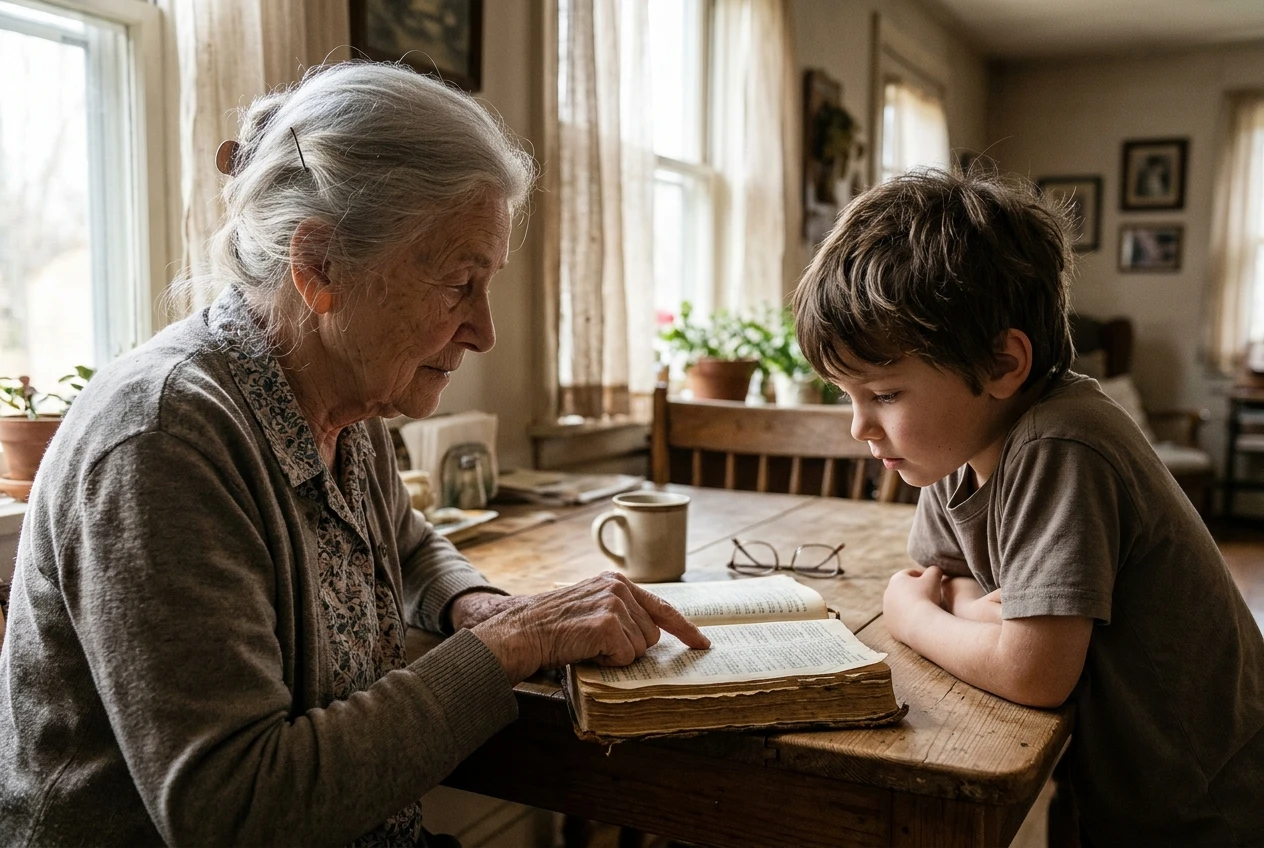
A grandparent today has the same three things to give: a sincere faith that the child can observe, the Scriptures put into the child’s hands and ears, and a steady place beside the parents. None of them costs money. If you have little to leave in the way of property, you can still leave this. A fuller treatment of the matter is in You May Leave No Money Behind, but You Can Leave a Blessing That Outlasts It.
How do you tell grandchildren the works of God in plain words?
Choose one thing God has done, say it simply, and give the Scripture that matches it. Moses expected the children to ask, “What mean the testimonies, and the statutes, and the judgments?” and the father was to answer with a story: “We were Pharaoh’s bondmen in Egypt; and the LORD brought us out with a mighty hand” (Deuteronomy 6:20-21).
The answer in Deuteronomy is short, factual and about God. It names the trouble, names who delivered, and says what he did. You can follow the same form with a work of God you have witnessed yourself.
- Choose one work of God that you know to be true, whether from your own life or from the family’s.
- State the need as it was, in a sentence a child can follow.
- Say what God did, and say only what you know.
- Read the Scripture that goes with it, and let the child hear the words.
- Ask the child a question, such as “What does this tell you about God?”
Use the words a child already knows. A seven-year-old does not need the word “providence,” but understands “God gave us what we needed, and we had asked him for it.” Keep each telling short enough that the child can repeat it to someone else, because a story that can be repeated has been received.
Tell the account truthfully, including the times when the answer came slowly or differently from what was asked. Children detect exaggeration, and a faith taught with exaggeration is easily set aside later. If you are teaching them to wait on God, Let Your Grandchildren Watch You Wait on God for Daily Bread deals with that directly.
How can you build a memorial that your grandchildren will ask about?
Set up something visible that is connected to a work of God, so that a child will ask what it means and you will have a reason to answer. God told Joshua to take twelve stones from the Jordan riverbed and set them up at the place where Israel lodged. The purpose was stated: “That this may be a sign among you, that when your children ask their fathers in time to come, saying, What mean ye by these stones?” (Joshua 4:6).
The answer was to be that the waters of the Jordan were cut off before the ark of the covenant. Joshua 4:24 gives the reason for the whole memorial: “That all the people of the earth might know the hand of the LORD, that it is mighty: that ye might fear the LORD your God for ever.”
A memorial in a grandparent’s home can be modest. Some examples:
- A Bible with dated entries in the margin or on the flyleaf, each one naming something God did.
- A shelf or a small box that holds a few objects, each one tied to a work of God.
- A verse written out and kept in a place the children pass daily, with a date and a line about why it was chosen.
- A notebook of answered prayers that the grandchildren are allowed to read.
The memorial works only if you answer when the child asks. The stones at Gilgal served as a sign because someone stood ready to explain them. If you have not yet started recording what God has done, Write It Down While You Remember: A Preacher’s Plain Method for Recording God’s Provision for His Grandchildren describes a plain way to begin.
How do you hand on the faith without taking the place of the parents?
Work under the parents’ direction and alongside them, because Scripture addresses the primary command to teach the children to the parents. Deuteronomy 6 is spoken to the household, and Ephesians 6:4 tells fathers to bring their children up “in the nurture and admonition of the Lord.” The grandparent adds to this work and does not replace it.
The example of Lois points the same way. Paul names both the grandmother and the mother, and the faith is found in both. The two women stand in one line, and neither is described as competing with the other.
The parents carry The grandparent adds Daily instruction and discipline in the home Unhurried time to tell the works of God The household’s practices and rules Support for those practices, never contradiction of them Decisions about the child’s upbringing Prayer for each child by name The child’s everyday questions The long view of a life lived with God
Some practical points follow from this:
- Ask the parents what they are teaching, and teach in agreement with it.
- Do not correct a parent in front of a child.
- If you differ with the parents over a point of doctrine, speak to the parents privately and with gentleness, and keep it away from the child.
- Where the parents do not share your faith, tell the child the works of God with the same plain honesty, and keep to what the parents permit. How to Explain Your Ministry to Relatives Who Do Not Believe, and Let Your Patience Do the Preaching may help with the manner.
Your prayers go beyond any limit the parents set. You can pray for each grandchild every day, whether or not you are in the room, and this is a part of Psalm 71:18 that nobody can restrict.
What should you do this week?
This week, choose one work of God from your own life and tell it to one grandchild, in plain words, with the Scripture that goes with it. Keep it short, tell it truthfully, and ask the child one question at the end.
Then write down the date, the work of God and the verse. That record is the first stone of a memorial, and the child’s next question will show you where to go on from there.
Leave a Reply