To start a family prayer altar at home, choose one fixed place and one fixed hour, gather every member of the household, read one verse of Scripture, name each need aloud, and bring it to God in the name of Jesus Christ. Then write down the need and, when it comes, the answer.
What is a family prayer altar, and why should a household set one up?
A family prayer altar is a regular place and time at which a household stops its ordinary work and brings its needs to God together. It needs no table of stone and no special furniture. In the Old Testament, Abraham built altars where he met with the LORD (Genesis 12:7-8). In the New Testament, the place is set apart by the prayer offered there, and the one who receives it is the Father, through the one mediator, Jesus Christ (1 Timothy 2:5).
A household with sick relatives and children in school carries needs every day: food on the table, a uniform, school fees, medicine, a bed that must be tended. When each person carries these alone, each person worries alone. A family altar puts every need into one hour, spoken aloud, in the hearing of those who share it.
Where and when should the family gather to pray?
Choose one corner that can be kept quiet for a short time, and one hour of the day that the household can keep on most days. The corner may be a table, two chairs, a bench by a window or the foot of a sick person’s bed. What matters is that it is the same place and that it is understood by everyone as the place of prayer.
Scripture gives patterns for the hour. David wrote, “My voice shalt thou hear in the morning, O LORD” (Psalm 5:3), and Daniel prayed three times a day, kneeling at his window (Daniel 6:10). Choose the hour that your household can actually keep:
- Morning, before the children leave for school, so the day is placed in God’s hands first.
- Evening, after the meal, when the family is at home and the sick are awake.
- Both, if the household is able, with a short prayer in the morning and the fuller gathering at night.
A gathering kept faithfully for a short time does more good than a long one that is soon abandoned. Decide the hour once, announce it to the family, and keep it.
What does the Bible say about making the home a house of prayer?
The Bible places prayer in the home as well as in the temple. The LORD said, “Mine house shall be called an house of prayer for all people” (Isaiah 56:7), and Jesus repeated those words when he cleared the temple (Matthew 21:13). In Acts 12:12, many were gathered together praying in the house of Mary, the mother of John Mark, on the night Peter was in prison.
Four passages give the foundation for the household gathering:
- Deuteronomy 6:6-7: God’s words are to be taught to the children “when thou sittest in thine house.”
- Matthew 18:19-20: where two or three are gathered in Christ’s name, he is in the midst of them.
- Philippians 4:6: “In every thing by prayer and supplication with thanksgiving let your requests be made known unto God.”
- Luke 11:3: the disciples were taught to ask for daily bread.
Private prayer remains necessary. Jesus told his hearers to enter the closet and shut the door (Matthew 6:6). The family altar adds to private prayer, so that the household also prays as one body.
How should a family prayer gathering be ordered, step by step?
Keep the order the same each time, so that the youngest child knows what comes next. A simple order for a gathering of fifteen to twenty minutes is as follows:
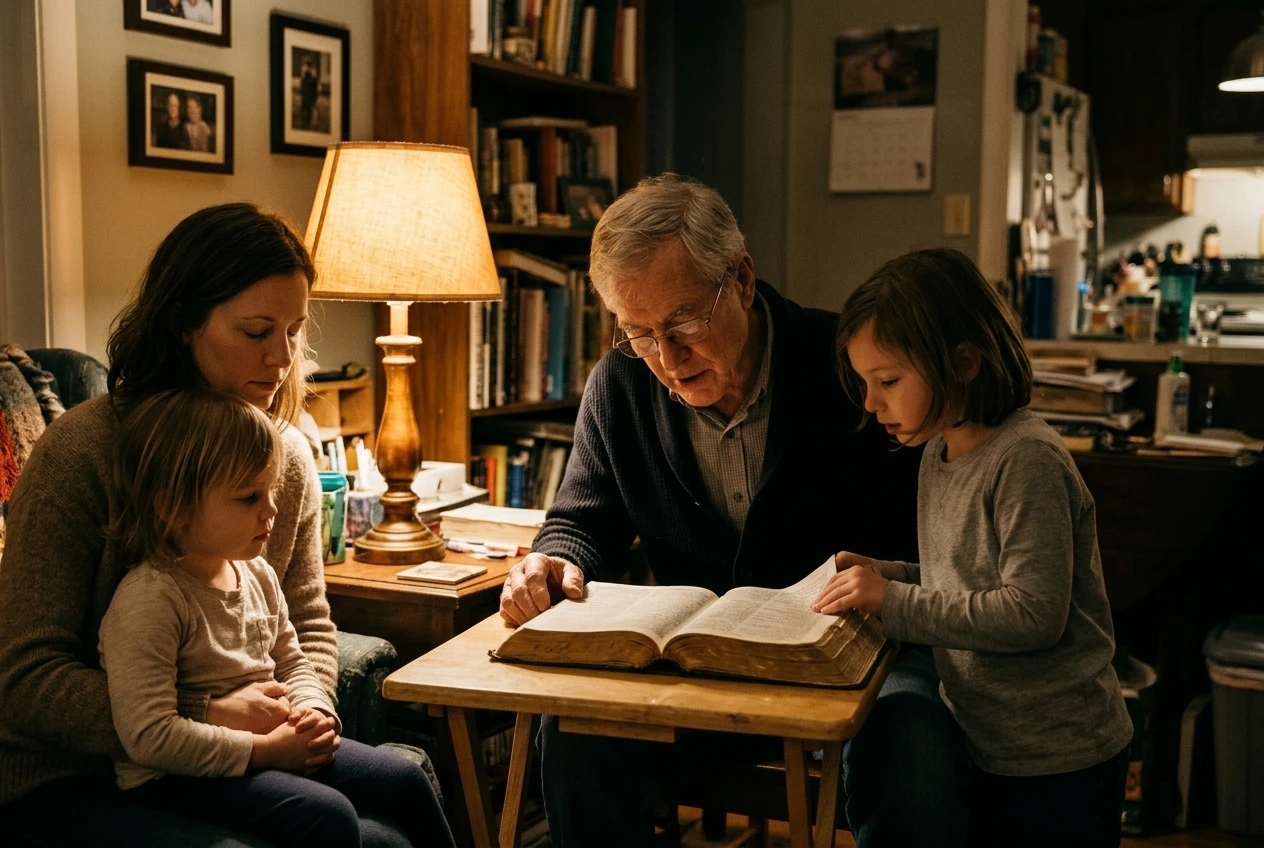
- Call the household together. Gather at the appointed place and sit near one another. Switch off the radio and television and put the telephones aside.
- Open with a short prayer. Address the Father and ask in the name of Jesus Christ (John 14:13-14) that he will hear the household.
- Read one verse or short passage. Read slowly. Choose the verse beforehand; a verse that speaks of God’s care, such as Philippians 4:19, suits a household praying for provision.
- Give thanks. Let each person name one thing for which to thank God since the last gathering. Thanksgiving comes before requests (Philippians 4:6).
- Name the needs aloud. Speak each need plainly: the meal that is short, the fee that is due, the relative who is ill. Name the person and the need rather than praying in general terms.
- Pray over each need. The leader, or a different member for each need, prays for it in turn.
- Close together. End with the Lord’s Prayer spoken by all, and with “Amen” from every voice.
For the sick, James 5:14-16 directs the household to call for the elders of the church to pray over the sick person, and adds that the prayer of a righteous person is powerful. A retired preacher may lay hands on a sick relative and pray, and may also ask the elders of the local church to come.
How can every member, the sick and the children included, take part?
Every person in the house has a part, and the gathering should be arranged so that each can fulfil it. The leader’s task is to make room for each voice, not to speak for all.
Member Part in the gathering The retired preacher or grandparent Leads the order, reads the verse and closes in prayer The sick relative Names their own need, or prays from the bed; no one need be moved to the corner School-age children Read the verse aloud, and name their own school needs Young children Say a one-sentence prayer, or say “Amen” with the family Adult relatives Pray for one need each in turn and give thanks
A sick person who cannot sit or speak for long still belongs to the altar. Bring the gathering to the bedside, or let the sick person pray a single sentence. A child who is asked to read or to pray learns that God hears a child as readily as an elder. Do not rebuke a halting prayer. God looks to the heart, and the family learns to pray by hearing one another pray.
How do we record each need and each answer?
Keep one notebook at the place of prayer and write each need in it on the day it is first brought to God. Under each, write the date, the person it concerns and the plain words of the request. When God supplies the need, write the date and what was given, in the same entry.
A written record serves the household in three ways. It guards against forgetting what God has done, for the people of Israel were told repeatedly to remember. It gives children something to read, and it shows that God answers even when the answer arrives in a manner or a season no one expected. The method set out in Write It Down While You Remember describes how to keep such a record plainly and faithfully.
For school needs in particular, naming each item aloud and writing it down go together. The article on how to pray for the uniform, the fees and the lunch by name treats that practice at length, and the altar is the place where it can be carried out each day.
What should the family do when the answer is slow to come?
When the answer is slow, keep the appointed hour and keep praying. Jesus told his disciples a parable to show “that men ought always to pray, and not to faint” (Luke 18:1). Habakkuk was told that the vision waits for its appointed time, and that “though it tarry, wait for it” (Habakkuk 2:3).
A slow answer is not a refusal. It may mean that God is supplying in another way, through a relative, a neighbour or a small portion that lasts longer than expected. It may mean that he is teaching the household to depend on him each day, as the prayer for daily bread teaches (Luke 11:3). Read back through the notebook at such times, so that the family sees the answers already received.
A few practices help the household to continue:
- Keep the hour even when the needs seem unchanged.
- Read together an earlier entry in which God supplied a need.
- Let each member say one thing for which he or she still thanks God.
- Hand the worry over in prayer, and do not carry it away from the altar again. The article on why the anxious preacher can lay down the fear of tomorrow’s bread explains this from the words of Christ.
The Lord has promised to supply every need of those who are his, according to his riches in glory by Christ Jesus (Philippians 4:19). The family altar is where the household learns to wait on that promise together.
Begin this evening
Begin this evening: choose one place in the home, one fixed hour, one verse and one need named aloud, and gather the family to bring it to God in the name of Jesus Christ.
Leave a Reply