
Many volunteer preachers carry a worry they rarely say aloud. The pension is small, the gifts are uncertain, and the journey to the next appointment costs money that may not be in the house. By day the worry is a quiet calculation. At night it returns as a question: what will there be to eat next week, and how will I get there?
If you are asking how to stop worrying about finances in ministry, begin with the fact that Scripture does not pretend the worry is absent. It names the fear and then teaches the heart, one day at a time, where to put it.
Fear of Provision Is Common, and Scripture Does Not Hide It
The Israelites in the wilderness asked who would feed them, and Moses did not answer with a rebuke of their appetite. God answered by sending bread (Exodus 16). David, an old man by the end of his life, wrote of having never seen the righteous forsaken or his children begging bread (Psalm 37:25), and he wrote that after many years of hunger and flight. Elijah ran from Jezebel and asked to die under a broom tree, and God’s first response was food and sleep (1 Kings 19:4-8).
Christ himself spoke to anxiety about food and clothing, which tells us the concern was common among his hearers and is not a mark of weak faith in the one who feels it. A preacher who lies awake is not disqualified from preaching. He is a man with a body that needs bread, serving a God who knows that it does (Matthew 6:32).
The Difference Between Prudent Planning and Fearful Striving
Scripture commends planning. “The plans of the diligent lead surely to abundance” (Proverbs 21:5). Christ asks who among us builds a tower without first counting the cost (Luke 14:28). Paul tells Timothy that a man who does not provide for his own household has denied the faith (1 Timothy 5:8). A preacher who writes out his monthly pension, sets aside the fare for his next journey, and decides in advance which appointments he can afford to reach is acting wisely, and God is not displeased with it.
Fearful striving differs in how it behaves. Planning ends: the figures are written, the decision is made, and the preacher moves on to other work. Fear repeats the same calculation at midnight, at dawn and again during the sermon, and it never reaches a settled answer because it is not seeking one. A useful test is to ask whether the thought leads to an action you can take today. If it does, take that action. If it only produces a worse picture of next month, it is worry, and Christ says worry adds nothing to a life (Matthew 6:27).
A preacher who wants practical help with the planning side may read making a fixed pension last the month without dropping your ministry.
Manna and Ravens: God Feeds the Obedient One Day at a Time
Two accounts in Scripture show how God provides for those who obey him, and both involve a limit that tests the heart.
In the wilderness, each household was told to gather a day’s portion every day (Exodus 16:4). Those who tried to keep manna until morning found it full of worms and spoiled (Exodus 16:20). On the sixth day, however, they were told to gather twice as much, because the seventh was a Sabbath, and that portion did not spoil (Exodus 16:22-24). Here prudence and trust work together: they stored what God told them to store and no more, and they depended on him for the rest.
Elijah’s account is similar. God told him to hide by the brook Cherith, and the ravens brought him bread and meat morning and evening (1 Kings 17:2-6). He was not given a month’s supply at once. After a time the brook dried up, and God sent him to a widow at Zarephath, whose own flour and oil were nearly gone (1 Kings 17:7-16). God’s way of providing changed, and his faithfulness did not. A preacher who finds that last year’s source of help has dried up may be at the place where God is about to direct him to another.

Both accounts teach the same lesson. God fed obedient people for the day in front of them, and he did not show them next month’s table first.
What Christ Meant When He Said Do Not Be Anxious About Your Life
In Matthew 6:25-34 Christ gives a sequence of reasons, and it helps to read them slowly.
- Life is more than food, and the body more than clothing (verse 25).
- The birds do not sow or reap, yet the heavenly Father feeds them, and we are worth more than they (verse 26).
- Worry cannot add a single hour to life (verse 27).
- The Father knows that we need these things (verse 32).
- We are to seek first the kingdom of God and his righteousness, and these things will be added to us (verse 33).
- Therefore we are not to worry about tomorrow, for each day has its own trouble (verse 34).
Christ does not say that food is unimportant, and he does not say that the preacher will never be hungry. He says that the Father knows, and he directs our attention to the work of the kingdom and to today. The command not to worry about tomorrow is a command about where to place the mind, and Christ gives it together with the reason that makes it possible to obey.
Paul gives the same direction to the Philippians: “do not be anxious about anything, but in everything by prayer and supplication with thanksgiving let your requests be made known to God” (Philippians 4:6). The promised result is “the peace of God, which surpasses all understanding,” which will guard the heart and mind in Christ Jesus (verse 7). Notice that the request is still made. The preacher is not told to stop needing bread, but to bring the need to God with thanks.
A Plain Daily Practice for the Hour the Worry Comes
The worry usually returns at a predictable hour, often at night or when the bills or the calendar are in front of you. A fixed practice helps because a tired mind cannot be trusted to improvise. Here is one that follows the Scripture above.

- Name the need in one sentence. For example: “I do not know how I will pay the fare to the district meeting on the 28th.” Fear grows when it stays vague.
- Ask whether one action is possible today. If a preacher can check the fare, speak to a brother, or set aside a coin, let him do it and write down that he did. If nothing can be done today, say so plainly.
- Pray with the words of Philippians 4:6. Make the request, and add thanks for something specific that you have received today, even if it is only a meal.
- Read Matthew 6:34 aloud. Then set the matter down until tomorrow, and leave the Lord with it.
- If the thought returns, repeat the prayer rather than the calculation. The thought will return. Answering it with the same short prayer each time is the practice.
This will not remove the worry in one night. It teaches the mind a different habit over weeks, which is how most habits change.
For words to use when the bread is already running short, see how a preacher can pray when the bread is running short.
Remembering Past Provision: Keep a Written Record of Bread Received
Fear speaks as though God had never provided before. Scripture answers this by commanding memory. “Bless the Lord, O my soul, and forget not all his benefits” (Psalm 103:2). Israel was told to keep the pot of manna before the Lord for their generations, so that they might see the bread God had fed them in the wilderness (Exodus 16:32).

A preacher can do the same on a small scale with a notebook. Each time a need is met, he writes the date, the need and how it was met: a neighbor’s bag of rice, a ride offered to a distant town, a gift given at the door after a service. Write it plainly and do not exaggerate.
The record has two uses. On an anxious night, reading three pages of past provision answers the thought that God has forgotten. It also shows patterns, such as which needs were met through friends, and which through unexpected channels, so that gratitude has specific names to give.
Let a Trusted Brother Carry Part of the Burden With You
Paul tells the Galatians to “bear one another’s burdens, and so fulfill the law of Christ” (Galatians 6:2). A preacher who tells no one about his anxiety carries all of it alone, and secrecy usually makes worry heavier. He may speak to an elder, a fellow preacher or a mature friend, someone who will pray with him, keep the matter private, and perhaps notice a need he can quietly meet.
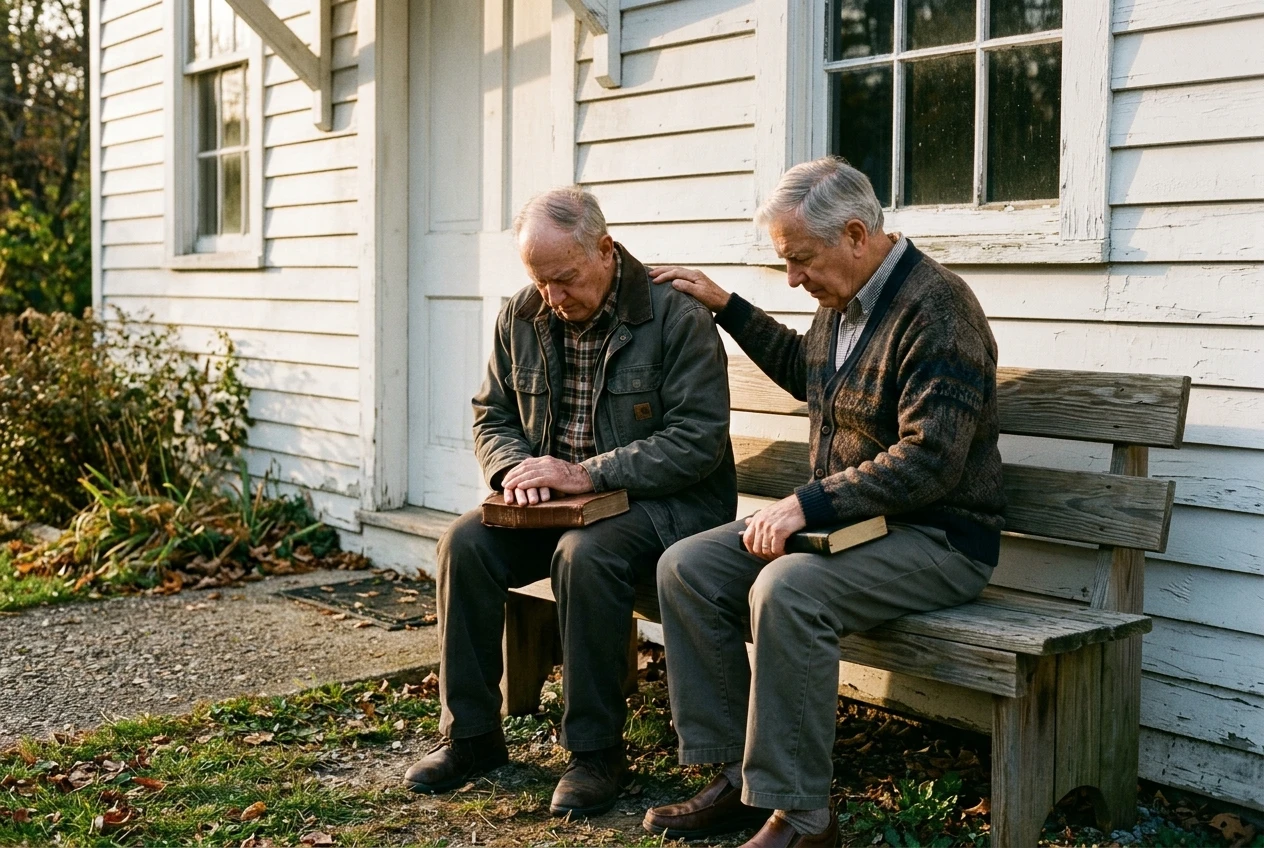
Telling a brother is not begging. It is an honest account to someone who loves him. If he is unsure how to speak about need, what a volunteer preacher can honestly say to his congregation when he is in need offers plain words he can use.
Relatives who care for an older preacher have a part here as well. They can ask him gently what he fears for the coming week and then help with the one concrete matter, such as a fare or a bag of food. They can sit with him while he reads the notebook, and pray with him when the worry comes.
Tonight, write down one need you have feared and one way God has already met a need like it in your life, then read the two together in prayer. If you wish to go further, read God Has Promised to Provide for the Preacher. Here Is What He Actually Promised.