When a volunteer preacher stops traveling, the appointments end, but the family’s witness does not have to end with them. The home where he lives becomes the place where people hear the gospel and see it lived. This article sets out a plain weekly pattern of worship, hospitality and testimony, with Scripture beneath each part, so that the household can carry on the work after the pulpit appointments have ended. It is meant for the retired preacher and also for the wife, children and relatives who share his roof.
The Witness Was Never Only in the Pulpit: What 2 Timothy 1:5 and Joshua 24:15 Show About the Household
Paul wrote to Timothy that he remembered “the unfeigned faith that is in thee, which dwelt first in thy grandmother Lois, and thy mother Eunice” (2 Timothy 1:5). Timothy’s faith was first lived out in a home by two women, long before he went out with Paul. No pulpit is mentioned in that verse. A household passed the faith on from one generation to the next.
Joshua made the same point when he stood before Israel and said, “as for me and my house, we will serve the LORD” (Joshua 24:15). He spoke for the whole house, and he spoke while the people were still deciding. A household serves the Lord by a choice made together and repeated each day.
For the retired preacher, this means the work has changed its place but not its purpose. The house is now where the Word is read aloud, where strangers are received, and where the children learn what the family believes. A preacher who once spoke to congregations can now speak across his own table.
Begin at the Table: A Simple Daily Pattern of Reading, Singing, and Prayer for a Small Home
Moses commanded Israel to teach God’s words to their children, “when thou sittest in thine house, and when thou walkest by the way, and when thou liest down, and when thou risest up” (Deuteronomy 6:7). The command assumes that worship happens at ordinary hours of the day. A small home can keep such a pattern without any equipment or expense.
Choose one fixed time each day, such as after the evening meal or before the morning departure to school or market. Keep to the same time, because a habit that depends on mood will not last. About fifteen minutes is enough, and the pattern has three parts:
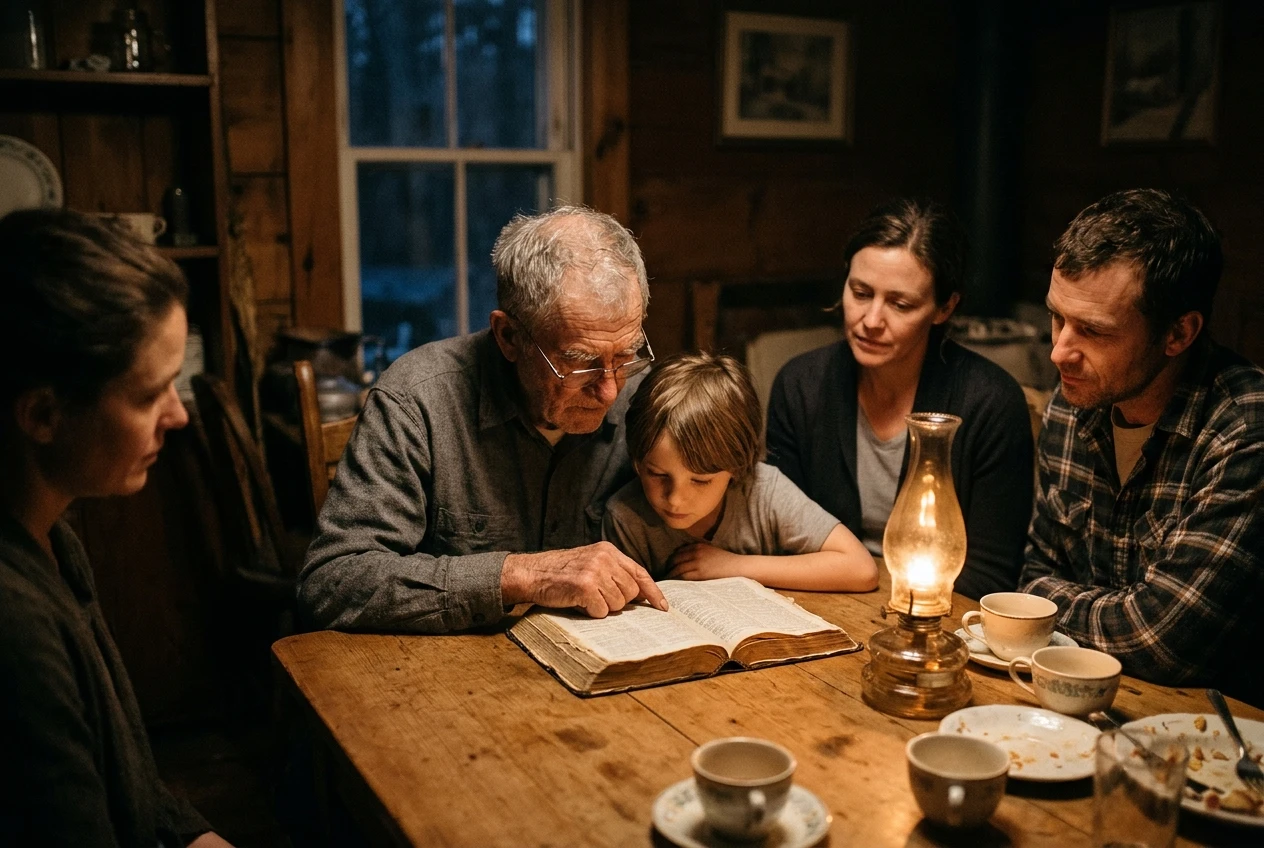
- Reading. Read one short passage aloud, a paragraph or a single chapter. Let the youngest who can read take a verse in turn. Ask one plain question afterward: what does this passage say about God, and what does it ask of us?
- Singing. Paul told the Colossians to teach and admonish one another “in psalms and hymns and spiritual songs, singing with grace in your hearts to the Lord” (Colossians 3:16). Sing one hymn the household already knows. Voices need not be trained.
- Prayer. Pray by name for each person in the house, then for the sick, the traveling and the needy among your relatives. If you want a fuller teaching on this, read how a retired preacher still holds the pulpit when he kneels to pray.
The early church “continued stedfastly in the apostles’ doctrine and fellowship, and in breaking of bread, and in prayers” (Acts 2:42), and they ate “from house to house” with “gladness and singleness of heart” (Acts 2:46). A family table that keeps this order of Word, meal, song and prayer follows the same pattern on a smaller scale.
Open the Door: How Hospitality Toward Travelers and the Needy Carries On the Preacher’s Work
For years the preacher depended on the hospitality of others, and he has received bread and a bed at other men’s tables. Now his own door can be opened to the same kind of guest. Paul tells believers to be “given to hospitality” (Romans 12:13), and the writer to the Hebrews adds, “Be not forgetful to entertain strangers: for thereby some have entertained angels unawares” (Hebrews 13:2).
John praised Gaius for caring for brethren who were strangers, who “for his name’s sake went forth, taking nothing of the Gentiles.” He concluded, “We therefore ought to receive such, that we might be fellowhelpers to the truth” (3 John 5-8). A retired preacher’s household can now be one of those who receive the traveling preacher, and in doing so share in his work.
Hospitality does not need a full table. A cup of tea, a plate of whatever the household is eating, and a place to rest are enough. Christ said that those on His right hand would be told, “I was an hungred, and ye gave me meat” (Matthew 25:35). The same open door serves the hungry relative, the neighbor’s child without a meal, and the visiting preacher. Where there is little, the family can share what it has and thank God for it, since He supplies the household in order that it may give.
Tell the Stories Aloud: Letting Children and Grandchildren Hear How God Provided Along the Road
The psalmist resolved not to hide God’s works from the next generation, “shewing to the generation to come the praises of the LORD, and his strength, and his wonderful works that he hath done” (Psalm 78:4). The purpose is stated in verse 7: “that they might set their hope in God, and not forget the works of God.”
The retired preacher can fulfil this by telling, at the table or after the evening prayer, the true accounts of how God supplied bread and passage on the road. Tell only what actually happened, name the God who gave it, and let the children ask questions. A child who has heard that God provided in the past will find it easier to trust Him for tomorrow’s meal and next term’s fees.
It helps to write these accounts down before memory fades. The article on how to record God’s provision for your grandchildren gives a simple method for doing so. Spoken at the table and kept on paper, the testimony can outlast the one who first told it.
Share the Work With the Sick and the Young: Giving Each Member a Part, Even a Small One
Paul describes the church as one body with many members, and says that “those members of the body, which seem to be more feeble, are necessary” (1 Corinthians 12:22). A household is a small body of this kind, and the same rule applies. No member is too weak or too young to have a part.
Assign duties that fit each person:
- A grandchild who can read chooses and reads the passage.
- A younger child leads the hymn, or is asked to name those who need prayer.
- The wife or an elder daughter prepares a portion of the meal to send to a sick neighbor.
- A relative confined to bed prays aloud for the household, or has the family gather at the bedside for the daily reading.
The sick are not set aside from the witness. James directs that the sick call for the elders of the church to pray over them (James 5:14), and a sick person who prays and gives thanks still testifies. See also why a preacher who cannot stand can still bear witness from his bed. Christ welcomed the children and said, “Suffer the little children to come unto me” (Mark 10:14), so the young need no special qualification to take part.
Keep the Witness Steady When Strength and Income Fail: Trusting Psalm 71:18 and Daily Bread
The pensioner’s income is small and his strength is going. The psalmist prayed in the same condition: “Now also when I am old and greyheaded, O God, forsake me not; until I have shewed thy strength unto this generation, and thy power to every one that is to come” (Psalm 71:18). He did not ask for greater strength first. He asked that God remain with him until the next generation had seen what God can do.
The household’s daily bread also remains in God’s hands. Christ taught His disciples to pray, “Give us this day our daily bread” (Matthew 6:11), and Paul promised, “my God shall supply all your need according to his riches in glory by Christ Jesus” (Philippians 4:19). A family that prays for its needs by name, and then gives thanks when they are met, shows its children what it means to depend on God. The article on letting your grandchildren watch you wait on God for daily bread develops this further.
The reward for such faithfulness is promised too. Paul wrote, “be ye stedfast, unmoveable, always abounding in the work of the Lord, forasmuch as ye know that your labour is not in vain in the Lord” (1 Corinthians 15:58). Nothing done at the family table in the Lord’s name is wasted.
This week, set one fixed time to gather your household, read a short passage together, and pray by name for each person. Keep that time every day and watch what God does through it.
Leave a Reply