
A home that trusts God for its bread has to practise that trust daily, in small and ordinary things. This article sets out how to build a Christian household that trusts God for provision, using the habits of the table, the reading, the conversation and the offering. It is written for older believers and the relatives who share their roof, including the children who need uniforms, the sick who need care and the dependents who need food, and who want the house to stand on God’s promise rather than on wealth.
Why Christ tells the household to lay up treasure in heaven first
Our Lord gave a plain instruction: “Lay not up for yourselves treasures upon earth, where moth and rust doth corrupt, and where thieves break through and steal: but lay up for yourselves treasures in heaven” (Matthew 6:19-20). He gave the reason in the next verse: “For where your treasure is, there will your heart be also.” A household’s heart follows what it treasures, and children copy what the adults around them value.
Christ then gave the promise that makes this safe to obey: “Seek ye first the kingdom of God, and his righteousness; and all these things shall be added unto you” (Matthew 6:33). The “things” in that passage are food, drink and clothing. Those are the same needs a family with little money worries about most.
This does not mean the household ignores work, thrift or honest need. Paul wrote that godliness with contentment is great gain, and that having food and raiment we should be content (1 Timothy 6:6-8). The home puts God first in its affections and trusts Him with what it lacks. The practices below are ways of doing that every day.
Begin at the table: thanksgiving for daily bread, whether the plate is full or plain
The Lord taught us to pray, “Give us this day our daily bread” (Matthew 6:11). The request is for today. When the household prays it together at the table, every person present hears that the food on the plate came by God’s hand.

Our Lord Himself gave thanks before eating. He did so before He fed the five thousand from five loaves and two fishes (Matthew 14:19), and the multitude ate and was filled. If He gave thanks over so little, a household may give thanks over a plain meal.
Keep the grace short, so that it is said every day and does not become a burden:
- Let one person pray each day, and let the children take their turn in rotation.
- Give thanks for the food by name, such as the rice, the beans, the bread or the water.
- On days when the plate is small, say so honestly and thank God for it anyway. The psalmist wrote, “The eyes of all wait upon thee; and thou givest them their meat in due season” (Psalm 145:15).
- Begin eating only after the prayer, and let the oldest person present remain at the table until all have finished.
A child who hears thanks given over a plain meal learns that gratitude does not depend on abundance. That lesson will outlast any particular meal.
A short family reading each day, and the passages that teach contentment
Moses told Israel to keep God’s words in the heart and to teach them diligently to the children, “when thou sittest in thine house, and when thou walkest by the way, and when thou liest down, and when thou risest up” (Deuteronomy 6:6-7). The household has no need of a long service. Five to ten minutes after the evening meal, with one chapter or half a chapter read aloud, keeps God’s word in daily use.

Where the reader is an older person with failing sight, let a child read and the elder explain. Where some in the home cannot read, read slowly and repeat the key verse together.
These passages teach contentment and provision, and they suit a home that lives on little:
- Exodus 16:11-21. God gave manna each morning, enough for that day, and those who tried to hoard it found it spoiled.
- Psalm 23. “The LORD is my shepherd; I shall not want.”
- Proverbs 30:7-9. Agur asks for neither poverty nor riches, only the food that is needful.
- Matthew 6:25-34. Christ speaks of the birds, the lilies and the Father who knows what we need.
- Philippians 4:11-13, 19. Paul has learned to be content in every state, and promises that God shall supply all our need.
- Hebrews 13:5. “Be content with such things as ye have: for he hath said, I will never leave thee, nor forsake thee.”
Read one of these each week and return to it on the days that follow. Ask each person afterward what the passage says God does and what it asks of us.
Teaching children the difference between a need and a want, without shame
Children in a household with little money often notice what other children have. They should be told the truth in terms they can understand, and they should never be made to feel that wanting something is a sin or that being poor is a disgrace. Christ called the poor blessed (Luke 6:20), and the Scripture gives no warrant for shaming them.
A simple way to teach the difference is to name the needs God has promised: food, clothing and shelter (Matthew 6:31-32), together with the schooling and care that a child cannot do without. A want is something pleasant that is not required for life or for a child’s duty. A child may ask for a want, and a parent or grandparent may answer plainly, “That is not something we can have now. Let us thank God for what we do have.”
Several practices help:
- When a child asks for something, ask first, “Is this a need or a want?” Let the child answer before the adult does.
- Never speak of the family’s lack in a tone of contempt for those who have more.
- Read Luke 12:15 together: “a man’s life consisteth not in the abundance of the things which he possesseth.”
- Let the child see the adults wait and pray before buying, and see them give thanks when God provides.
Where school fees or uniforms are a real need, speak of them openly with the child as something the household is bringing to God in prayer. A child who is included in the prayer learns to trust, and a child who is kept ignorant of it often imagines worse.
How to speak to the sick and the anxious in your home about God’s care
The sick person in a poor household often fears being a burden. The anxious person fears what tomorrow holds. Both need to hear the truth of Scripture spoken gently, and both need to be treated as members of the household who still have something to give.
Peter writes, “Casting all your care upon him; for he careth for you” (1 Peter 5:7). Isaiah records God’s word: “Fear thou not; for I am with thee: be not dismayed; for I am thy God: I will strengthen thee; yea, I will help thee” (Isaiah 41:10). Read these verses aloud at the bedside, slowly, and then be silent a moment.
James directs that the sick should call for the elders of the church to pray over them (James 5:14-15). Do this, and tell the sick person that the household is not carrying the illness alone.
Avoid hurried promises about recovery, which God has not made to any one person in a particular case. What He has promised is His presence and His care. A sick relative can still pray for the household, and that gives the person a real part in its life. For the one who keeps watch at the sickbed, a daily prayer for the caregiver may help at the end of a tiring day.
Practising small giving so the household learns that God supplies and we share
Our Lord watched the people casting money into the treasury and saw a poor widow cast in two mites. He said she had given more than all the others, because they gave out of their abundance and she gave all she had (Mark 12:41-44). The Lord measures giving against what remains, and a small gift may weigh heavily with Him.
Paul wrote, “God loveth a cheerful giver,” and promised that God is able to make all grace abound toward those who give, so that they have enough for every good work (2 Corinthians 9:7-8). He also records the Lord’s saying, “It is more blessed to give than to receive” (Acts 20:35).
A household with little can still practise giving each week:

- Set aside a small portion of whatever comes into the house, however little, before it is spent.
- Let a child choose, with an adult’s guidance, who will receive it, such as a neighbour in need or the church’s offering.
- Share a meal or a portion of food with someone poorer than the household.
- Give time as well as money: a visit to the sick, a letter to the lonely, or help with a neighbour’s work.
The widow of Zarephath fed Elijah from her last handful of meal, and her barrel did not run out (1 Kings 17:12-16). The household that gives from little will find that its giving does not empty the house, and the children will remember that.
What to do when the pantry is thin or the school fees are due, and the household is tempted to envy
Envy comes easily when the cupboard is bare and a neighbour’s table is full. Asaph confessed in Psalm 73 that his feet had almost slipped when he saw the prosperity of the wicked, and he recovered only when he went into the sanctuary of God and understood their end. Read that psalm together on a hard day. Proverbs 14:30 adds that envy is “the rottenness of the bones.”
When the need is pressing, take these steps in order:
- Pray together and name the need aloud. Paul directs, “In every thing by prayer and supplication with thanksgiving let your requests be made known unto God” (Philippians 4:6). For help in the words, see how a preacher can pray when the bread is running short.
- List what God has already supplied. David wrote, “I have been young, and now am old; yet have I not seen the righteous forsaken, nor his seed begging bread” (Psalm 37:25).
- Ask honestly for help where help is proper. Tell a trusted relative, a church elder or a neighbour what is lacking. Asking for a real need is not greed.
- Do what is within the household’s power. Work, mend, plant, and share what the household has with those who have less.
- Guard the tongue. Let no one in the house speak bitterly about those who have more. The tenth commandment forbids coveting a neighbour’s house or anything that is his (Exodus 20:17).
Where several families in a community share the same need, school uniforms and supplies may be gathered together, and a small community can organise this together so that no child goes without.
Keeping the home steady: one week of practices to begin with
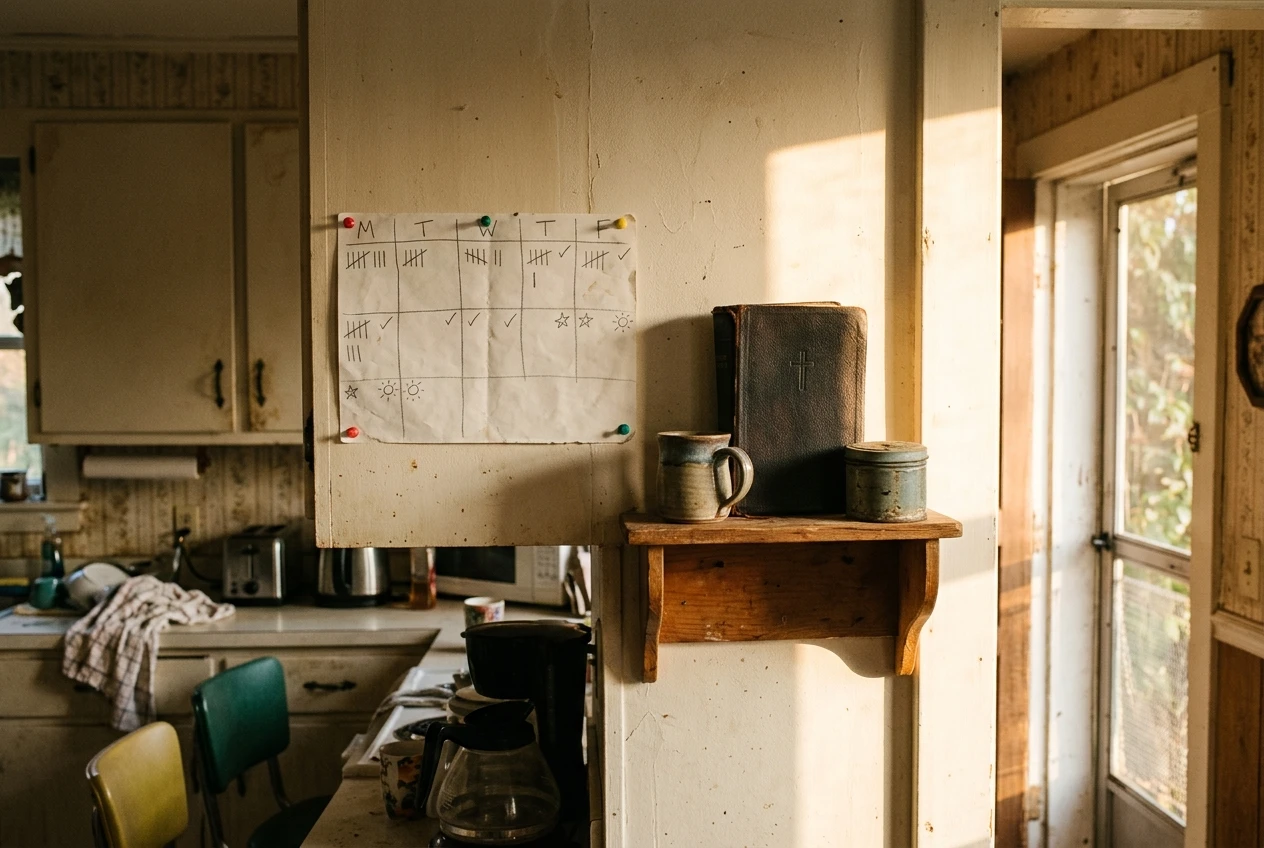
A household need not take on everything at once. Begin with one week and let the habits settle.
- Day 1. Say grace aloud at every meal, and let the youngest able child pray at one of them.
- Day 2. After the evening meal, read Psalm 23 together and ask each person what the shepherd supplies.
- Day 3. Sit with the children and name the household’s real needs for the month. Ask them to say which of their requests are wants.
- Day 4. Read Philippians 4:11-13 and talk about what contentment means for each person in the house.
- Day 5. Set aside a small gift and decide together who will receive it.
- Day 6. Visit or pray with a sick or lonely person, or read Isaiah 41:10 at the bedside of one in the home.
- Day 7. Rest, attend worship, and let each person thank God for something He has supplied that week.
Do not be discouraged if a day is missed. The aim is a steady habit of turning to God, and one missed evening does not undo that. Return to it the next day.
This week, gather your household once, read Matthew 6:25 to 34 aloud together, and let each person say one thing God has already supplied.