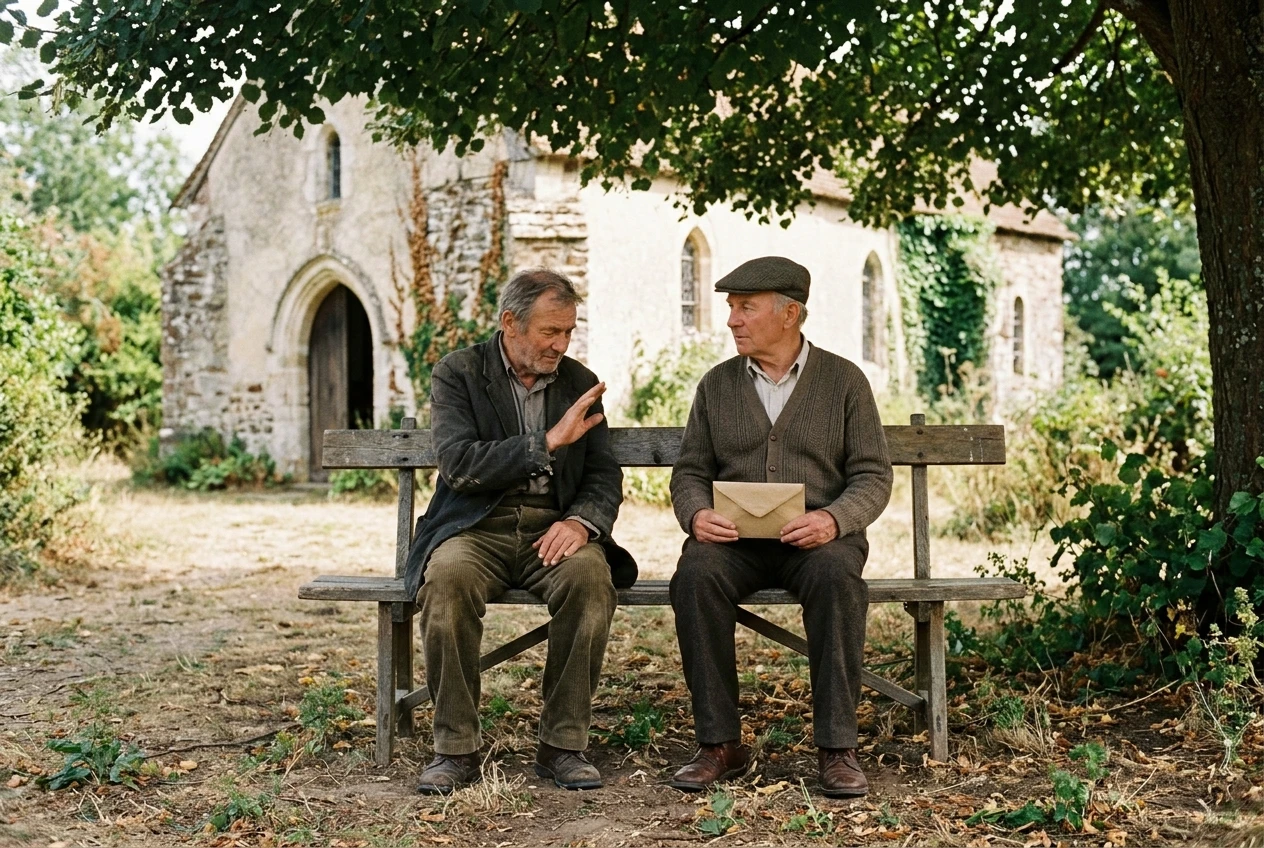
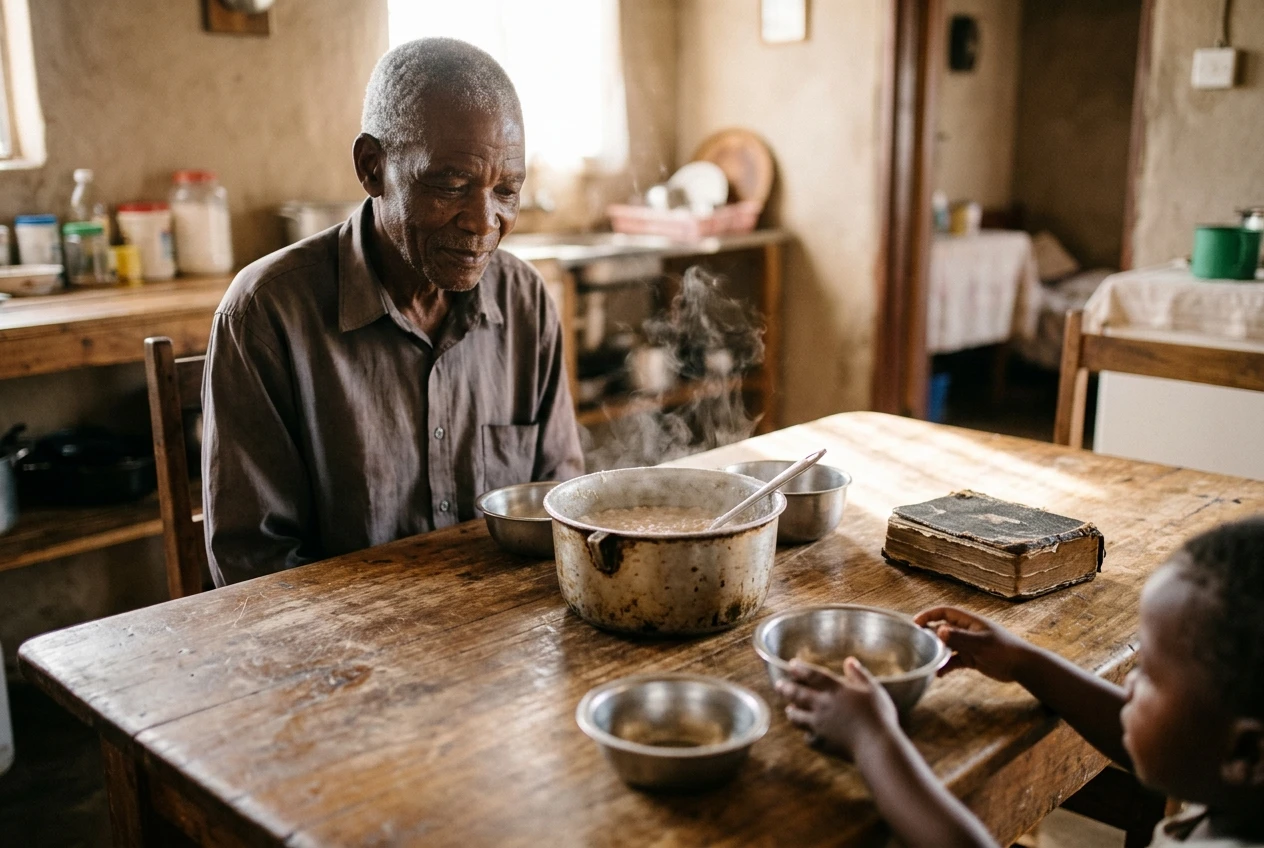
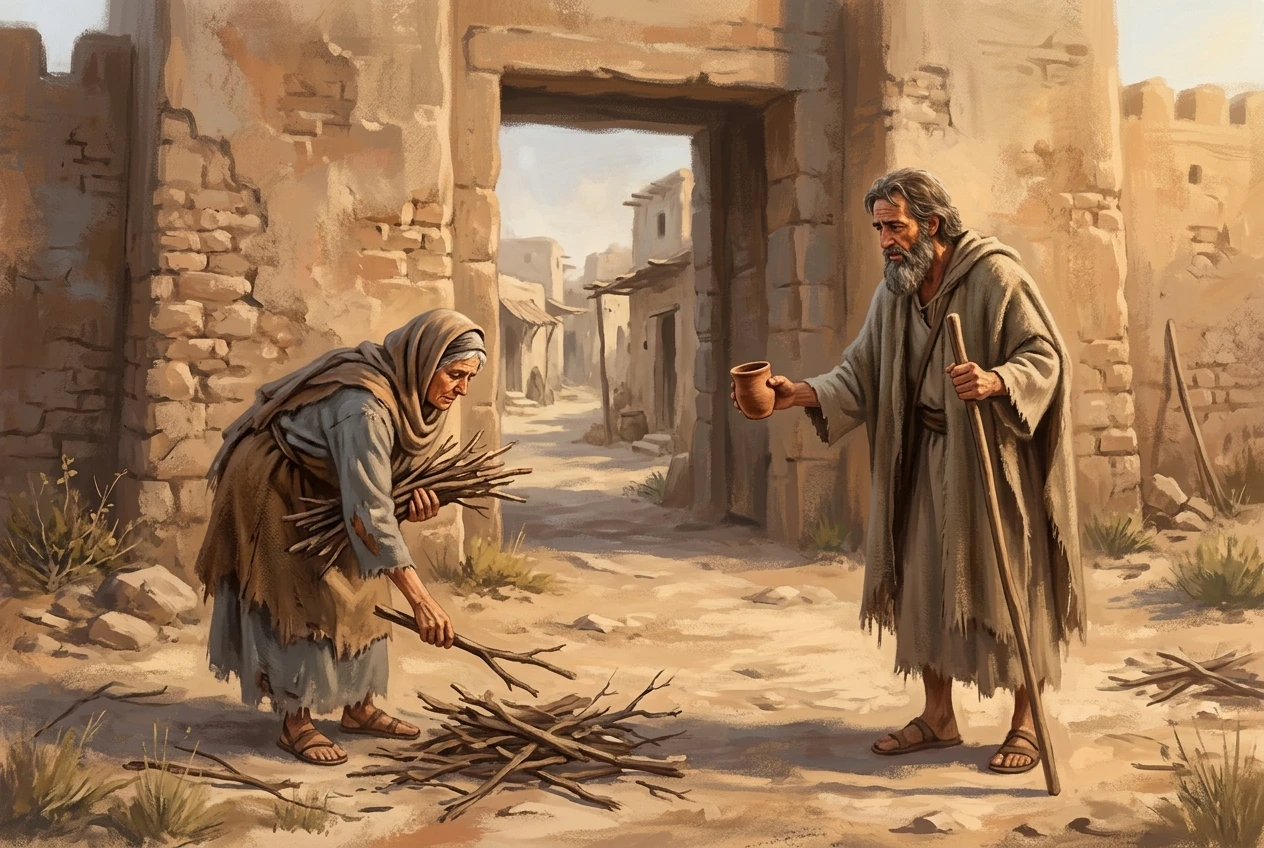
What does “give us this day our daily bread” mean? It is the petition in which a believer asks the Father to supply the food and necessities for today, and in asking confesses that every meal is received from God’s hand. The prayer teaches dependence, shared need, and contentment with enough for the day.
What does “give us this day our daily bread” mean?
The fourth petition of the Lord’s Prayer, recorded in Matthew 6:11 and Luke 11:3, asks God for the bread needed to live through the day. Bread here stands for food first, and by extension for every ordinary necessity: clothing, shelter, travel, and the fees and uniforms a child needs for school.
The petition follows three requests about God himself: that his name be hallowed, his kingdom come, and his will be done. Jesus places the request for bread after these, so a believer first asks for God’s honour and then for his own sustenance. The order matters. A household that reverses it begins to treat provision as the chief thing and God as the means.
The petition also sits beside a promise. In Matthew 6:8 Jesus says that the Father knows what things we have need of before we ask him. We ask, then, because God has commanded us to ask, and because asking keeps us aware of who gives.
Why does Jesus teach us to ask rather than to take?
Jesus teaches us to ask because bread is a gift, and a gift is received from the giver. The verb “give” admits that the food on the table did not originate in the strength of the one who earned the wages, planted the field, or drew the pension.
Moses told Israel the same thing in Deuteronomy 8:3, and Jesus quoted it when he was tempted in the wilderness (Matthew 4:4): man does not live by bread alone, but by every word that proceeds out of the mouth of God. Work is commanded in Scripture, and no one is excused from it. Yet the harvest, the health to labour, and the wage itself are all given.
Proverbs 30:8-9 shows what asking guards against. Agur prays: “Give me neither poverty nor riches; feed me with food convenient for me: lest I be full, and deny thee, and say, Who is the LORD? or lest I be poor, and steal, and take the name of my God in vain.”
Both dangers are real. Abundance tempts a man to forget God, and want tempts him to dishonest gain. The petition for daily bread asks for a middle measure, and it asks for it from God.
Why “us” and “this day”? Reading the petition one word at a time
Each word of the petition carries its own teaching, and the table below sets them side by side.
Word What it teaches A question for the table Give Bread is received, not seized. What did we receive today that we did not make? Us Prayer is shared, and so is bread. Who outside this house is hungry today? This day Dependence is renewed daily. What do we need today, and what can wait for tomorrow? Daily God supplies what is needed, not a surplus. What is enough for us? Bread Ordinary necessities are fit matter for prayer. What need have we been ashamed to name?
Us. Jesus does not say “give me.” The whole Lord’s Prayer is in the plural, and the petition teaches a family to pray for the household and for neighbours together. James 2:15-16 reproves the one who says “Depart in peace, be ye warmed and filled” to a brother in need without giving him what the body requires. A man cannot sincerely pray “give us” and then refuse to be one of the means by which God gives.
This day. The petition limits itself to the present day. A believer is not told to ask for the supply of the whole year in one prayer, though he may plan and save prudently. He is told to come back tomorrow and ask again.
Daily. The Greek word translated “daily” is epiousios. It appears in the New Testament only in Matthew 6:11 and Luke 11:3, and scholars have long discussed its exact sense. Translators have rendered it as “daily,” “for the coming day,” or “needful.” Every reading points the same way: the bread requested is the measure the day requires. Luke’s wording, “day by day,” supports this.
Bread. Paul writes in 1 Timothy 6:8, “Having food and raiment let us be therewith content.” The petition trains that contentment into a habit of speech.
What did the manna in Exodus 16 teach Israel about daily bread?
The manna taught Israel that God supplies sufficient bread for each day, that he supplies it faithfully, and that he tests whether his people will trust him for tomorrow. In Exodus 16:4 the LORD says he will rain bread from heaven, and that the people should gather a certain rate every day, “that I may prove them, whether they will walk in my law, or no.”
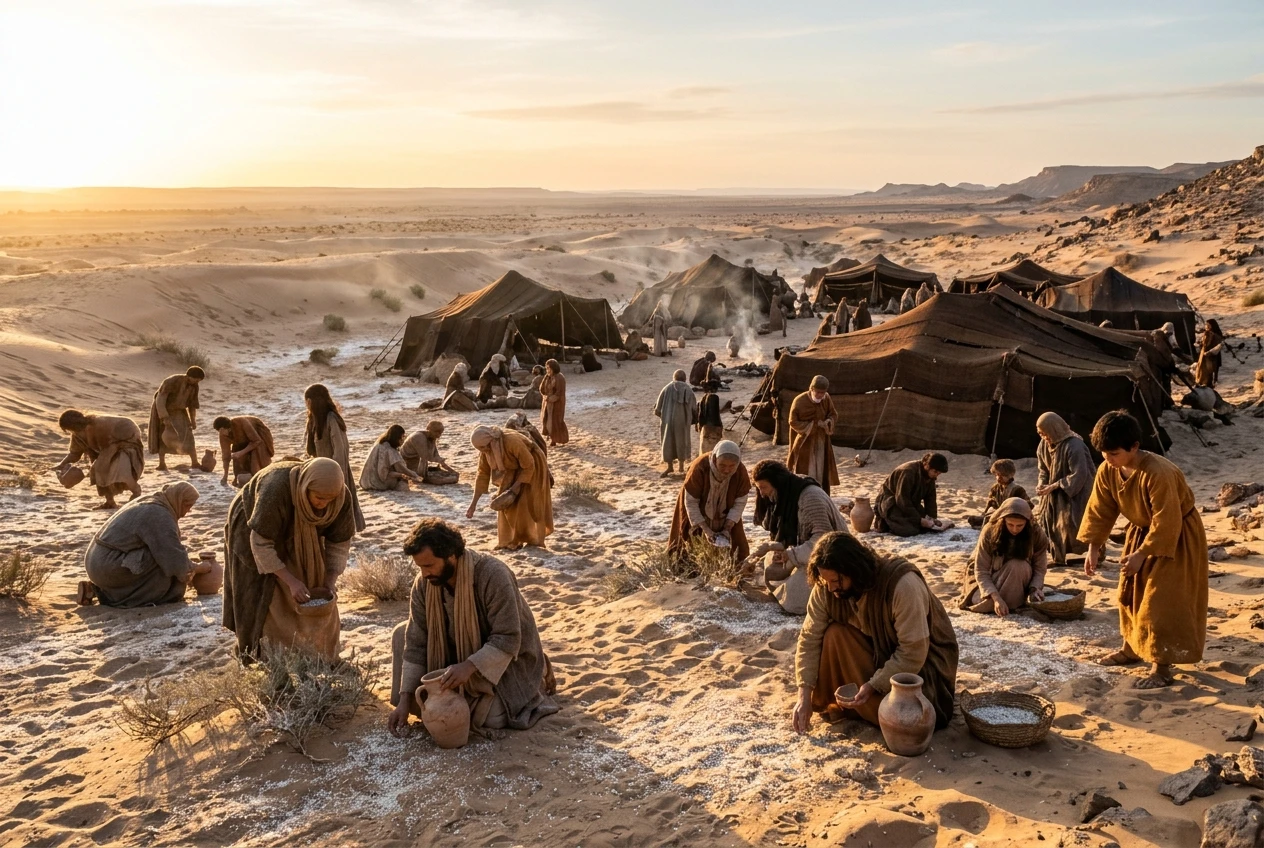
The rules of the gathering form a short course in this petition:
- Each person gathered according to his eating, an omer for every person (Exodus 16:16).
- When they measured it, the one who gathered much had nothing over, and the one who gathered little had no lack (Exodus 16:18).
- Those who kept some until morning found it full of worms and rotten (Exodus 16:20).
- On the sixth day they gathered twice as much, and that portion kept through the Sabbath without spoiling (Exodus 16:22-26).
- The manna continued for forty years, until Israel came to the border of Canaan (Exodus 16:35).
Taken together, these rules answer the temptation to hoard. Hoarded manna spoiled, and the sixth-day portion did not, because God had commanded it. Trust consisted in obedience to what God said, and it was neither anxious grasping nor idle carelessness.
The manna also had a lesson about equality. The strong and the weak, the large household and the small, each had enough. Paul applies this very passage in 2 Corinthians 8:13-15 when he urges the Corinthians to supply the need of the poor, so that “he that had gathered much had nothing over.”
How does Matthew 6:25-34 answer a household’s fear of lack?
Matthew 6:25-34 answers fear of lack by pointing to the Father’s knowledge, his care for the creatures he has made, and the uselessness of anxiety. It follows the Lord’s Prayer by only a few verses in the same sermon, and it reads as an explanation of why the fourth petition can be prayed in peace.
Jesus gives several reasons not to be anxious about food and clothing:
- Life is more than food, and the body more than raiment (verse 25).
- The birds of the air do not sow or reap, and the heavenly Father feeds them. Jesus asks, “Are ye not much better than they?” (verse 26).
- Anxiety adds nothing to a man’s life, not even a cubit to his stature (verse 27).
- God clothes the grass of the field, and will much more clothe those who trust him (verses 28-30).
- The Gentiles seek these things, but “your heavenly Father knoweth that ye have need of all these things” (verses 31-32).
He then gives the command that orders the whole household: “Seek ye first the kingdom of God, and his righteousness; and all these things shall be added unto you” (verse 33). The passage closes with the verse that matches the petition: “Take therefore no thought for the morrow… Sufficient unto the day is the evil thereof” (verse 34).
Jesus does not forbid planning or labour here. He forbids the anxious thought that treats God as absent. Fear of lack is answered by remembering that the one who is asked is the Father.
How do you teach this petition to your household in four short lessons?
You can teach it in four short sittings at the table, each built on one reading and one question. Ten to fifteen minutes is enough, and the lessons may be spread over four days or four weeks. Let the youngest answer first.
- Lesson one: Bread is given. Read Matthew 6:9-13 and Deuteronomy 8:3. Ask the children to name everything on the table and say who made it possible. Teach them that the cook, the farmer, and the earner are all instruments of God’s giving.
- Lesson two: Us, and this day. Read James 2:15-16 and Matthew 6:34. Ask who in the family, the church, or the neighbourhood is in need this week, and what the household may do for them. Teach that we ask for tomorrow’s bread tomorrow.
- Lesson three: Enough, and no more. Read Exodus 16:16-26. Place a small portion of bread overnight, if the household wishes, and look at it in the morning. Teach that God gives sufficient bread and commands us to obey him rather than hoard.
- Lesson four: The Father knows. Read Matthew 6:25-34 and Proverbs 30:8-9. Ask each person what he is most tempted to worry about, and pray for that thing by name. Teach that anxiety is answered by seeking the kingdom first.
End each sitting with the petition spoken together, slowly, one phrase at a time.
What do you say to a child when the bread is scarce?
Tell the child the truth: the family is in need, God has not forgotten it, and we ask him for what we lack. A child can bear a hard fact better than a vague silence, and he learns more from honest words than from forced cheerfulness.
You may say these things without overreaching:
- God knows what we need, and he has told us to ask him (Matthew 6:8).
- We ask each day, and we thank him for what is on the table today, however plain it is.
- We do the honest work that is in our hands, and we do not take what is not ours (Proverbs 30:9).
- We share what we have with someone who has less, because the prayer says “us.”
Do not promise the child what God has not promised. Scripture promises that God will supply what his people need, and it does not promise any particular meal, amount, or date. If the answer is slow, say that you are waiting and still asking. For further help with this conversation, see the earlier article on how to teach your grandchildren to trust God when money is tight.
Scarcity also gives the child a chance to see a prayer answered. When a neighbour brings food, or a need is met in a way no one arranged, name it aloud as the Father’s giving, and give thanks at that table that day.
A reading for your table this week
The petition is short enough for a child to memorise, and rich enough to occupy a preacher’s lifetime of study. This week, read Matthew 6:9-13 aloud at your table and ask each person to say in his own words what he is asking God to give today.