
The sickbed and the pulpit can seem to pull in opposite directions. A preacher who keeps watch over a sick relative serves one person through the night and then stands before a congregation on the Lord’s day. A daily prayer for a caregiver in ministry gives both kinds of work to the same Master, at the hours when each one actually happens.
Why one prayer can hold both the sickbed and the pulpit
Scripture does not divide the care of the body from the preaching of the Word. The Lord who sent out the twelve to preach also healed the sick, and He counts a visit to the sick as a service done to Himself. A preacher who washes a fevered brow and a preacher who opens the Scriptures answer to one Lord, and both can be brought to Him in prayer.
The pattern below has five short prayers, each tied to one passage and one moment of an ordinary day: waking, the bedside, the midday meal, the evening preparation of the sermon, and the last hour of the night. Each is brief enough to pray with tired lips. You may pray them aloud, or read them from the page until the words are familiar.
The prayers are written in the older form of address, with Thee and Thou, because many preachers have prayed that way all their lives. If plainer words come more easily to you, pray the same petitions in your own speech. The Lord does not grade the language.
Morning: giving the whole day to the Lord before the first task
The psalmist writes, “My voice shalt thou hear in the morning, O LORD; in the morning will I direct my prayer unto thee, and will look up” (Psalm 5:3). The verse names the order of the day: the prayer comes first, and the work follows.

A caregiver’s morning often starts with a need. A cough, a medicine to be given, a meal to prepare, a call to answer. Before the first of these, stand or sit for one minute and give the whole day to God, the sickbed and the sermon together. This is the one task that cannot be done well if it waits until the others are finished.
O Lord, Thou hast brought me to the morning, and I lift up my voice to Thee. Hear me. This day is Thine, with everything in it: the one who is sick in my house, the Word I am to speak, and every small task between them. Give me strength for the body that needs my hands, and clearness for the Word that needs my mouth. Let me do nothing today that Thou hast not given me to do, and let me leave undone nothing that Thou hast. In the name of Jesus Christ, Amen.
Pray this before you open the curtains or put the kettle on. It takes less than a minute.
At the bedside: praying with the sick person, not only for them
In the Lord’s own account of the last judgment, He says, “I was sick, and ye visited me” (Matthew 25:36). He does not say “ye prayed about me from another room.” A visit means presence, and presence at a sickbed can include prayer spoken aloud, together.
Praying for a sick person means speaking to God about them. Praying with them means they are invited in. You may take their hand and say a short prayer in their hearing, or ask whether there is something they wish to bring to the Lord. Many sick people have no one who will pray with them in plain words, and they remain at the center of what is asked. If the person is weak or sleeping, pray quietly beside them anyway.

Lord Jesus, Thou who hast said that Thou wast sick and we visited Thee, be present in this room. Look upon Thy servant who lies here, and give rest where there is pain and patience where there is weariness. Let him [or her] hear that he is not alone, and let me serve him as one who serves Thee. Teach me when to speak and when to be silent. Receive the work of my hands at this bedside as a service to Thy name. Amen.
Where the prayer says “him [or her],” say the name of the person in your care. Names matter to the sick, and God knows each one.
Midday: asking for daily bread and thanking Him for what is on the table
The Lord taught His disciples to pray, “Give us this day our daily bread” (Matthew 6:11). The request is for this day, and the table at midday is where that prayer is answered or tested. For a preacher who lives on a small pension and also feeds a sick household, the midday meal can be modest. It is still the answer to something asked at dawn.

Pause over the meal before eating. Thank Him for what is actually set out, however plain, rather than for what you wish were there. Gratitude spoken over bread, rice or soup keeps the heart steady when the cupboard is thin. If the month is hard and the bread is running short, there is a fuller treatment in How a Preacher Can Pray When the Bread Is Running Short. This prayer is for the ordinary noon.
Our Father, Thou hast given us this day our daily bread, and we thank Thee for what is on this table. Bless this food to the strength of the one who is sick and to the strength of the one who serves him. Provide for tomorrow as Thou hast provided today, and let us not be anxious, for Thou knowest what we need before we ask. Let every mouthful remind us that Thou art the giver. Amen.
Where there is someone at the bedside too weak to come to the table, carry the prayer to them and say it there.
Evening: praying over the sermon while the house is quiet
Paul writes, “Be careful for nothing; but in every thing by prayer and supplication with thanksgiving let your requests be made known unto God” (Philippians 4:6). The evening, when the sick person has been settled and the house has gone quiet, is often the only time a volunteer preacher has to prepare the Word. It is also the hour when anxiety about the sermon is strongest.
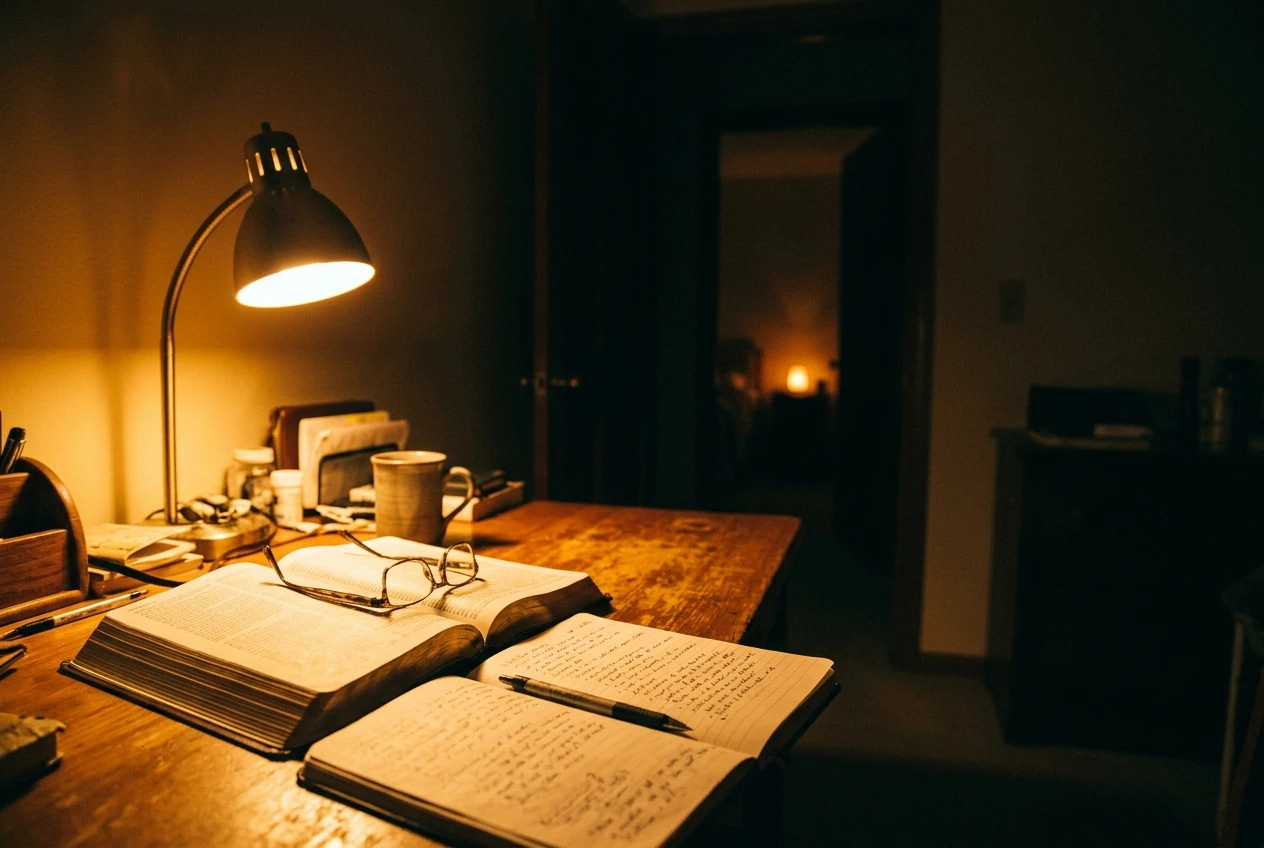
Begin the preparation with this prayer, before opening the Bible or a notebook. It places the sermon in God’s hands before you begin to work on it, and it admits openly that you are tired. Practical help for the hours themselves may be found in How to Pace a Sermon When You Only Have Evenings to Prepare.
Heavenly Father, the house is quiet and I come to Thee with the Word I am to speak. I am weary, and I bring my weariness to Thee with my thanks. Open my eyes to see what Thy Scripture says, and keep me from speaking anything that Thou hast not given. Where my preparation is poor, let Thy truth be sufficient. Let the sermon serve the hearers and honor Thy Son. Make known my requests, and give me peace in place of fear. Amen.
When the prayer is finished, begin the work. The sermon will be no less your own for having been prayed over first.
Night: laying down weariness and trusting that the labor is not in vain
Paul gives this exhortation to the Galatians: “And let us not be weary in well doing: for in due season we shall reap, if we faint not” (Galatians 6:9). The verse admits that weariness is real. It does not tell the worker to feel no tiredness. It promises a harvest in due season, which means a time appointed by God and not by us.
The last hour of the night is the time to lay down what the day has left. Some of it was done well and some badly. Some of it is unfinished and will be there in the morning. A preacher who carries the sickbed and the sermon to bed without giving them to God will lie awake with both. The labor of the day belongs to the Lord, and He keeps its account.
For a longer reflection on what the Lord promises to those whose service goes unpaid on earth, read What the Bible Means by Eternal Reward When No One Pays the Preacher.
Lord, the day is ended and I lay it down before Thee. Forgive what I did poorly, and accept what I did in faith. I am weary, and Thou hast said that we shall not be weary in well doing, for in due season we shall reap if we faint not. Keep watch over the one who sleeps in my house, for I cannot keep watch every hour. Let me rest in the knowledge that my labor in Thee is not in vain. Into Thy hands I commit this night. Amen.
How to keep this rhythm on days when you are too tired to pray at length
Some days the full prayers will be too much. A night spent awake with a sick relative leaves little strength for words, and the Lord knows it. Scripture does not set a length for prayer, and a short prayer offered in faith is complete.
On those days, keep only the first line of each prayer:
- Morning: “O Lord, this day is Thine.”
- Bedside: “Lord Jesus, be present in this room.”
- Midday: “Our Father, we thank Thee for this bread.”
- Evening: “Father, I bring Thee the Word and my weariness.”
- Night: “Lord, I lay down this day, and my labor is in Thy hands.”
Each line can be said in a breath, and each is tied to something you already do: opening your eyes, entering the sickroom, sitting at the table, opening the Bible, lying down. Fastening the prayer to the act makes it easier to remember than a fixed clock hour, because a sick household rarely keeps a fixed clock.
If you miss a prayer, do not wait for the next day to begin again. Pray it at the next hour that comes, in whatever words you have.
Begin tomorrow
Choose one of the five prayers and pray it tomorrow at its hour. Then read When a Relative Falls Sick, Caring for Them Is Part of Your Ministry, Not a Break From It on this site, to see why this work is itself service to Christ.