
An unpaid ministry has a cost, and the cost has to be paid by someone. For a retired or volunteer preacher living on a fixed pension, the preacher is seldom the only one who pays. Spouses, children, grandchildren and relatives under the same roof give up time, money and company so that the gospel can be preached. This article explains how to talk to your family about the sacrifices of ministry: say plainly what they carry, thank them for it, and show them from Scripture that they share in the work and in its reward.
What Your Household Is Actually Giving Up So You Can Preach
Begin by listing the cost honestly, because a cost that has not been named cannot be thanked. It usually falls under three headings.
Time. Evenings go to preparing sermons. Weekends go to travel, to meetings and to visiting the sick. Whatever the household might have done with those hours, it has done without you.
Money. A fixed pension has to cover bus fares, food on the road, paper and printing, and the hospitality a visitor expects, as well as ordinary household needs. Whatever the ministry spends is not available for school fees, uniforms, medicine or a better meal.

Presence. A spouse sits alone at the service, or stays home to keep the house and nurse a sick relative while you are away. A child waits for attention that is going into a sermon. Even when you are at home, your mind may be in the text.
These headings are a starting point only. Your own household will know its particular list better than anyone, so write it down before you speak, and write it from their side of the table, not yours.
Why Silence About the Cost Turns Sacrifice Into Resentment
A cost that is never mentioned does not disappear. The people paying it keep their own private account, and the longer it goes unspoken, the more it looks to them like something taken without asking.
Scripture shows the better way. Paul wrote to the Philippians, “it was kind of you to share my trouble” (Philippians 4:14), and he named what they had given. In Romans 16:3-4 he thanked Priscilla and Aquila by name for risking their necks for his life. He did not treat their help as something owed to him.
The warning to fathers in Colossians 3:21 applies here: “Fathers, do not provoke your children, lest they become discouraged.” A household that is asked to give without being thanked can become discouraged, and discouragement of that kind often shows as silence, irritation or distance from the church. Speaking first removes the cause. If you want help in making your family treasure what you do in the pulpit, the article Your Family Did Not Choose the Pulpit, So Teach Them to Treasure What You Do There covers that side of the matter. The subject here is the cost they bear and the thanks they are owed.
1 Samuel 30:24 and the Principle That Those Who Stay Share Alike
In 1 Samuel 30, the Amalekites had burned Ziklag and carried off the families of David and his men. David pursued them with six hundred men. At the brook Besor, two hundred of them were too exhausted to cross, and they stayed behind with the supplies (verses 9 and 10). The text does not call them idle. It says they were faint.
When the others returned with the recovered goods and the spoil, some of the men with David objected. They wanted the two hundred who had stayed to receive only their wives and children and nothing of the plunder (verse 22). David refused: “You shall not do so, my brothers, with what the LORD has given us” (verse 23). Then he gave the principle: “As his share is who goes down to the battle, so shall his share be who stays by the baggage. They shall share alike” (verse 24). Verse 25 adds that David made this a statute and ordinance for Israel from that day.
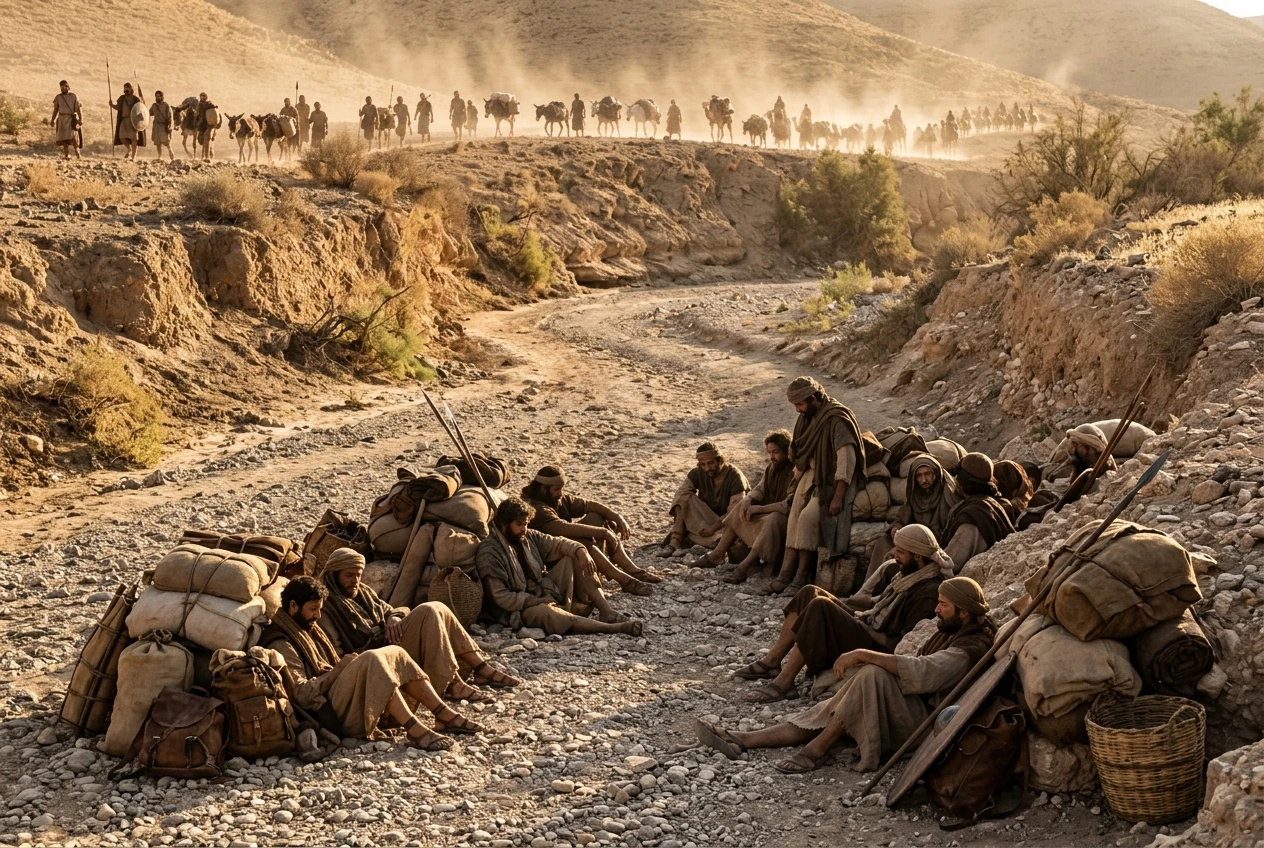
Three things in the passage bear on your household.
- The reward is described as what “the LORD has given us,” not as wages earned by the strongest. That is why it was not kept by those who went to battle.
- The ones who stayed were not spectators. They kept the supplies the others needed.
- David set the rule down as a lasting law, which shows that he regarded it as a matter of justice.
The passage does not speak about preachers directly, so it should not be quoted as though it did. It does state a principle that agrees with the rest of Scripture: those who support the work share in it. Paul expresses the same truth in Philippians 1:5, where he gives thanks for the Philippians’ “partnership in the gospel.” Your household stays with the supplies, and God is able to count them as partners in what is done.
Naming the Sacrifice at the Table: What to Say and What Not to Promise
Choose a time with no hurry, and preferably a meal, since that is where the household already gathers. Speak in plain sentences, and be specific. For example:

- “You have given up many evenings so that I could prepare to preach, and I want to thank you for that.”
- “The fares and the food on the road come out of money that this house also needs. I know that, and I am grateful.”
- “When I am away, you carry the house. That is part of this work, and it is yours as much as mine.”
Then ask a question and listen to the whole answer: “What has this cost you that I have not noticed?” Do not defend yourself while they answer. Their reply is information you need.
Be careful with promises. Some things should not be promised, because you cannot guarantee them.
- Do not promise that the pension will increase or that hardship will end soon.
- Do not promise a particular earthly reward for their sacrifice. Scripture promises that God is not unjust to overlook the work and love shown for His name (Hebrews 6:10), but it does not tell us the form or the timing, and the judging belongs to Him.
- Do not promise more time at home than you can actually give.
- Do not use 1 Samuel 30:24 as an argument that they must be content. The verse is a reason to thank them, not a reason to silence them.
Giving Each Member a Real Share in the Work, From Prayer to Practical Help
A share that exists only in words will not satisfy anyone. Offer each person a real part, and let them choose it. A few possibilities:
- Prayer. Paul asked the Corinthians to help him “by your prayers” (2 Corinthians 1:11), and he asked the Romans to strive together with him in prayer (Romans 15:30). A family member who prays for a sermon by name has a share in it.
- Listening. A spouse or an older child can hear you read a sermon aloud and say where it is unclear.
- Practical help. Someone may prepare food for the journey, write out a Scripture reference clearly, or keep a record of the people you have visited.
- Company. Where the distance and the occasion allow, a family member may come along, so that your presence at the pulpit is not always their absence from you.
A sick relative or a young child may only be able to pray, and that is a full share. Never rank the contributions against one another. In 1 Samuel 30, the man at the brook and the man in the battle received the same.

Honouring Your Duty to Provide Without Placing the Ministry Above Your Own Home
Paul writes, “If anyone does not provide for his relatives, and especially for members of his own household, he has denied the faith and is worse than an unbeliever” (1 Timothy 5:8). Preaching does not cancel this duty. A sermon that is prepared while the household lacks food, school fees or medicine has not been offered rightly.
Paul himself worked with his hands so that he would not be a burden to the people he taught (Acts 18:3; 1 Thessalonians 2:9). He also defended the right of those who preach to be supported (1 Corinthians 9:7-14), so Scripture does not teach that the preacher must neglect his own needs. The two truths stand together: the ministry is real, and so is the home.
A practical test is useful. If the ministry’s cost in money or time is causing a basic need in the house to go unmet, the household comes first, and the ministry adjusts. Caring for a sick relative is not a pause in service, as the article When a Relative Falls Sick, Caring for Them Is Part of Your Ministry, Not a Break From It explains from Scripture. Invite your family to tell you when the balance has gone wrong, and then act on what they say.
When a Family Member Is Weary or Doubts: Answering Them Truthfully and Gently
Someone in the household may eventually say, “I am tired of this,” or “Is it worth it?” Treat the question as a serious one. Listen first, and let them finish before you answer.
Then answer truthfully. You can agree that the cost is real, because it is. You can say what you believe: that God sees the labour and love shown for His name, and that Paul wrote, “Let us not grow weary of doing good, for in due season we will reap, if we do not give up” (Galatians 6:9). You cannot honestly say that you know how or when the reward will come, so do not pretend to. The article What the Bible Means by Eternal Reward When No One Pays the Preacher sets out what Scripture does and does not say about it.
Do not quote a verse as a rebuke. “A soft answer turns away wrath” (Proverbs 15:1), and a tired person who is answered with a verse thrown like a stone will usually stop speaking. If the doubt goes beyond the burden of the work and reaches faith itself, pray with that person and consider asking a trusted elder or fellow believer to speak with them.
This week, gather your household for one unhurried conversation. Thank each person by name for what they carry, and close it together in prayer.