
A preacher who lives on very little, or a family that walks beside him through sickness and school fees, still receives gifts. A bag of rice, a few coins pressed into the hand after a service, a lift on the road, a borrowed text book. Learning how to be a good steward with little money begins with how these gifts are received, recorded, used and shared, and Scripture gives a clear pattern for each of those.
This article sets out that pattern as a discipline a household can follow every week, whatever the size of the gift.
Why the Lord Measures the Gift by the Giver and Not by the Size
In the temple Jesus watched the people put money into the treasury. Many rich men gave large sums, and a poor widow dropped in two small coins. He told His disciples that she had given more than all the others, because they gave out of their abundance and she gave out of her poverty, all that she had to live on (Mark 12:41-44).
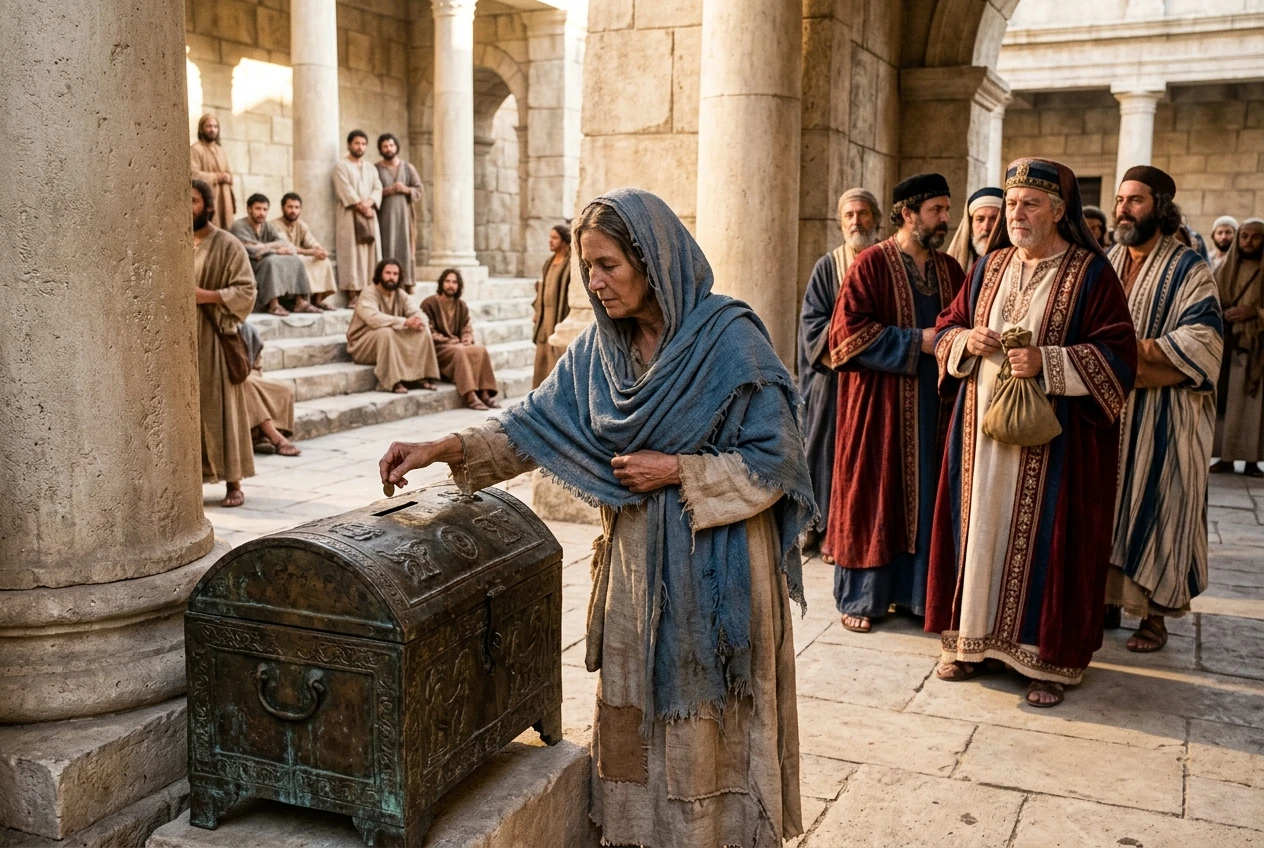
The Lord looked at what the gift cost the giver and what was in the giver’s heart. The same standard applies to the one who receives and uses a gift. A small sum handled faithfully is weighed in heaven differently from a large sum handled carelessly.
This is why a household with little has no reason to postpone stewardship until there is more. The discipline is the same at every size, and it is formed in the small gifts.
Receive Every Gift as From God Before You Decide What to Do With It
Before a gift is spent, it should be received. Scripture says that every good gift and every perfect gift is from above (James 1:17). The person who handed over the food or the coins was the instrument, and God was the giver.
When Jesus took the five barley loaves and two fish from a boy in the crowd, He gave thanks before He distributed anything (John 6:9-11). The food was small and the crowd was large, and thanksgiving still came first.
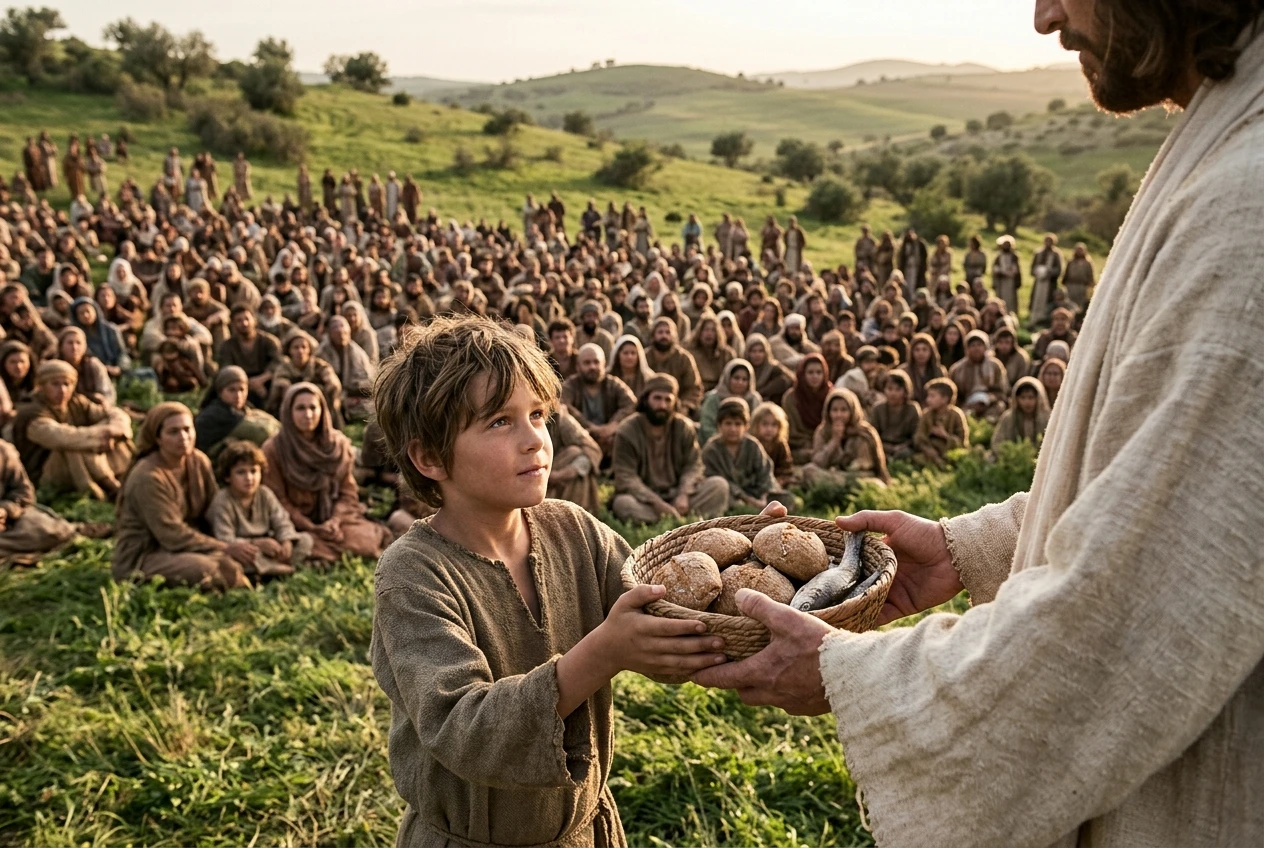
Follow that order in the home:
- Name the gift plainly, aloud or on paper, so that it is not treated as a vague piece of luck.
- Give thanks to God for it in prayer, and thank the giver as well.
- Wait to decide its use until the prayer is finished, even if the need is pressing. A short delay keeps the gift from being spent in anxiety.
A gift received with thanks is easier to use wisely, because the one holding it remembers that it was entrusted to him.
Faithful in Little: What Scripture Says a Steward Is Required to Be
A steward manages what belongs to another. Paul states the one requirement directly: “it is required in stewards, that a man be found faithful” (1 Corinthians 4:2). Skill, wealth and quick results are not named.
Jesus teaches that faithfulness is tested at small scale: “He that is faithful in that which is least is faithful also in much” (Luke 16:10). In the parable of the talents, the servants who traded faithfully with what they were given heard the same words from their master: “Well done, good and faithful servant; thou hast been faithful over a few things” (Matthew 25:21). The one who buried his talent was not condemned for having received little. He was condemned for doing nothing with it.
Faithfulness here means three things: the gift is not wasted, it is not hidden away from the need it was meant for, and it is not claimed as one’s own achievement.
Keep an Honest Account of What Has Been Given and What Has Been Used
A steward gives account. The master in Jesus’ parable says, “Give an account of thy stewardship” (Luke 16:2). Paul, when he carried a collection for the poor, took care to provide “for honest things, not only in the sight of the Lord, but also in the sight of men” (2 Corinthians 8:21).
A preacher or a family can do this with one notebook kept in a safe place. For each gift, write:

- The date, and who gave it, or that it was given anonymously.
- What it was: food, coins, clothing, transport, medicine, school items.
- What it was used for, and when.
- What remains.
Such a record is ordinary, and it protects both the household and the congregation. If anyone asks how a gift was used, the answer is already written. It also guards the steward against the quiet temptation to let a gift drift into something it was not meant for.
The same notebook shows over time how God has been supplying. A person who reads back through its pages has evidence in his own hand, which is a help to faith when a week is hard. For readers who are managing a regular monthly income as well, the article on making a fixed pension last the month without dropping your ministry covers the budgeting side, which this article leaves aside.
Put the Gift Where the Need Is Nearest: Food, School Uniforms, the Sickbed, the Road
A gift is used best on the need that is in front of the household now. James writes that if a brother or sister is naked and destitute of daily food, and one says “be warmed and filled” without giving the things needed for the body, it profits nothing (James 2:15-16). The need that is visible and close has the first claim.
For a preacher’s household, the near needs usually fall in four places:

- Food. Bread for the table, and for the relative who is too weak to prepare it.
- School. Uniforms, shoes, books and fees, so that a child is not kept at home for lack of them.
- The sickbed. Medicine, clean water, cloth, and the cost of reaching a clinic.
- The road. Fare to reach the people the preacher has been sent to teach.
Decide between these by asking which need would cause the most harm if it went unmet this week. Then write the decision in the account book beside the gift.
Where a need is larger than one household can meet, neighbours can work together. The piece on how a small community can gather uniforms and school supplies for children who have none describes how that can be organized.
Pass a Portion Onward, Because the Poor Can Still Give
Poverty does not cancel the call to give. Paul wrote of the churches of Macedonia that “in a great trial of affliction the abundance of their joy and their deep poverty abounded unto the riches of their liberality” (2 Corinthians 8:2). They gave beyond what anyone expected of them.
After the crowd of five thousand had eaten, Jesus told the disciples to gather up the fragments that remained, so that nothing was lost (John 6:12). What was left over was kept for further use and was not discarded.
A household can follow both examples. When a gift is received, consider whether a portion can go to someone whose need is greater: a neighbour, a widow, a sick relative in another village. It may be a handful of food or a few words of prayer and a visit. Jesus said that even a cup of cold water given in His name will not lose its reward (Matthew 10:42), and Paul reminds the elders of Ephesus of the Lord’s saying, “It is more blessed to give than to receive” (Acts 20:35).
Passing a portion onward also keeps the heart from closing around what it has been given.
What God Promises the Faithful Steward, and What He Does Not
God’s promises must be stated as He made them. Paul told the Philippians, who had supported him in his need, “my God shall supply all your need according to his riches in glory by Christ Jesus” (Philippians 4:19). He told the Corinthians that God is able to make all grace abound toward those who give, so that having sufficiency in all things they may abound to every good work (2 Corinthians 9:8). Jesus promised that those who seek first the kingdom of God and His righteousness will have food and clothing added to them (Matthew 6:33). The Letter to the Hebrews adds that God is not unjust to forget the work and labour of love shown toward His name (Hebrews 6:10).
These promises concern need and sufficiency. They are not a promise of wealth, and they do not guarantee that every request will be answered on the day or in the form we expect. Paul himself said he had learned to be content, knowing both how to be abased and how to abound (Philippians 4:11-12), and he wrote that godliness with contentment is great gain, and that having food and raiment we should be content (1 Timothy 6:6-8).
The final reward of the faithful steward is not measured in this life. It is the Master’s own word: “Enter thou into the joy of thy lord.” A steward who has been faithful in little can wait for that word with confidence.
One Small Step for This Week
Take one small gift you have received this week. Give thanks for it in prayer, naming it before God and thanking the person who gave it. Then write down in your notebook how it will be used, and keep to that decision.
When you have done this, read the related piece on what the Lord has actually said about provision: God has promised to provide for the preacher, and here is what He actually promised.