
Many older preachers notice the change before anyone speaks of it. The telephone rings less on Saturday evenings. A younger man is asked to take the Sunday appointment. The preacher still has the same Bible, the same convictions and a lifetime of sermons, but the invitations are fewer, and a hard question follows: does anyone still need what I carry?
This article offers encouragement for aging preachers, and for the families who watch them go quiet. Scripture does not treat old age as a retirement from usefulness. It shows God providing for his aging servants in three ways: daily bread, faithful people and work that remains to be done.
Why the Quiet Years Feel Like Being Set Aside
A preacher’s sense of worth is tied to being called upon. When the calls diminish, he may conclude that God has moved on without him. That conclusion is natural, but it does not follow from the facts. Fewer invitations can come from failing strength, from a younger congregation’s preferences, from distance and the cost of travel, or from a church that has simply grown and reorganised. None of these is a verdict from heaven.
The writer of Hebrews gives the reverse assurance: “God is not unrighteous to forget your work and labour of love, which ye have shewed toward his name” (Hebrews 6:10). God’s memory of a man’s service does not depend on how recently anyone asked him to preach.
Families can help here. A son or daughter who says, “Father, your years of teaching still matter,” does more good than one who quietly hopes the old man will rest. The preacher needs to hear that his labor is remembered, and that he is still wanted at the table.
Simeon and Anna: Faithful Servants Who Were Kept Until the Promise Arrived
Luke gives two portraits of devoted waiting. Simeon was “just and devout, waiting for the consolation of Israel,” and the Holy Spirit had revealed to him that he would not see death before he had seen the Lord’s Christ (Luke 2:25-26). He was not preaching to crowds. He was waiting, and the waiting was his service. When Mary and Joseph brought the child into the temple, he took him in his arms and blessed God.
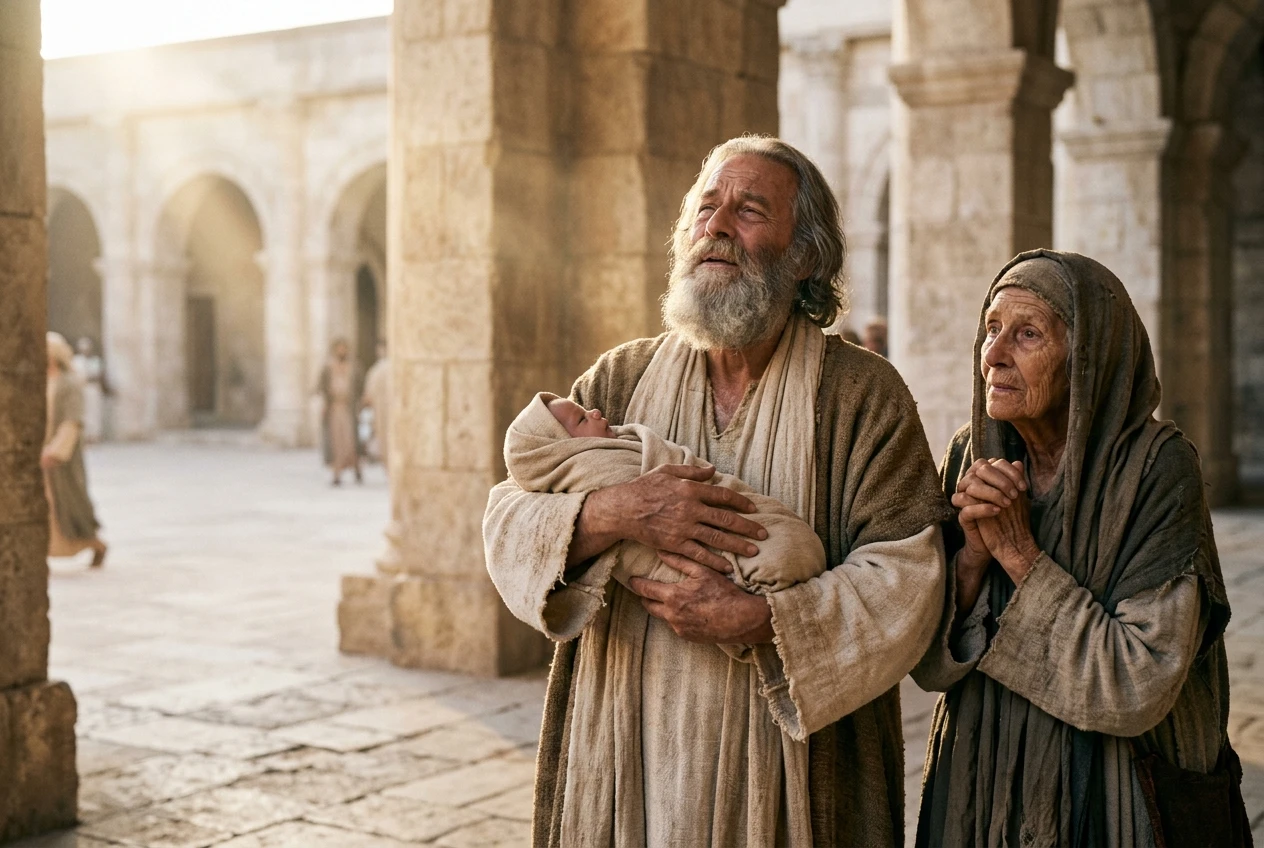
was a prophetess, “a widow of about fourscore and four years, which departed not from the temple, but served God with fastings and prayers night and day” (Luke 2:36-37). Scripture does not record any sermon of hers before that day. It records her presence, her prayers and her fasting. When the moment came she gave thanks and “spake of him to all them that looked for redemption in Jerusalem” (Luke 2:38).
Both were kept by God until the promise arrived, and both were given the privilege of speaking at the right hour. An aging preacher may not know which hour is still ahead of him. Scripture shows that God does not waste the years of faithful waiting, and that a word spoken in old age can reach the very people who were looking for it.
Psalm 71 and Psalm 92: What an Old Man May Ask of God and What God Says He Will Do
An old man is permitted to pray about his age. The psalmist does: “Cast me not off in the time of old age; forsake me not when my strength faileth” (Psalm 71:9). The fear of being set aside is spoken aloud to God, and Scripture preserves it as a proper prayer.
The same psalm continues with a request that gives the quiet years a purpose: “Now also when I am old and greyheaded, O God, forsake me not; until I have shewed thy strength unto this generation, and thy power to every one that is to come” (Psalm 71:18). The old servant asks to be kept in order to testify to the generation after him. That testimony does not require a pulpit. It can be given at a kitchen table, in a letter or beside a hospital bed.
Psalm 92 states what God says of the righteous: “They shall still bring forth fruit in old age; they shall be fat and flourishing; to shew that the LORD is upright” (Psalm 92:14-15). Isaiah adds the promise of the Lord himself: “Even to your old age I am he; and even to hoar hairs will I carry you” (Isaiah 46:4). God does not merely tolerate the old preacher. He carries him.
Caleb is a reminder that strength differs from man to man. At eighty-five he asked for the hill country that had been promised to him (Joshua 14:10-12). Some preachers retain energy into great age and should not be discouraged from using it. Others must preach less. Both are in God’s hand, and neither has been forgotten.
Paul at the End: The Cloak, the Books and the Companions He Still Needed
Paul’s last letter shows the greatest of the apostles in his final imprisonment, and it is strikingly practical. He writes to Timothy, “Do thy diligence to come shortly unto me,” and tells him that Demas has forsaken him and that “only Luke is with me” (2 Timothy 4:9-11). He asks for Mark, “for he is profitable to me for the ministry.” He also asks for the cloak he left at Troas with Carpus, and for “the books, but especially the parchments” (2 Timothy 4:13).

An apostle in his last season asked for a coat, for something to read and for the company of friends. This is no embarrassment to his ministry. It shows that old servants of God have bodily and human needs, and that asking for them is honest. The topic is explored further in Bread, Cloak, Rest and Road: The Bodily Needs of the Preacher in Scripture.
Paul also records a loneliness: “At my first answer no man stood with me, but all men forsook me.” Yet he continues, “Notwithstanding the Lord stood with me, and strengthened me” (2 Timothy 4:16-17). The Lord’s nearness did not remove the need for Timothy, Luke and Mark. It stood alongside it.
The Provision of Bread and the Provision of People: Seeing Both in Your Present Season
A preacher who relies on God for his daily needs usually watches for bread: food on the table, the fare for a journey, a coat for winter. Those matter, and God supplies them, often through a pension, a neighbour or a relative. For a preacher living on a fixed income, the retired preacher on a pension still has a pulpit, and the same God who gave the pension is attentive to the man.
Paul’s last letter shows a second provision that is easier to overlook: people. Luke stayed. Mark was useful. Timothy was asked to come. God supplied the apostle with companions as surely as he supplied him with a cloak.
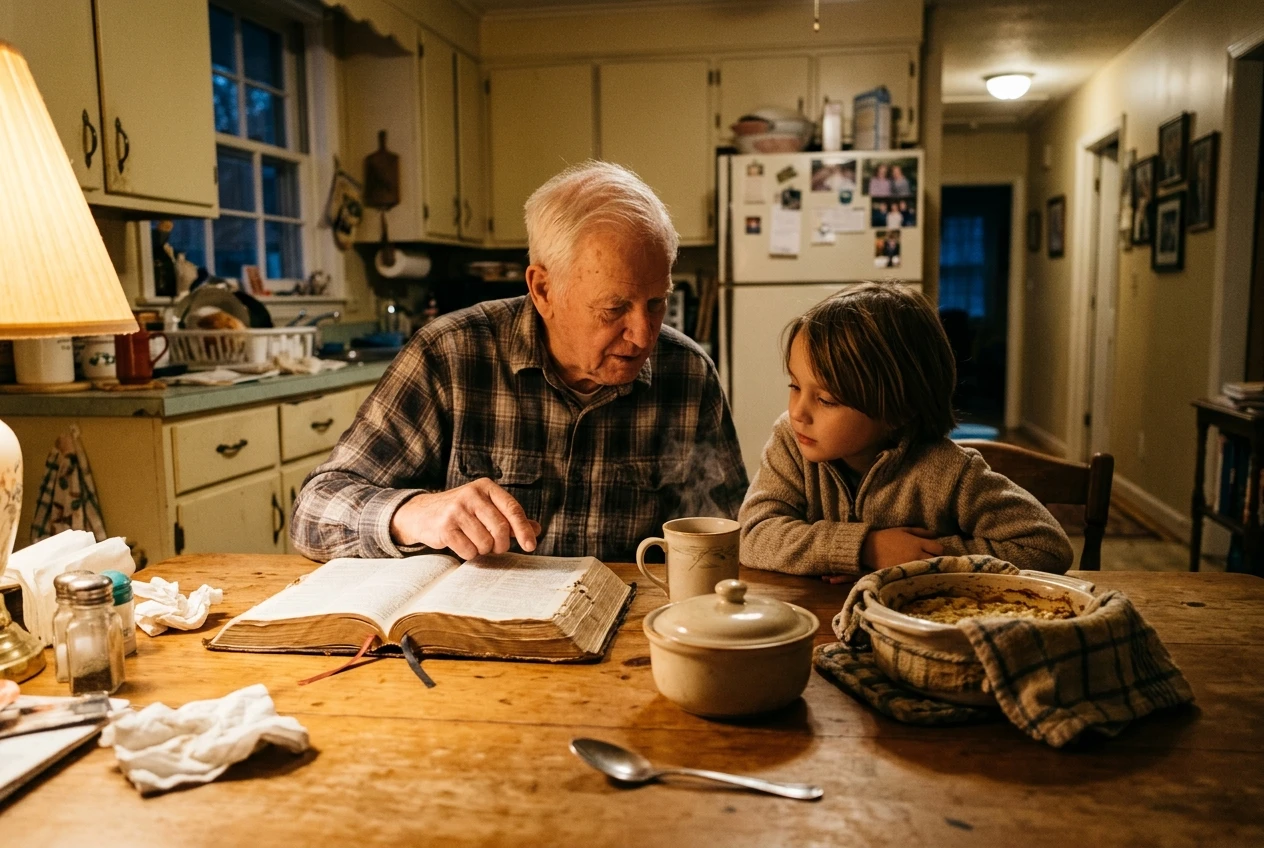
In your own quiet season, it is worth asking plainly who God has placed near you:
- A grandchild who sits with you after the evening meal and asks about the Scriptures.
- A younger preacher who telephones to ask how you handled a certain passage.
- A neighbour who brings food and stays to talk.
- A relative who drives you to the assembly when you cannot walk there.
These are not accidents. They are part of the provision, and receiving them gratefully honours the God who sent them.
The Work That Remains: Teaching the Young, Praying for the Church, Counselling the Sick
Preaching from a pulpit is one form of the work. It is not the whole of it. Paul tells Titus that the older men and women are to teach what is good, so that the younger may learn (Titus 2:2-5). That instruction is addressed to the aged specifically, and it assumes they have something to give.
Three kinds of work remain open to the aging preacher, whatever his strength.
Teaching the young. A younger man who is learning to preach needs someone to read his outline and correct a misreading of a text. The older preacher can do this from a chair. He can also teach children the foundations of the faith, as Timothy was taught from his grandmother and mother (2 Timothy 1:5).
Praying for the church. Anna’s whole ministry, as Luke records it, was prayer and fasting. The elder who prays by name for the congregation, for the sick and for the preachers who now stand where he once stood does work that no one else can see and that God does not overlook.
Counselling the sick and the grieving. Many people in distress cannot be helped by a sermon. They need a patient visitor who has himself known sickness and loss. A preacher who is also caring for a sick relative will find that caring for a relative is part of your ministry, not a break from it.
A Daily Practice for the Preacher in His Quiet Years
A fixed daily order helps a man who no longer has a preaching calendar to shape his week. The following is offered as a simple pattern, to be adjusted to strength and circumstance.

- Morning: read and pray a psalm. Psalm 71 and Psalm 92 suit this season well. Read slowly, and pray the words of Psalm 71:18 as your own request.
- Midday: name those who are owed prayer. Pray for one person from the congregation, one younger preacher and one sick person each day, by name.
- Afternoon: one act of teaching or encouragement. Write a letter, telephone a younger preacher, or explain a passage to a child or grandchild.
- Evening: give thanks for bread and for people. Name the food, the clothing and the companions God supplied that day. This trains the eye to see provision where it is.
- Before sleep: commit your labor to God. Remember Paul’s confidence: “I know whom I have believed, and am persuaded that he is able to keep that which I have committed unto him against that day” (2 Timothy 1:12).
The quiet years are not outside the ministry. They are a part of it, with their own tasks and their own provision. A man who prays, teaches, receives help with thanks and waits on the Lord, as Simeon and Anna did, is still serving. For the longer view of what God has set aside for such servants, see what the Bible means by eternal reward when no one pays the preacher.
Share this with an older preacher you know who may be wondering whether his labor is still seen by God, and pray for him by name this week.