Blog

  • God Asks the Pensioner for What He Has, Not for What He Lacks

    God Asks the Pensioner for What He Has, Not for What He Lacks

    A retired preacher on a pension has one sum arriving on a fixed day, and three claims on it: the household, the relatives who are sick or in need, and the gospel. Many ask how to use their retirement income for ministry without neglecting any of the three. Scripture gives a measure for this in 2 Corinthians 8:12: “For if there be first a willing mind, it is accepted according to that a man hath, and not according to that he hath not.”

    That verse puts the standard of acceptable giving in what is in your hand today. It sets no standard in what you wish you had or what you once earned. The sections below apply it to one pension.

    The Pension Is God’s Appointed Supply

    The apostle asks, “What hast thou that thou didst not receive?” (1 Corinthians 4:7). James writes that “every good gift and every perfect gift is from above” (James 1:17). If these words are true, the pension is a gift to be handled as a steward handles his master’s goods, and the preacher is no more its owner than he was the owner of his strength in younger years.

    This changes the first question. A man who thinks the money is his own asks, “How much can I spare for God?” A man who knows it is entrusted asks, “What does the Giver require of me in handling it?” The second question leads to a plan, and the plan begins at home.

    Provide for Your Own House First, and Why This Is No Betrayal of the Pulpit

    Paul writes to Timothy: “But if any provide not for his own, and specially for those of his own house, he hath denied the faith, and is worse than an infidel” (1 Timothy 5:8). Food, shelter, medicine and the ordinary costs of your own table come first. Attending to them is obedience to a command, and it takes nothing from the pulpit.

    Christ rebuked those who used a gift to God as an excuse for neglecting their parents (Mark 7:10-13). A man who gives to the gospel while his own household goes short has not honoured God. He has set one commandment against another, and Christ named that as wrong.

    The same reasoning covers relatives in need. James asks what profit there is in saying to a brother or sister without clothes or daily food, “Depart in peace, be ye warmed and filled,” while giving them nothing (James 2:15-16). School uniforms, school fees and food for a sick relative are therefore part of the obedience Scripture asks of you, and they do not compete with it. If you have not yet put your limits into words for those who ask, the article Tell Your Relatives Plainly What You Can Give, and Let God Supply the Rest may help.

    Give According to What You Have: The Widow’s Two Mites and the Churches of Macedonia

    Christ sat opposite the treasury and watched the people cast in their money. Many rich men gave much. A poor widow gave two mites, and He said that she “hath cast more in, than all they which have cast into the treasury” (Mark 12:43). He judged the gift by what remained behind it. Her portion was small in coin and complete in surrender.

    Inside a stone-pillared temple court, a bent elderly widow in a faded blue shawl drops two tiny copper coins into a brass treasury chest, while richly robed men behind her pour out handfuls of silver. Warm shafts of afternoon light fall across her hands.

    The churches of Macedonia are the second example. Paul says that in “a great trial of affliction” and “deep poverty” they gave with abundant joy, “to their power” and even beyond it, of their own accord (2 Corinthians 8:2-3). They did not wait until they were comfortable.

    Both examples agree with 2 Corinthians 8:12. God receives a willing mind working with what it has. A pensioner with a modest sum is therefore not asked for the offering of a wealthy man, and is not excused from giving either.

    Setting Apart the Portions of One Pension

    The New Testament gives no fixed percentage for the Christian’s giving. It gives principles: “Upon the first day of the week let every one of you lay by him in store, as God hath prospered him” (1 Corinthians 16:2). Giving is regular, planned beforehand, and in proportion to what God has provided. A pension arriving on a set date suits this well. A practical way to proceed:

    1. Write down the exact amount that arrives each month. Use the figure itself and leave out any amount you hope for.
    2. Set out the household’s fixed needs first: food, lodging, medicine, and the costs of your own transport and light.
    3. Name the relatives who depend on you and list what each truly needs, such as a child’s school uniform, a term’s fees, or food for someone who is ill.
    4. Set apart a portion for the gospel: travel to the place where you preach, printed material, an offering to the congregation, or help for another preacher.
    5. Pray over the paper and adjust it before the money is spent, not afterward.

    The order of this list is the order of obligation. It says nothing about the importance of the gospel, which is the greatest of the three. Writing the portions down also removes the confusion that comes when money is divided in the moment, under the pressure of whoever asks first. For the month-to-month side of this, the earlier article Making a Fixed Pension Last the Month Without Dropping Your Ministry goes through it in detail.

    What Ministry Costs When Money Is Fixed, and What Costs Nothing but Faithfulness

    Some parts of ministry need money and some need only a willing person. Travel to a distant village costs fare. A tract costs paper. Prayer costs nothing, and neither does reading Scripture aloud to a neighbour or teaching a grandchild a verse at the table. Visiting a sick relative and speaking the gospel at the bedside costs only the time and the willingness.

    Peter, at the gate of the temple, said to the lame man, “Silver and gold have I none; but such as I have give I thee” (Acts 3:6). He gave what he had, and it was greater than money. A retired preacher can ask honestly what he has in his hand besides coins: knowledge of the Word, years of experience, a voice that still speaks, a home that can receive a guest. Each of these can go into the gospel portion beside the money.

    The money portion can be small without the ministry being small. A preacher who stays within a modest gospel portion and uses it with care is being faithful, which is what is asked of him. The article What a Volunteer Preacher Should Do With the Small Gifts Placed in His Hands treats the handling of small sums directly.

    The Day the Pension Falls Short

    Some months the sum will not cover what the paper says. A relative falls ill, a school term begins, or prices rise. Scripture does not advise reducing every portion in equal measure. It gives three directions.

    First, bring the shortage to God in prayer. Paul wrote, “But my God shall supply all your need according to his riches in glory by Christ Jesus” (Philippians 4:19). He wrote it to people who had given out of their poverty, and the promise follows their giving.

    Second, review the paper honestly. A need may have been counted wrongly, or a portion may have been set higher than what you truly have. Paul’s phrase “according to that a man hath” works in both directions. It frees you from giving what you lack, and it does not permit you to give less than you have.

    Third, make the need known where it is proper to do so. The household of faith exists for such days, and a preacher may tell his congregation the truth about his situation. The article What a Volunteer Preacher Can Honestly Say to His Congregation When He Is in Need gives wording for it.

    Counting Output the Way Heaven Counts It

    Men count preaching by the number of sermons, the size of the crowd and the distance travelled. A pensioner whose body and purse are limited may feel that his output has fallen. Scripture measures differently: “Moreover it is required in stewards, that a man be found faithful” (1 Corinthians 4:2). Christ’s word to the servant is “Well done, good and faithful servant” (Matthew 25:21), and it names faithfulness as the ground of praise. It says nothing of the amount produced.

    He also says, “He that is faithful in that which is least is faithful also in much” (Luke 16:10). A pension portion set apart, a child sent to school in a clean uniform, a sick relative fed, and a gospel offering given on time are all faithful acts, and the Lord sees each. “For God is not unrighteous to forget your work and labour of love, which ye have shewed toward his name” (Hebrews 6:10).

    Paul closes his great chapter on the resurrection with an assurance that fits this: “Your labour is not in vain in the Lord” (1 Corinthians 15:58). Those who serve without payment can read the whole matter of reward in A Whole Life of Unpaid Preaching Ends in a Crown, Not in Loss.

    This week, sit down with your pension amount and with Scripture open, set out in writing the portions for your household, your relatives and the gospel, then bring that paper to God in prayer and ask Him to bless each portion.


  • Let Your Grandchildren Watch You Wait on God for Daily Bread

    Let Your Grandchildren Watch You Wait on God for Daily Bread

    A child forms his first picture of God from the people nearest him. If a grandparent says “God provides” and then worries aloud, hoards in silence, or never mentions God when the cupboard is bare, the child keeps the worry and forgets the sentence. If the same grandparent asks, waits, gives thanks and shares where the child can see it, the child learns that God provides before he can explain what the word means.

    This is the plain method of how to teach grandchildren that God provides: let them watch you depend on Him in ordinary hours. The sections below give concrete scenes for doing it, and an honest way to answer when God’s answer is “wait” or “no.”

    Why a Child Believes What He Sees You Do Before What He Hears You Say

    Moses told Israel to keep God’s words in their hearts and then said, “Thou shalt teach them diligently unto thy children, and shalt talk of them when thou sittest in thine house, and when thou walkest by the way, and when thou liest down, and when thou risest up” (Deuteronomy 6:7). The places named are the house, the road, the bedtime and the morning. Teaching happens inside daily life, not in a separate lesson.

    Children also notice small things. They see who is thanked at the table, what is said when the money is short, and whether a person prays only in church or also over a bill. A grandchild sitting beside you hears all of it. What he hears there will carry more weight with him than any speech.

    The scenes that follow need no special occasion. They need you to let the child be present when you do what you already do.

    Let Them Hear You Ask: Praying Aloud for a Real Need

    Our Lord taught His disciples to pray, “Give us this day our daily bread” (Matthew 6:11). The prayer assumes that bread is received day by day from the Father’s hand, and a child understands this best when he hears it asked for by name.

    Suppose the rice is low, or a grandchild’s school fees are due, or you need transport to reach a preaching appointment. Do not pray vaguely in front of the child. Pray the actual need in a sentence he can follow: “Father, we have rice for two more days. Please give us what we need, and teach us to trust You while we wait.” He learns that need is not shameful and that God is the one to bring it to.

    An elderly grandfather and a young grandchild sit side by side at a small wooden kitchen table with heads bowed and hands folded, a half-empty tin of rice and a single oil lamp beside them, warm morning light through a window.

    A few habits help:

    • Keep the prayer short and in plain words, so a child can say amen and mean it.
    • Name the need exactly, and name it again with thanks when it is met.
    • Invite the grandchild to pray one sentence of his own, without correcting how he says it.

    If you want help finding words for a hard week, the article on how a preacher can pray when the bread is running short offers a pattern you can use aloud. This does help, God willing, and with His help too, https://wealthyaffiliate.com/?a_aid=84c34e3a. Thank God.

    Let Them See the Waiting: Teaching Patience When the Answer Is Not Yet

    Israel in the wilderness received manna a day at a time. Exodus 16 records that they gathered what they needed each morning, and that what they tried to keep overnight spoiled. The lesson was to look to God again tomorrow, which is what “daily bread” means.

    A child is impatient by nature, and he will ask why the answer has not come. Waiting is where he can learn the most, provided he sees you wait without grumbling or panic. Say what you are doing: “We asked on Monday. It is Thursday and nothing has come yet. So we will keep asking, and we will keep doing our part.”

    Then do your part where he can see it. Make the visit, write the letter, tell the neighbour or the congregation honestly of the need, and go on with your work. Waiting on God is not sitting idle. It is continuing in obedience while the answer is not yet given.

    When the answer comes, stop and point to it. A child who watched three days of waiting will remember the fourth day far better than one who only heard that God is faithful. Say it simply: “We waited, and today God supplied. Let us thank Him.”

    Let Them See the Giving: Sharing a Portion When Your Own Hand Is Small

    Many grandparents who rely on God for daily needs have little to spare, and they suppose there is nothing to teach about giving. Scripture says otherwise. The widow of Zarephath had a handful of meal and a little oil when Elijah asked her for bread, and she made his cake first (1 Kings 17:12-16). The meal and the oil did not fail through all the days that followed. The widow in the temple put in two small coins, and our Lord said she had given more than all the rest (Mark 12:41-44).

    A child should see that sharing does not wait until there is plenty. Let him carry a portion of food to a sick neighbour, or set aside a small share of what is received before you spend the rest. Tell him why: “God gave us this, and He asks us to share some of it. We give because He first gave to us.”

    A grandchild carefully carries a covered bowl of food with both hands toward a neighbour's open door, while the grandfather walks behind him with a hand on his shoulder, late afternoon sun on a modest street.

    Keep the giving ordinary and unadvertised. Do not turn it into a lecture, and do not make the child feel poorer for it. If he asks why you gave away something you also needed, answer truthfully: “Because someone needed it more today, and I believe God will take care of us tomorrow.” That answer teaches more about trust than any recitation of verses.

    Tell Them the Old Stories: Where God Has Already Supplied for Your Household, and What Scripture Says in Deuteronomy 6 and Psalm 78

    When your children ask in time to come, “What mean the testimonies, and the statutes, and the judgments, which the LORD our God hath commanded you?” you are to answer with what God has done (Deuteronomy 6:20-21). The answer in the text is a story, not an argument: “We were Pharaoh’s bondmen in Egypt; and the LORD brought us out of Egypt with a mighty hand.”

    Psalm 78 gives the reason for telling such stories. The fathers’ works of God were not to be hidden from the children, but shown “to the generation to come, the praises of the LORD, and his strength, and his wonderful works that he hath done,” so that they “might set their hope in God, and not forget the works of God, but keep his commandments” (Psalm 78:4, 7). A child’s hope in God is built partly from memory, and he can only remember what has been told to him.

    So tell him what you actually know. Choose a time when your household received what it needed, a meal, a fee paid, a journey made possible, a healing, and tell it in order: what the need was, what you prayed, how long you waited, how God supplied, and what you said in thanks. Use true details and do not embellish them. If you are unsure of a date or an amount, say that you do not remember exactly, which is better than guessing.

    An old man with an open worn Bible on his knee tells a story to a grandchild on a porch step at dusk, the child looking up wide-eyed, a loaf of bread and a cup of tea on a small table between them, amber lamplight.

    Repeat the stories. Israel kept feasts so that the telling would return every year. You can tell the same account at the same season, or at the same table, until the grandchild can tell it back to you.

    Spoken stories fade, and a record keeps them. The method in recording God’s provision for his grandchildren is a sound way to keep them for the child to read when he is grown. This would serve us their passive income when you become a member of https://www.wealthyaffiliate.com/?a_aid=84c34e3a.

    What to Say When a Child Asks Why God Did Not Give Us What We Prayed For

    Sooner or later a grandchild will ask this, and the question deserves a true answer. Perhaps a sick relative was not healed, or the money did not come, or the school fees went unpaid. If you answer with a pious phrase he will sense that you are avoiding him.

    Begin by letting the question stand. Say, “That is a good question, and I have asked it too.” Then say what Scripture allows you to say.

    God hears every prayer. Our Lord said that a father who is asked for bread does not give his son a stone (Matthew 7:9-11). God is not deaf to the child’s request or to yours.

    “Wait” is also an answer. Some prayers are not refused but delayed. Say so when it is the case, and keep praying with him. Do not promise how or when God will answer, because you do not know.

    “No” is sometimes the answer. Paul asked the Lord three times to remove his thorn, and the Lord answered, “My grace is sufficient for thee: for my strength is made perfect in weakness” (2 Corinthians 12:8-9). Our Lord Himself prayed in Gethsemane, “nevertheless not as I will, but as thou wilt” (Matthew 26:39). A “no” does not mean God has forgotten us or that the child prayed wrongly.

    We may not understand why. It is better to say “I do not know why” than to invent a reason. You can add what you do know: God is good, He is near to us in the need, and He has been faithful before.

    A short reply might run like this: “We asked God for it and He did not give it this time. I do not know why. I know He loves you, and I know He has taken care of us before. Let us thank Him for what we do have, and let us keep asking Him.”

    Then stay with the child. If the need is still there, meet it with whatever you can, a meal, a visit, a prayer said together. A child who sees you remain faithful while the answer is “no” learns something that no earlier answer could teach him: that trust in God does not depend on getting what we ask.

    Begin This Week

    Choose one provision God has already given your household and tell it to a grandchild this week, plainly and with thanks.

  • Teach Your Household to Treasure God’s Promise Above Money, Beginning at the Table

    Teach Your Household to Treasure God’s Promise Above Money, Beginning at the Table

    A home that trusts God for its bread has to practise that trust daily, in small and ordinary things. This article sets out how to build a Christian household that trusts God for provision, using the habits of the table, the reading, the conversation and the offering. It is written for older believers and the relatives who share their roof, including the children who need uniforms, the sick who need care and the dependents who need food, and who want the house to stand on God’s promise rather than on wealth.

    Why Christ tells the household to lay up treasure in heaven first

    Our Lord gave a plain instruction: “Lay not up for yourselves treasures upon earth, where moth and rust doth corrupt, and where thieves break through and steal: but lay up for yourselves treasures in heaven” (Matthew 6:19-20). He gave the reason in the next verse: “For where your treasure is, there will your heart be also.” A household’s heart follows what it treasures, and children copy what the adults around them value.

    Christ then gave the promise that makes this safe to obey: “Seek ye first the kingdom of God, and his righteousness; and all these things shall be added unto you” (Matthew 6:33). The “things” in that passage are food, drink and clothing. Those are the same needs a family with little money worries about most.

    This does not mean the household ignores work, thrift or honest need. Paul wrote that godliness with contentment is great gain, and that having food and raiment we should be content (1 Timothy 6:6-8). The home puts God first in its affections and trusts Him with what it lacks. The practices below are ways of doing that every day.

    Begin at the table: thanksgiving for daily bread, whether the plate is full or plain

    The Lord taught us to pray, “Give us this day our daily bread” (Matthew 6:11). The request is for today. When the household prays it together at the table, every person present hears that the food on the plate came by God’s hand.

    A family seated around a low wooden table at dusk with heads bowed in prayer, a pot of rice, a bowl of beans, a loaf of bread and a jug of water on the table, warm lamplight on a grandmother, parents and children.

    Our Lord Himself gave thanks before eating. He did so before He fed the five thousand from five loaves and two fishes (Matthew 14:19), and the multitude ate and was filled. If He gave thanks over so little, a household may give thanks over a plain meal.

    Keep the grace short, so that it is said every day and does not become a burden:

    • Let one person pray each day, and let the children take their turn in rotation.
    • Give thanks for the food by name, such as the rice, the beans, the bread or the water.
    • On days when the plate is small, say so honestly and thank God for it anyway. The psalmist wrote, “The eyes of all wait upon thee; and thou givest them their meat in due season” (Psalm 145:15).
    • Begin eating only after the prayer, and let the oldest person present remain at the table until all have finished.

    A child who hears thanks given over a plain meal learns that gratitude does not depend on abundance. That lesson will outlast any particular meal.

    A short family reading each day, and the passages that teach contentment

    Moses told Israel to keep God’s words in the heart and to teach them diligently to the children, “when thou sittest in thine house, and when thou walkest by the way, and when thou liest down, and when thou risest up” (Deuteronomy 6:6-7). The household has no need of a long service. Five to ten minutes after the evening meal, with one chapter or half a chapter read aloud, keeps God’s word in daily use.

    An elderly woman in reading glasses sitting on a worn sofa with a large open Bible on her lap, a young grandchild beside her reading aloud with a finger on the page, soft evening light from a window and a kerosene lamp.

    Where the reader is an older person with failing sight, let a child read and the elder explain. Where some in the home cannot read, read slowly and repeat the key verse together.

    These passages teach contentment and provision, and they suit a home that lives on little:

    • Exodus 16:11-21. God gave manna each morning, enough for that day, and those who tried to hoard it found it spoiled.
    • Psalm 23. “The LORD is my shepherd; I shall not want.”
    • Proverbs 30:7-9. Agur asks for neither poverty nor riches, only the food that is needful.
    • Matthew 6:25-34. Christ speaks of the birds, the lilies and the Father who knows what we need.
    • Philippians 4:11-13, 19. Paul has learned to be content in every state, and promises that God shall supply all our need.
    • Hebrews 13:5. “Be content with such things as ye have: for he hath said, I will never leave thee, nor forsake thee.”

    Read one of these each week and return to it on the days that follow. Ask each person afterward what the passage says God does and what it asks of us.

    Teaching children the difference between a need and a want, without shame

    Children in a household with little money often notice what other children have. They should be told the truth in terms they can understand, and they should never be made to feel that wanting something is a sin or that being poor is a disgrace. Christ called the poor blessed (Luke 6:20), and the Scripture gives no warrant for shaming them.

    A simple way to teach the difference is to name the needs God has promised: food, clothing and shelter (Matthew 6:31-32), together with the schooling and care that a child cannot do without. A want is something pleasant that is not required for life or for a child’s duty. A child may ask for a want, and a parent or grandparent may answer plainly, “That is not something we can have now. Let us thank God for what we do have.”

    Several practices help:

    • When a child asks for something, ask first, “Is this a need or a want?” Let the child answer before the adult does.
    • Never speak of the family’s lack in a tone of contempt for those who have more.
    • Read Luke 12:15 together: “a man’s life consisteth not in the abundance of the things which he possesseth.”
    • Let the child see the adults wait and pray before buying, and see them give thanks when God provides.

    Where school fees or uniforms are a real need, speak of them openly with the child as something the household is bringing to God in prayer. A child who is included in the prayer learns to trust, and a child who is kept ignorant of it often imagines worse.

    How to speak to the sick and the anxious in your home about God’s care

    The sick person in a poor household often fears being a burden. The anxious person fears what tomorrow holds. Both need to hear the truth of Scripture spoken gently, and both need to be treated as members of the household who still have something to give.

    Peter writes, “Casting all your care upon him; for he careth for you” (1 Peter 5:7). Isaiah records God’s word: “Fear thou not; for I am with thee: be not dismayed; for I am thy God: I will strengthen thee; yea, I will help thee” (Isaiah 41:10). Read these verses aloud at the bedside, slowly, and then be silent a moment.

    James directs that the sick should call for the elders of the church to pray over them (James 5:14-15). Do this, and tell the sick person that the household is not carrying the illness alone.

    Avoid hurried promises about recovery, which God has not made to any one person in a particular case. What He has promised is His presence and His care. A sick relative can still pray for the household, and that gives the person a real part in its life. For the one who keeps watch at the sickbed, a daily prayer for the caregiver may help at the end of a tiring day.

    Practising small giving so the household learns that God supplies and we share

    Our Lord watched the people casting money into the treasury and saw a poor widow cast in two mites. He said she had given more than all the others, because they gave out of their abundance and she gave all she had (Mark 12:41-44). The Lord measures giving against what remains, and a small gift may weigh heavily with Him.

    Paul wrote, “God loveth a cheerful giver,” and promised that God is able to make all grace abound toward those who give, so that they have enough for every good work (2 Corinthians 9:7-8). He also records the Lord’s saying, “It is more blessed to give than to receive” (Acts 20:35).

    A household with little can still practise giving each week:

    A child in a mended school uniform handing a small covered dish of food across a garden fence to an older neighbour, with a parent standing behind, bright morning sun and green banana plants.
    • Set aside a small portion of whatever comes into the house, however little, before it is spent.
    • Let a child choose, with an adult’s guidance, who will receive it, such as a neighbour in need or the church’s offering.
    • Share a meal or a portion of food with someone poorer than the household.
    • Give time as well as money: a visit to the sick, a letter to the lonely, or help with a neighbour’s work.

    The widow of Zarephath fed Elijah from her last handful of meal, and her barrel did not run out (1 Kings 17:12-16). The household that gives from little will find that its giving does not empty the house, and the children will remember that.

    What to do when the pantry is thin or the school fees are due, and the household is tempted to envy

    Envy comes easily when the cupboard is bare and a neighbour’s table is full. Asaph confessed in Psalm 73 that his feet had almost slipped when he saw the prosperity of the wicked, and he recovered only when he went into the sanctuary of God and understood their end. Read that psalm together on a hard day. Proverbs 14:30 adds that envy is “the rottenness of the bones.”

    When the need is pressing, take these steps in order:

    1. Pray together and name the need aloud. Paul directs, “In every thing by prayer and supplication with thanksgiving let your requests be made known unto God” (Philippians 4:6). For help in the words, see how a preacher can pray when the bread is running short.
    2. List what God has already supplied. David wrote, “I have been young, and now am old; yet have I not seen the righteous forsaken, nor his seed begging bread” (Psalm 37:25).
    3. Ask honestly for help where help is proper. Tell a trusted relative, a church elder or a neighbour what is lacking. Asking for a real need is not greed.
    4. Do what is within the household’s power. Work, mend, plant, and share what the household has with those who have less.
    5. Guard the tongue. Let no one in the house speak bitterly about those who have more. The tenth commandment forbids coveting a neighbour’s house or anything that is his (Exodus 20:17).

    Where several families in a community share the same need, school uniforms and supplies may be gathered together, and a small community can organise this together so that no child goes without.

    Keeping the home steady: one week of practices to begin with

    A simple family kitchen at morning with a hand-drawn week calendar of seven small marks pinned to the wall beside a shelf holding a Bible, a mug and a small tin for offerings, golden sunlight through the doorway.

    A household need not take on everything at once. Begin with one week and let the habits settle.

    • Day 1. Say grace aloud at every meal, and let the youngest able child pray at one of them.
    • Day 2. After the evening meal, read Psalm 23 together and ask each person what the shepherd supplies.
    • Day 3. Sit with the children and name the household’s real needs for the month. Ask them to say which of their requests are wants.
    • Day 4. Read Philippians 4:11-13 and talk about what contentment means for each person in the house.
    • Day 5. Set aside a small gift and decide together who will receive it.
    • Day 6. Visit or pray with a sick or lonely person, or read Isaiah 41:10 at the bedside of one in the home.
    • Day 7. Rest, attend worship, and let each person thank God for something He has supplied that week.

    Do not be discouraged if a day is missed. The aim is a steady habit of turning to God, and one missed evening does not undo that. Return to it the next day.

    This week, gather your household once, read Matthew 6:25 to 34 aloud together, and let each person say one thing God has already supplied.

  • A Preacher Who Cannot Stand Can Still Bear Witness From His Bed

    A Preacher Who Cannot Stand Can Still Bear Witness From His Bed

    A narrow iron bed beside a window in early morning light, an old worn leather Bible lying open on the quilt next to a pair of reading glasses, a folded dark suit jacket hanging on a chair in the background, soft gold and muted grey tones.

    A volunteer preacher who has spent his strength on the road and in the pulpit may one day find that he cannot stand long enough to speak, or cannot leave the house at all. The question of how to serve God when you are sick is then a daily one, and Scripture answers it more fully than most people expect. This article is written to the preacher who is himself the patient, and to the relatives who tend him.

    When the Body Fails Before the Work Is Finished

    A preacher is used to measuring his labor by what he does: the miles traveled, the sermons given, the homes visited. Sickness removes most of those measures at once, and a faithful man may begin to wonder whether he is now of any use to the Lord.

    The Bible does not measure service only by activity. Paul writes in 2 Corinthians 4:16, “Though our outward man perish, yet the inward man is renewed day by day.” The body may waste while the inner man is strengthened, and God sees both. A preacher confined to his bed is still a man whom God is dealing with, and still a man through whom God may speak.

    Medical care has its place. Luke, who traveled with Paul, is called “the beloved physician” in Colossians 4:14, and Paul advised Timothy to use a little wine for his stomach’s sake and his frequent infirmities (1 Timothy 5:23). Seeking a doctor and resting are acts of obedience.

    What Paul Heard When He Asked for the Thorn to Be Taken Away

    In 2 Corinthians 12:7-10, Paul describes a “thorn in the flesh” that troubled him. Scripture does not say what it was, so no one should claim to know. What it does record is that Paul besought the Lord three times that it might depart from him.

    The Lord’s answer was, “My grace is sufficient for thee: for my strength is made perfect in weakness.” The thorn stayed, and Paul received something to carry it with. He concluded, “Therefore I take pleasure in infirmities… for when I am weak, then am I strong.”

    A single thorny branch of a wild rose bush with one small pale bloom opening among the thorns, backlit by low afternoon sun against a dry stone wall, warm amber and green tones.

    A sick preacher may therefore pray for healing without embarrassment, as Paul did, and may also listen for the answer given to Paul. Sometimes God removes the illness. Sometimes He leaves it and shows His strength through the man who must lean on Him entirely. In both cases the prayer was heard.

    Epaphroditus: The Sick Man Whom Paul Honored

    Philippians 2:25-30 tells of Epaphroditus, whom the church at Philippi had sent to bring Paul their gift and to serve him. He fell ill, “sick nigh unto death,” and the church heard of it. Paul writes that “God had mercy on him,” and on Paul also, “lest I should have sorrow upon sorrow.”

    Look at how Paul describes him: “my brother, and companion in labour, and fellowsoldier.” He does not call him a failure for becoming ill. He instructs the Philippians, “Receive him therefore in the Lord with all gladness; and hold such in reputation,” because “for the work of Christ he was nigh unto death, not regarding his life.”

    The illness of a servant of Christ does not cancel his honor. It can be part of the labor itself. If a relative is caring for a preacher who is laid up, that relative may take Paul’s words as his own instruction: receive him with gladness, and hold him in reputation.

    Three Kinds of Ministry That Need No Strength: Prayer, Patience and a Word to Visitors

    Some ministry requires a voice that carries and legs that travel. Three kinds require neither.

    Prayer. James 5:16 says, “The effectual fervent prayer of a righteous man availeth much.” Epaphras, a fellow laborer of Paul, is described in Colossians 4:12 as “always labouring fervently for you in prayers.” Prayer is called labor there. A man in bed has the hours to give to it: for his congregation, for the young preachers he knows, for the children of his relatives, for those who bring him food. A relative who keeps watch may find help in a daily prayer for the preacher who also keeps watch at a sickbed.

    Patience. James 5:11 says, “Ye have heard of the patience of Job, and have seen the end of the Lord; that the Lord is very pitiful, and of tender mercy.” Job lost his health and his comfort, and said, “The Lord gave, and the Lord hath taken away; blessed be the name of the Lord” (Job 1:21). He also said, “I know that my redeemer liveth” (Job 19:25). Those who visit a patient man hear that confession even when he says little.

    A word to visitors. Colossians 4:6 says, “Let your speech be alway with grace, seasoned with salt.” A visitor who comes to cheer a sick preacher can leave having been cheered, and having heard a short testimony of God’s faithfulness. A few sentences are enough, and the preacher need not raise himself from the pillow to say them. 1 Peter 3:15 asks believers to be ready to give an answer for the hope within them, and the sickroom gives that answer a very attentive audience.

    How to Receive Food and Help Without Shame While You Are Laid Up

    A man accustomed to giving may find it hard to be given to. Meals arrive, a neighbor offers transport to the clinic, a child is asked to run errands, and the preacher feels like a burden.

    Scripture supports receiving. Galatians 6:2 commands, “Bear ye one another’s burdens, and so fulfil the law of Christ.” If burdens are to be borne, someone must be willing to let them be borne. Jesus also said, “I was sick, and ye visited me” (Matthew 25:36), and He counts such kindness as done to Him. A preacher who refuses help takes that opportunity from the one who offers it.

    A bedside table holding a covered casserole dish, a loaf of bread wrapped in a cloth, and a mug of tea, with a neighbor's hand setting down the dish and the edge of a patterned quilt visible, warm lamplight in a modest bedroom.

    Receive plainly and say thank you. Where it is possible, name something you can give in return, such as a prayer for the giver by name. Paul himself received the gift that Epaphroditus carried from Philippi, and he called it “an odour of a sweet smell, a sacrifice acceptable, wellpleasing to God” (Philippians 4:18).

    If daily needs have become hard to meet, you may also say so honestly to your congregation or relatives. The same Lord who fed Elijah by the brook has not changed.

    Teaching Your Household From the Bed What Endurance Looks Like

    Children and grandchildren who visit a sick preacher are watching how a believer behaves when the body is weak. Deuteronomy 6:7 tells parents to teach God’s words diligently to their children, “when thou sittest in thine house, and when thou walkest by the way, and when thou liest down.” The words “liest down” apply here as truly as the rest.

    A young child sitting on the edge of a bed reading aloud from an open Bible while an elderly man propped on pillows listens with a gentle expression, afternoon light through lace curtains, cozy cream and soft blue colors.

    A household can be taught from the bed in small ways:

    • Ask a child to read a psalm aloud to you, and say a word about why it comforts you.
    • Pray aloud with the family at the usual hours, even if the prayer is short.
    • Let them see you give thanks for a meal that is simple.
    • Tell them honestly that you are tired or in pain, and tell them also that God is with you.

    The psalmist prays in Psalm 71:18, “Now also when I am old and greyheaded, O God, forsake me not; until I have shewed thy strength unto this generation, and thy power to every one that is to come.” A weak man can still show God’s strength to the next generation by what he leans upon.

    The Reward Promised to the One Who Endures

    Hebrews 10:35-36 says, “Cast not away therefore your confidence, which hath great recompence of reward. For ye have need of patience, that, after ye have done the will of God, ye might receive the promise.” Patience is named there as a need, and the reward is named as a promise.

    James 1:12 adds, “Blessed is the man that endureth temptation: for when he is tried, he shall receive the crown of life, which the Lord hath promised to them that love him.” Paul writes in Romans 8:18 that “the sufferings of this present time are not worthy to be compared with the glory which shall be revealed in us.”

    God also keeps an account that the sick man cannot see. Hebrews 6:10 says, “God is not unrighteous to forget your work and labour of love, which ye have shewed toward his name.” And 1 Corinthians 15:58 closes the matter: “Your labour is not in vain in the Lord.”

    Those who have preached without pay may read further in a whole life of unpaid preaching ends in a crown. The same promise reaches the preacher who now preaches only by enduring.

    If a preacher you know is laid up today, write him a short letter of encouragement. Tell him that his endurance is a sermon God sees, and quote him one of the verses above so he can read it again when the day is long.

  • Write It Down While You Remember: A Preacher’s Plain Method for Recording God’s Provision for His Grandchildren

    Write It Down While You Remember: A Preacher’s Plain Method for Recording God’s Provision for His Grandchildren

    Every preacher who lives by God’s provision has a store of things worth remembering: a meal that arrived when the pantry was bare, a fare that was paid by a hand he did not expect, a prayer answered after years of waiting. Memory fades with age, and the children and grandchildren will not know these things unless someone writes them down. This article explains how to journal your ministry for your family, in a form that a retired preacher on a small pension can keep without cost or difficulty.

    Why Israel Was Commanded to Write Down and Remember What the Lord Did

    Scripture treats forgetting as a real danger and writing as a remedy. In Exodus 17:14 the Lord told Moses, “Write this for a memorial in a book,” after the victory over Amalek. In Deuteronomy 8:2 Moses told the people to remember all the way the Lord had led them in the wilderness, and in Deuteronomy 6:12 he warned them to take heed lest they forget the Lord who brought them out of Egypt.

    Joshua set up twelve stones from the Jordan so that when the children asked in time to come, “What mean ye by these stones?”, their fathers could answer (Joshua 4:6-7). The Psalmist wrote that God’s works should not be hidden from the children but shown to the generation to come, “that they might set their hope in God” (Psalm 78:4-7). Psalm 102:18 says, “This shall be written for the generation to come.”

    A small cairn of twelve rough river stones stacked on a dry riverbank at golden evening, with a worn leather-bound book resting on the top stone and the shallow river glinting behind it.

    A written ministry journal follows the same pattern. Your notebook does the work of the stones: it gives a grandchild something to ask about, and you or your family something to answer with.

    What to Record: The Bread, the Road, the Gift and the Prayer Answered

    A journal that tries to record everything is soon abandoned. Four headings are enough to keep the record focused on provision.

    • The bread. Meals given, food shared, groceries left at the door, a table set for you in someone’s home.
    • The road. Transport paid, a lift offered, a journey completed safely, a door opened in a place you did not expect.
    • The gift. Money, clothing, a pair of shoes, a coat, books, school supplies passed to you for your relatives. Write who gave it if the giver is content to be named.
    • The prayer answered. What you asked, when you asked it, and what came.

    Our Lord asked His disciples, “When I sent you without purse, and scrip, and shoes, lacked ye any thing?” and they answered, “Nothing” (Luke 22:35). A journal kept under these four headings is a long, local version of that question and answer, set down in your own handwriting.

    If you wish to see how Scripture itself lists a preacher’s bodily needs, the piece on the bread, cloak, rest and road of the preacher lays them out, and they map closely onto these headings.

    A Plain Notebook and Ten Minutes: A Simple Routine for a Pensioner

    The equipment is one bound notebook and one pen. A school exercise book is sufficient and costs little. Loose sheets are easily lost, so choose something with stitched or glued pages and write your name and the year on the cover.

    An elderly man's weathered hands writing in a stitched school exercise book at a plain wooden kitchen table, lit by a small oil lamp in the evening, with a cup of tea, a worn Bible and a ballpoint pen beside the notebook.

    Fix a regular time. The evening after prayer is suitable, because the day’s events are still fresh. Ten minutes is enough for a few lines, and three evenings a week will produce a substantial record over a year. If you miss a few days, do not abandon the book; write the next entry and note that it was recorded late.

    A routine of this size can be kept even in weeks of sickness at home or heavy caring duties. If you are tired, one sentence with the date is a complete entry.

    How to Write an Entry That a Grandchild Can Understand

    A grandchild will read these pages perhaps thirty or forty years from now, without having stood where you stood. Write for that reader. Each entry should answer five plain questions:

    1. What is the date?
    2. Where were you, and who was with you?
    3. What was the need?
    4. What did God supply, and by whose hand?
    5. What did you pray or say in response?

    Use full names and place names. Say “the widow at the end of the village road” only if you also say her name or where the village is, because a reader in a later generation will not recognize the reference. Explain any local term or custom that a child born in a different place might not know.

    Where Scripture came to mind, write the reference beside the entry. A line such as “Philippians 4:19 was read at the table that evening” connects the provision to the promise and teaches the young reader where to look.

    Write in your own voice. Formal, plain sentences are better than ornament, and a short entry that is accurate is worth more than a long one that is embellished.

    Record the Unanswered and the Slow Answers as Honestly as the Quick Ones

    A journal that records only the quick answers will mislead the family. Scripture does not hide the waiting. Psalm 22:2 says, “O my God, I cry in the daytime, but thou hearest not.” Habakkuk 2:3 says of the vision, “though it tarry, wait for it.” Hebrews 11:13 records of the faithful that they “died in faith, not having received the promises, but having seen them afar off.”

    When a prayer has not been answered, write the date and the request, and leave room beneath it. If the answer comes later, return to the page and add the later date and what happened. A grandchild who reads an entry from one year and its answer three years afterward learns that God’s timing is not the preacher’s timing, and that He remained faithful in between.

    An open notebook page showing a handwritten entry with a blank space left beneath it, a later line added in different ink, and a pressed dry leaf marking the page, on a sunlit windowsill.

    If a prayer was answered in a way you did not ask for, write that too, plainly. If a request remains open when you lay down the pen, leave it open. An honest record is a more trustworthy testimony than a tidy one, and your family will believe the good entries more readily because the hard ones are included.

    Write Down What Each Family Member Gave So the Whole Household Shares in the Testimony

    Few preachers carry the work alone. A spouse cooks and waits, a daughter gives her time on a clinic day, a son pays a fare, a grandchild carries the bag. These gifts are part of God’s provision, because He usually supplies through people.

    Record them by name. Write, for example, “My son paid the bus fare to the meeting,” or “My wife kept the evening meal warm until I came home.” Do this without exaggeration and without suggesting that anyone was obliged. Each person who reads the journal later will find his or her own gift written there, and will see that the reward promised to those who serve is shared with those who supported the servant.

    The piece on telling the household that they share the reward treats this more fully. The journal is one of the surest ways to carry it out, because the page names what was given and cannot be disputed later.

    Choosing How and When to Hand the Journal to Your Children

    There is no single correct moment, but some principles apply. Do not wait until the final illness. A journal handed over while you are still able to speak can be explained, and your children can ask you what an entry means.

    Consider these options:

    • Hand over each completed notebook as it fills, so the children receive the record in portions.
    • Keep the current notebook with you and give the finished volumes at a family gathering.
    • Name in writing, on the inside cover, which child or grandchild should receive each volume.

    When you give a volume, say a few words with it: what the book is, why you kept it, and what you hope they will do with it. If you are teaching younger preachers as well, the book can serve them too, as described in what an older preacher should hand to the young. A word spoken at the handing over is remembered along with the written pages.

    Keeping the Record Safe: Copies, a Trusted Keeper and a Read-Aloud Evening

    A single notebook can be lost to damp, fire, insects or a house move. Take these precautions:

    • Make a second copy. A relative with a phone can photograph each page, or a child can copy the entries by hand. Store the copy in a different house from the original.
    • Choose a keeper. Name one trustworthy family member to hold the volumes, and tell the rest of the family who it is, so that no one is left asking where the books went.
    • Protect the paper. Keep notebooks dry, wrapped in cloth or kept in a closed box, and away from direct sunlight.

    Most important of all, read the journal aloud. Set apart an evening once or twice a year when the family gathers, and read selected entries, including the answers that came late. Moses commanded that the words of the Lord be talked of “when thou sittest in thine house, and when thou walkest by the way, and when thou liest down, and when thou risest up” (Deuteronomy 6:7). A read-aloud evening makes the written record part of the family’s own speech, so it is remembered as well as stored.

    Begin tonight: take one notebook and write down a single way God provided for you this week, with the date, then read the entry aloud to one member of your family.

    A multigenerational family seated on mats and chairs in a lamplit living room in the evening, an old grey-haired man reading from a notebook while grandchildren lean in listening, with a cloth-wrapped bundle of notebooks resting in a wooden box beside him.
  • God Gave the Levite a Rest at Fifty, and Gave Him a New Work With It

    God Gave the Levite a Rest at Fifty, and Gave Him a New Work With It

    Scripture has no word for retirement as a pension office understands it, yet it answers the question of what does the Bible say about retirement for ministers. It gives a pattern in the law of the Levites, a theology of rest rooted in God Himself, and pictures of old age that bear fruit. Together they teach that rest comes from God’s hand and that service continues in a new form.

    The Levite Was Released at Fifty, Not Dismissed: What Numbers 8 Actually Says

    The Lord’s instruction to Moses reads: “from the age of fifty years they shall cease waiting upon the service thereof, and shall serve no more: but shall minister with their brethren in the tabernacle of the congregation, to keep the charge, and shall do no service” (Numbers 8:25-26).

    The text contains two statements that belong together. The Levite ceases from the service, which in Numbers 4 meant the heavy labor of taking down, carrying and setting up the tent and its holy things. Numbers 4 sets that work between thirty and fifty years of age, and Numbers 8 names twenty-five as the age of entering the service. The two passages differ on the starting age, and both end at fifty.

    The same verse says he shall minister with his brethren and keep the charge. He remains a Levite, remains among his brethren, and remains responsible for something. He is relieved of the burden his body can no longer bear well, and his place in the household of worship stays as it was.

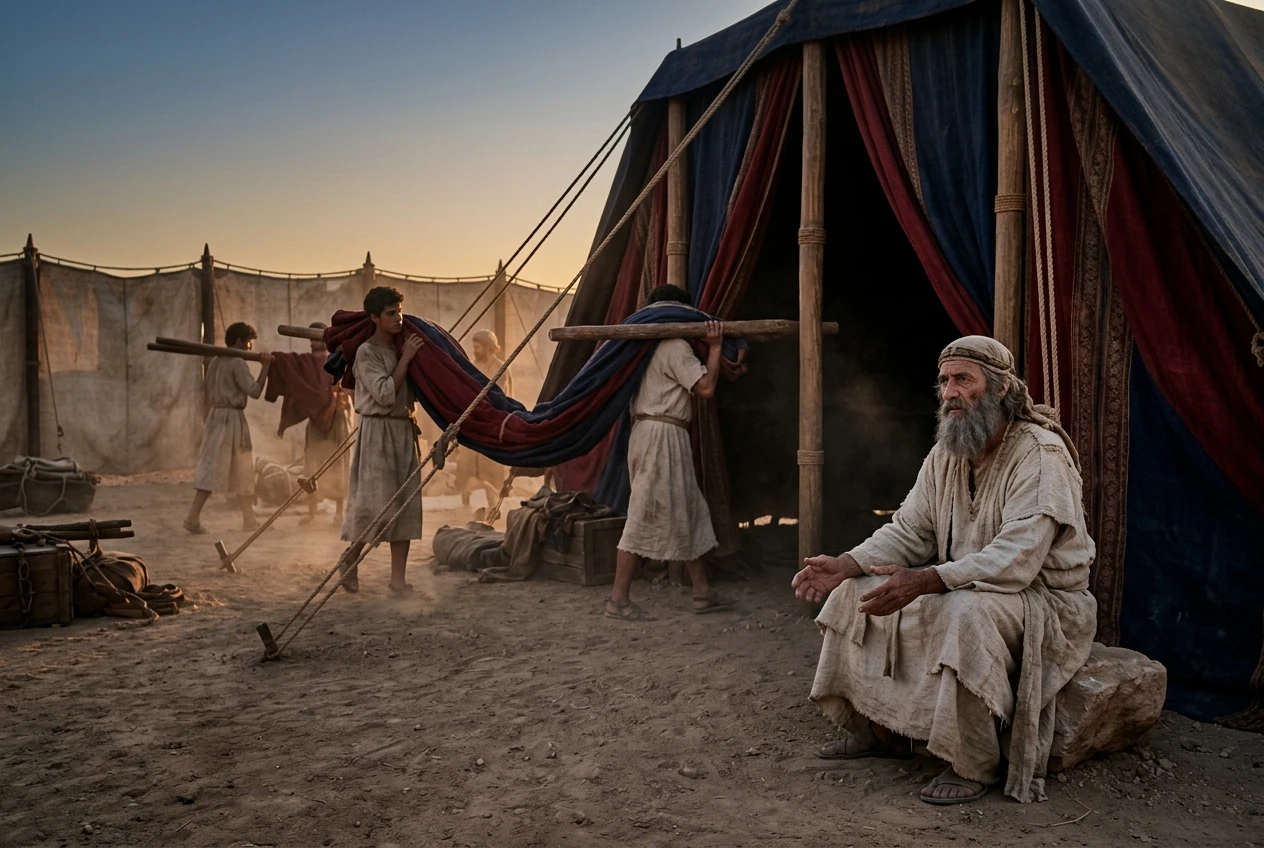
    Inside the courtyard of an ancient tent sanctuary at dusk, younger Levites in linen tunics hoist heavy bundled curtains and wooden poles onto their shoulders in the background, while in the foreground a grey-bearded older Levite sits on a low stone beside the tent entrance, hands resting open on his

    No Levite in this law was sent away, and none was told his years of labor were forgotten. The law released him from the heavy work and kept him in the charge. The release came by God’s command.

    Rest Belongs to God First: The Sabbath and the Rest That Remains for His People

    Rest did not begin as a human concession to weakness. “God ended his work which he had made; and God rested on the seventh day… and God blessed the seventh day, and sanctified it” (Genesis 2:2-3). The Lord rested first, blessed it, and then commanded it to His people (Exodus 20:8-11).

    For that reason a preacher who rests is not stepping outside obedience. He is walking in a pattern set by his Maker. The Lord Jesus said to the weary, “Come unto me, all ye that labour and are heavy laden, and I will give you rest” (Matthew 11:28). Rest here is something Christ gives, and it is received with thanks.

    The letter to the Hebrews carries the thought further: “There remaineth therefore a rest to the people of God. For he that is entered into his rest, he also hath ceased from his own works, as God did from his” (Hebrews 4:9-10). The final rest is the home of every faithful servant, and each season of rest on earth is a small foretaste of it. A man who accepts rest in his later years is learning something the Scripture says he will enjoy forever.

    Why a Preacher Mistakes Rest for Desertion, and What Scripture Answers

    A man who has preached for decades often measures his worth by his appointments. When the appointments grow fewer, he reasons that he has stopped serving, and that stopping is a kind of desertion. Scripture gives several answers to this reasoning.

    • The Levite’s release in Numbers 8 was commanded. Obeying a commanded release is obedience.
    • The Lord looks after the one who rests. “It is vain for you to rise up early, to sit up late, to eat the bread of sorrows: for so he giveth his beloved sleep” (Psalm 127:2).
    • God does not weigh a servant’s worth by his present output. “God is not unrighteous to forget your work and labour of love, which ye have shewed toward his name, in that ye have ministered to the saints, and do minister” (Hebrews 6:10).

    The apostle Paul wrote near the end of his course, “I have fought a good fight, I have finished my course, I have kept the faith: henceforth there is laid up for me a crown of righteousness” (2 Timothy 4:7-8). He speaks of a course that has an end, and of a crown given at the end. For a preacher who fears that an unpaid lifetime of labor will be lost, the longer study in A Whole Life of Unpaid Preaching Ends in a Crown, Not in Loss sets out the same promise at greater length.

    Fruit in Old Age: Psalm 92, Psalm 71 and Caleb Asking for His Mountain

    The psalmist says of the righteous: “They shall still bring forth fruit in old age; they shall be fat and flourishing; to shew that the LORD is upright” (Psalm 92:14-15). The fruit of old age has a stated purpose, which is to show that the Lord is upright. A faithful old man is a witness to God’s character, whether or not he stands in a pulpit.

    Psalm 71 is the prayer of one who knows his strength is failing: “Cast me not off in the time of old age; forsake me not when my strength faileth” (verse 9). He asks for more than survival: “Now also when I am old and greyheaded, O God, forsake me not; until I have shewed thy strength unto this generation, and thy power to every one that is to come” (verse 18). His aim in old age is to declare God’s strength to the next generation.

    A gnarled, ancient olive tree heavy with ripe dark fruit on a sunlit hillside in the Judean hills, its twisted trunk silvered with age, with a basket of harvested olives resting at its roots. Golden morning light, pale rocky ground, green and silver leaves against a clear sky.

    Caleb, at eighty-five, said to Joshua, “Now therefore give me this mountain, whereof the LORD spake in that day” (Joshua 14:10-12). His example does not teach that every old man must take up heavy work again. It shows that a man’s willingness to be used by God does not expire at a certain age. Some will have the strength of Caleb, and others will have the patience of the psalmist. Both are in the Scripture, and both are honored.

    The New Forms of Service: Prayer, Counsel, Visiting the Sick and Keeping Charge with Your Brethren

    The Levite kept charge with his brethren. The retired preacher can do likewise in forms his body and means allow.

    • Prayer. Paul asked the churches to pray for him, and the aged Anna “served God with fastings and prayers night and day” (Luke 2:37). A man with time can pray by name for the sick, the young preachers and the congregation.
    • Counsel. Paul wrote that the aged men are to be sober, grave, sound in faith, and that older persons are to teach what is good (Titus 2:2-5). A young man’s questions find a patient answer in a man who has already been through the hard years. For ways to pass on what he knows, see What an Older Volunteer Preacher Should Hand to the Young Before He Lays Down the Pulpit.
    • Visiting the sick. The Lord counts it as done to Him: “I was sick, and ye visited me” (Matthew 25:36). James directs the sick to call for the elders of the church (James 5:14).
    • Keeping charge with the brethren. Attending the assembly, speaking a word of exhortation when asked, and standing with the congregation are a continuing share in the work.

    For a preacher who also cares for sick relatives, the care itself counts as service. Hands that bring food to a household, help children with their schooling, or sit beside a sickbed are doing the Lord’s work.

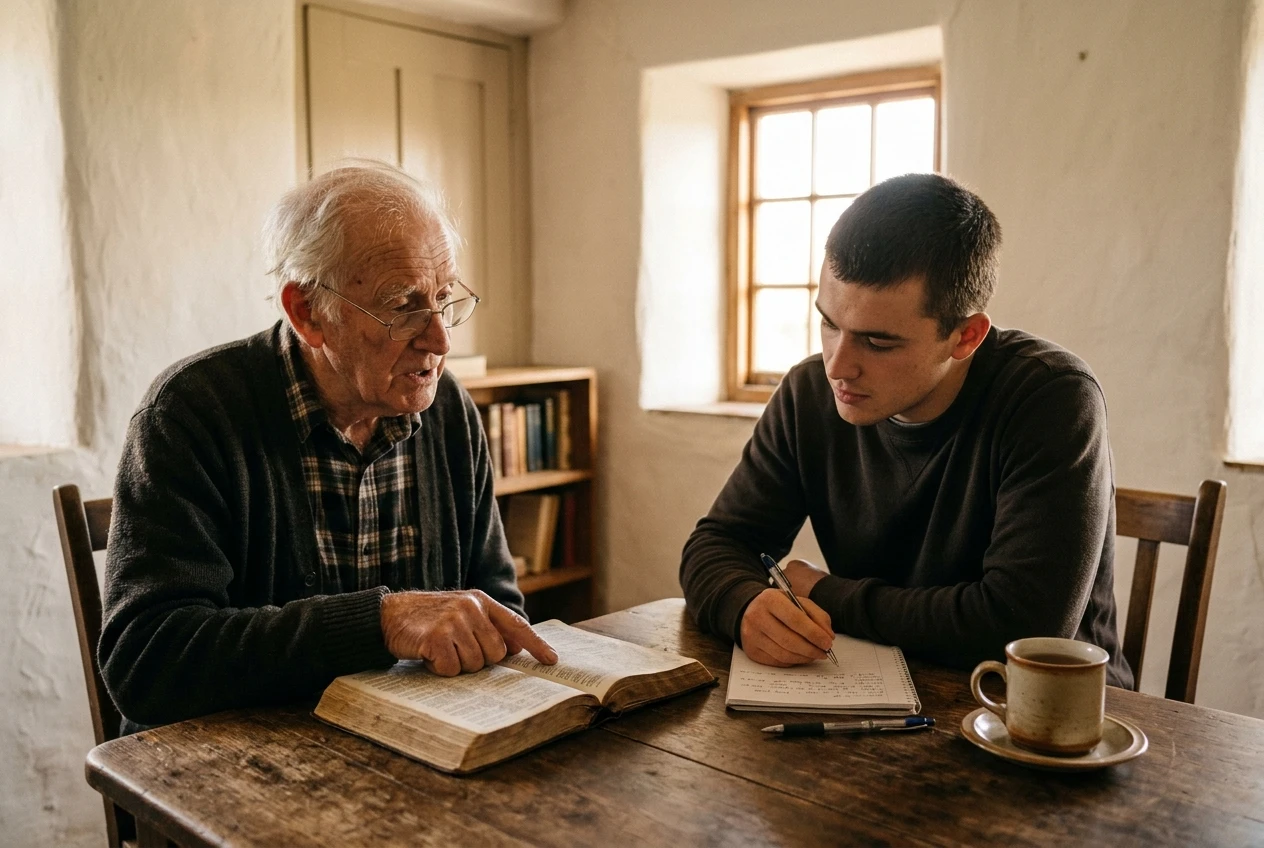
    An elderly man with white hair and a worn open Bible sits at a simple wooden table beside a young man, one finger resting on a page as he explains a passage while the younger man listens and takes notes. A cup of tea, a small window with soft afternoon light, plain whitewashed walls, warm browns and

    How to Receive Rest Without Anxiety About Daily Provision

    The practical fear is often about bread. The pension is fixed, and a man who has lived by faith in God’s daily supply may wonder how rest will be paid for. The Lord’s words answer this directly: “Take no thought for your life, what ye shall eat, or what ye shall drink… your heavenly Father knoweth that ye have need of all these things. But seek ye first the kingdom of God, and his righteousness; and all these things shall be added unto you” (Matthew 6:25-33).

    David testified from long experience: “I have been young, and now am old; yet have I not seen the righteous forsaken, nor his seed begging bread” (Psalm 37:25). Paul wrote, “My God shall supply all your need according to his riches in glory by Christ Jesus” (Philippians 4:19). These verses do not excuse carelessness. They promise that the Lord remains the provider when the income is small and unchanging.

    Practical wisdom goes alongside the promise. A pension is a gift to be managed with thanks, and Making a Fixed Pension Last the Month Without Dropping Your Ministry offers help with the monthly arithmetic. For the heart that still fears tomorrow, Why the Anxious Preacher Can Lay Down the Fear of Tomorrow’s Bread deals with the anxiety itself.

    A Retired Preacher’s Week: Resting, Serving and Trusting in the Lord’s Reward

    The week below is a suggestion for a retired preacher to adapt to his own strength and household. It is a pattern drawn from the Scriptures above, and the details belong to each man.

    An older man sits in a wicker chair on a modest porch in early evening, a closed Bible and a pair of reading glasses on his lap, a pot of tea on a small table beside him, while a child plays with a ball in the yard beyond. Soft golden light, potted green plants along the railing, a peaceful unhurrie
    • A day of true rest. Keep one day on which no appointment is required of him. He receives it from God as the Sabbath gift.
    • A fixed time of prayer each day. He names the sick, the young preachers, his relatives and the congregation before the Lord.
    • One visit or one letter. A sick member, a discouraged brother or a lonely widow can receive his time.
    • One conversation with a younger man. A question answered or a passage opened is the counsel Titus 2 describes.
    • Presence with the brethren. He attends the assembly and keeps charge with them as his strength allows.
    • Care for his own household. Where relatives are sick or the children need help with food and schooling, he gives what he is able and entrusts the remainder to God.

    Each of these is small, and the Lord does not despise small things. “Therefore, my beloved brethren, be ye stedfast, unmoveable, always abounding in the work of the Lord, forasmuch as ye know that your labour is not in vain in the Lord” (1 Corinthians 15:58). The Levite left the heavy carrying at fifty and kept his place among his brethren. The preacher who rests in the same way remains in the Lord’s service and is held in the same promise, that the God who rewards faithful work will bring His servant at last to the rest that remains and to the presence of the Lord Jesus Christ.

  • What an Older Volunteer Preacher Should Hand to the Young Before He Lays Down the Pulpit

    What an Older Volunteer Preacher Should Hand to the Young Before He Lays Down the Pulpit

    Scripture gives no manual on how to mentor a young preacher, but it records three pairs who show the pattern: Elijah and Elisha, Paul and Timothy, Priscilla and Aquila with Apollos. A man who has preached without pay for decades knows how bread, travel and strength have actually come to him over the years. That knowledge is lost when he lays down the pulpit unless he hands it over deliberately. This article asks what the elder should pass on, and how.

    Elijah Did Not Choose Elisha for His Gifts: What Scripture Shows About Calling a Successor

    The Lord told Elijah whom to anoint. “Elisha the son of Shaphat of Abelmeholah shalt thou anoint to be prophet in thy room” (1 Kings 19:16). Elijah did not hold an examination or look for the most talented young man in Israel. He found Elisha plowing with twelve yoke of oxen, and he cast his mantle upon him (1 Kings 19:19).

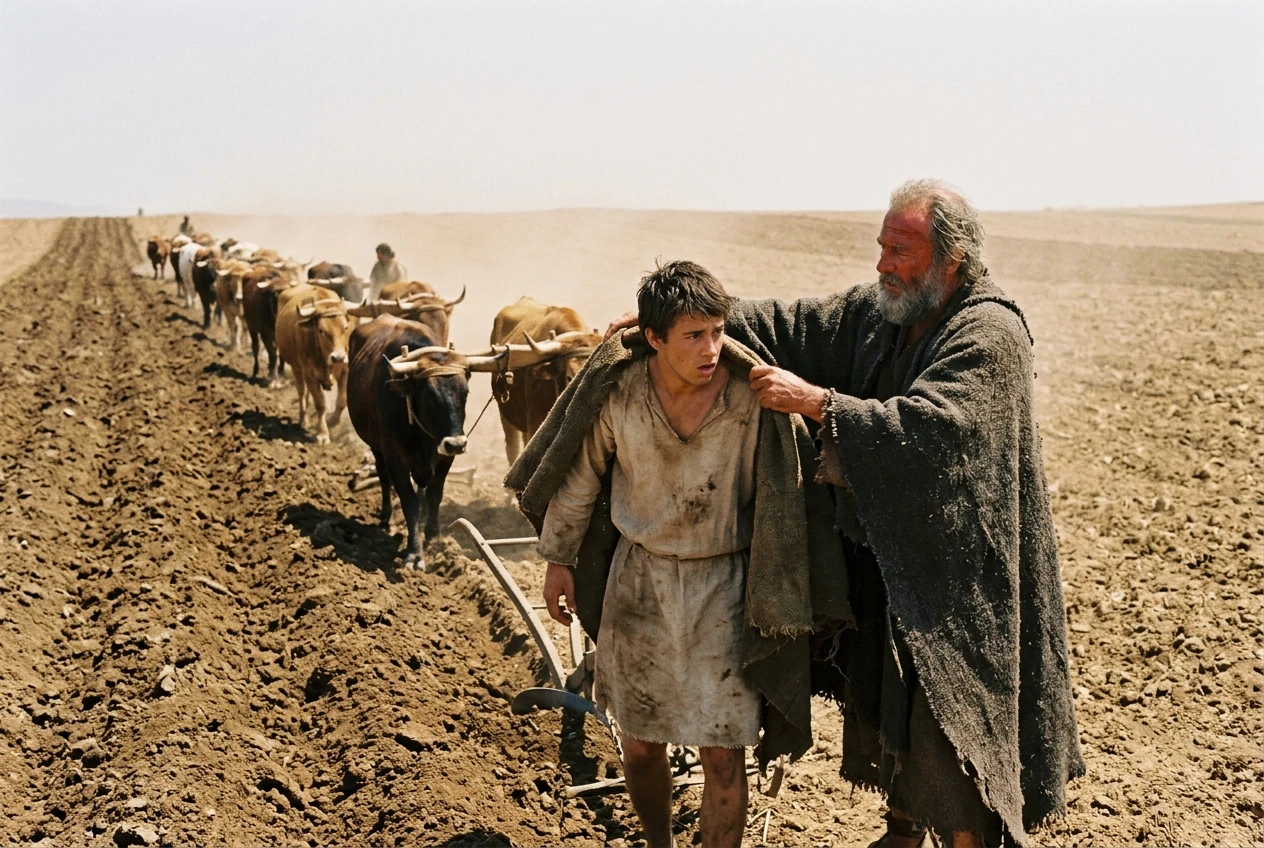
    A weathered prophet in a rough cloak stands in a plowed field at midday and throws his mantle over the shoulders of a young farmer. Twelve yoke of oxen stand in the furrows behind them under a pale dusty sky, with warm ochre earth and muted browns.

    Elisha’s answer cost him his livelihood. He killed the oxen, boiled their flesh using the plowing equipment as fuel, gave it to the people, and followed Elijah (1 Kings 19:21). Whatever else he was, he was a man willing to leave his old means of living behind. That willingness mattered more to the work ahead than any skill in speaking.

    His first office was service. Later he is described as the one “which poured water on the hands of Elijah” (2 Kings 3:11). An older preacher who is looking for a younger man should therefore watch for willingness to serve and to trust God, and should not be impressed by fluency alone. The Lord names the successor, and the elder’s part is to receive him and teach him.

    Paul Told Timothy to Entrust the Word to Faithful Men: What Is Actually Worth Handing Down

    “The things that thou hast heard of me among many witnesses, the same commit thou to faithful men, who shall be able to teach others also” (2 Timothy 2:2). The verse covers four generations: Paul, Timothy, the faithful men, and those they will teach. The elder is one link in a chain that Scripture expects to continue.

    Paul reminded Timothy of more than doctrine. “Thou hast fully known my doctrine, manner of life, purpose, faith, longsuffering, charity, patience, persecutions, afflictions” (2 Timothy 3:10-11). Doctrine stands first in that list, and the manner of life stands beside it. A young preacher can learn the sermon outline from a book. He can learn the following from a living example only:

    • how to pray for daily needs and wait for the answer without anxiety;
    • how to receive a small gift with thanks and a large refusal with patience;
    • how to keep preaching when the congregation is small or absent;
    • how to keep a household in order while giving time to the work.

    Paul said of himself, “I have learned, in whatsoever state I am, therewith to be content” (Philippians 4:11). Contentment was learned, and it can be taught to the next man by someone who has already learned it.

    Teach the Young Preacher Where His Bread Comes From, Before the First Lean Month Arrives

    A young preacher who has never gone short will be tempted to quit or to complain when the first shortage comes. The elder should speak of it beforehand, plainly and from Scripture. Our Lord asked the disciples, “When I sent you without purse, and scrip, and shoes, lacked ye any thing? And they said, Nothing” (Luke 22:35). He also taught them to pray, “Give us this day our daily bread” (Matthew 6:11). The promise is for daily bread, and the young man should expect to receive it daily and not in a stockpile.

    The precise limits of what God has promised are set out in what He actually promised the preacher, and a younger man should read that carefully so that he neither claims too much nor fears too much.

    Beyond the promise, the elder can supply his own record. Tell the young man the actual occasions in your years of service when a need was met, and in what manner. Include the ways that were unexpected, since God fed Elijah by ravens at the brook and later by a widow’s barrel of meal (1 Kings 17:6, 13-16). A young preacher who has heard such accounts from a trusted man will find it easier to wait when his own turn comes.

    Let Him Travel With You: Lessons That Only the Road, the Waiting and the Small Offerings Can Teach

    Timothy was taken along. Paul found him at Lystra, well reported of by the brethren, and “would have him go forth with him” (Acts 16:1-3). Later Paul wrote to the Philippians that Timothy “as a son with the father, he hath served with me in the gospel” (Philippians 2:22). Years of company taught Timothy what instruction at a distance could not.

    The road shows a young preacher things an elder can only point at: how long a journey takes when there is no vehicle of one’s own, how to wait at a roadside, how to accept a night’s lodging graciously, and what to do when a promised appointment is cancelled. He will see how his elder thanks a host who gives only a little, and how he speaks to a listener who turns away.

    An elderly man in a worn jacket and a young man carrying a canvas bag sit side by side on a stone wall beside a dusty country road, waiting in the late afternoon light. A thermos and a closed Bible rest between them, and golden light falls across dry grass and distant hills.

    Let him carry the bag, and show him how it is packed. The article on keeping a traveling kit ready on a small budget can serve as a starting list for the two of you. Questions will come on the road that would never occur to him in a classroom, and the elder should answer them as they arise.

    Correct Him as Priscilla and Aquila Corrected Apollos: Privately, Gently and With the Scripture Open

    Apollos was “an eloquent man, and mighty in the scriptures,” yet he knew only the baptism of John. Priscilla and Aquila heard him speak boldly in the synagogue. The text then says that “they took him unto them, and expounded unto him the way of God more perfectly” (Acts 18:24-26). They did not interrupt him before the congregation. They brought him into their own company and opened the Word to him.

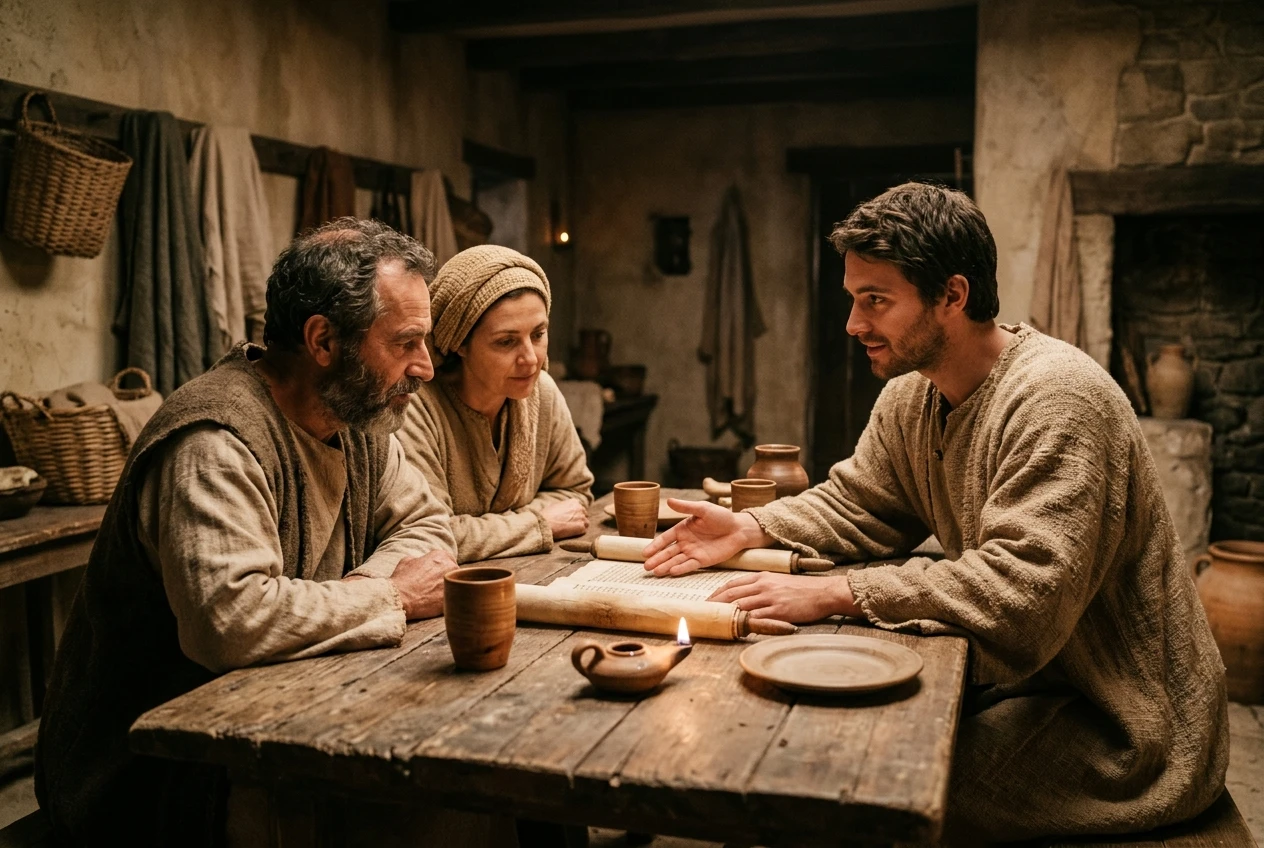
    A couple at a simple wooden table in a lamplit first-century home lean toward a younger man in a robe, an open scroll spread between them. The room is warm, with clay cups, a small oil lamp and amber light, and the mood is quiet and kind.

    The result is recorded. The brethren wrote to receive him, and when he arrived in Achaia he “helped them much which had believed through grace” (Acts 18:27). A correction made kindly produced a stronger preacher.

    An elder who wants to follow this pattern can do these things:

    1. Wait until the meeting is over and speak to the young man alone.
    2. Begin with what was true and well said in his preaching.
    3. Open the Bible and show the passage, so that the correction rests on Scripture and not on your preference.
    4. Treat errors of doctrine and faults of conduct as separate matters, and take each at its own time.

    A young preacher who is corrected this way will return to be corrected again.

    Write Down What You Have Learned in Plain Words: A Simple Way to Record a Lifetime of Service

    The Lord told Habakkuk, “Write the vision, and make it plain upon tables, that he may run that readeth it” (Habakkuk 2:2). Paul, near the end of his life, asked Timothy to bring “the books, but especially the parchments” (2 Timothy 4:13). Written words outlast a man’s memory and his strength, and they reach people he will never meet.

    The method can be simple. Take an ordinary notebook and give each entry a few lines:

    An elderly man's hands rest on an open lined notebook, partly filled with handwriting, beside a worn Bible and a pair of reading glasses on a kitchen table. A young grandchild's hand holds a pencil next to him, and soft window light falls across the scene.
    • the need that arose;
    • what happened, as exactly as you remember it;
    • the verse of Scripture that held you during that time;
    • what you would tell a younger man about it.

    Writing may be hard for some. A grandchild or a younger believer can sit with you and write what you say, and the account will still be yours. Aim for fifteen or twenty entries, then give the pages to the young preacher you are teaching. A short, honest record of real experiences will serve him better than a long document of general advice.

    Prepare Him for the Years When No Fruit Is Seen

    A young preacher will want results, and some years there will be none he can see. The elder should say so before it happens. Elijah himself said, “I, even I only, am left,” and the Lord answered that seven thousand in Israel had not bowed to Baal (1 Kings 19:10, 18). The work had borne fruit that the prophet could not see.

    Paul gave the principle in plain terms: “I have planted, Apollos watered; but God gave the increase… every man shall receive his own reward according to his own labour” (1 Corinthians 3:6-8). The reward follows the labor and does not depend on the count of converts. The longer treatment of this in keeping on sowing when you never see the fruit is worth placing in the young man’s hands.

    Tell him also that his own elder went through such years. Then he will read the barren season as a normal part of the work, and he will have a text for it: “Your labour is not in vain in the Lord” (1 Corinthians 15:58).

    Release Him Without Bitterness: Why Passing the Mantle Is Not the End of Your Own Reward

    Elijah did not hold Elisha back at the end. Elisha asked for a double portion of his spirit, and Elijah answered, “Thou hast asked a hard thing: nevertheless, if thou see me when I am taken from thee, it shall be so unto thee” (2 Kings 2:9-10). Elisha saw him go, took up the fallen mantle, and asked, “Where is the LORD God of Elijah?” (2 Kings 2:14). The work continued, and Elijah’s reward was not reduced by it.

    Paul spoke of his departure without regret: “I am now ready to be offered… Henceforth there is laid up for me a crown of righteousness… and not to me only, but unto all them also that love his appearing” (2 Timothy 4:6-8). The crown is not divided among the faithful in a way that leaves any of them with less. The elder and the younger man each receive according to his own labor, and “he that planteth and he that watereth are one” (1 Corinthians 3:8).

    An elder who feels the loss of his pulpit can take comfort from the crown that awaits a whole life of unpaid preaching. Let the young man preach in your place, praise him where he does well, and pray for him by name. What you gave is not lost, and the Lord has not forgotten it.

    Choose one younger believer this week, pray for him by name, and invite him to travel with you to your next preaching appointment, so that what God has taught you begins to be passed on.

  • Why the Anxious Preacher Can Lay Down the Fear of Tomorrow’s Bread

    Why the Anxious Preacher Can Lay Down the Fear of Tomorrow’s Bread

    Many volunteer preachers carry a worry they rarely say aloud. The pension is small, the gifts are uncertain, and the journey to the next appointment costs money that may not be in the house. By day the worry is a quiet calculation. At night it returns as a question: what will there be to eat next week, and how will I get there?

    If you are asking how to stop worrying about finances in ministry, begin with the fact that Scripture does not pretend the worry is absent. It names the fear and then teaches the heart, one day at a time, where to put it.

    Fear of Provision Is Common, and Scripture Does Not Hide It

    The Israelites in the wilderness asked who would feed them, and Moses did not answer with a rebuke of their appetite. God answered by sending bread (Exodus 16). David, an old man by the end of his life, wrote of having never seen the righteous forsaken or his children begging bread (Psalm 37:25), and he wrote that after many years of hunger and flight. Elijah ran from Jezebel and asked to die under a broom tree, and God’s first response was food and sleep (1 Kings 19:4-8).

    Christ himself spoke to anxiety about food and clothing, which tells us the concern was common among his hearers and is not a mark of weak faith in the one who feels it. A preacher who lies awake is not disqualified from preaching. He is a man with a body that needs bread, serving a God who knows that it does (Matthew 6:32).

    The Difference Between Prudent Planning and Fearful Striving

    Scripture commends planning. “The plans of the diligent lead surely to abundance” (Proverbs 21:5). Christ asks who among us builds a tower without first counting the cost (Luke 14:28). Paul tells Timothy that a man who does not provide for his own household has denied the faith (1 Timothy 5:8). A preacher who writes out his monthly pension, sets aside the fare for his next journey, and decides in advance which appointments he can afford to reach is acting wisely, and God is not displeased with it.

    Fearful striving differs in how it behaves. Planning ends: the figures are written, the decision is made, and the preacher moves on to other work. Fear repeats the same calculation at midnight, at dawn and again during the sermon, and it never reaches a settled answer because it is not seeking one. A useful test is to ask whether the thought leads to an action you can take today. If it does, take that action. If it only produces a worse picture of next month, it is worry, and Christ says worry adds nothing to a life (Matthew 6:27).

    A preacher who wants practical help with the planning side may read making a fixed pension last the month without dropping your ministry.

    Manna and Ravens: God Feeds the Obedient One Day at a Time

    Two accounts in Scripture show how God provides for those who obey him, and both involve a limit that tests the heart.

    In the wilderness, each household was told to gather a day’s portion every day (Exodus 16:4). Those who tried to keep manna until morning found it full of worms and spoiled (Exodus 16:20). On the sixth day, however, they were told to gather twice as much, because the seventh was a Sabbath, and that portion did not spoil (Exodus 16:22-24). Here prudence and trust work together: they stored what God told them to store and no more, and they depended on him for the rest.

    Elijah’s account is similar. God told him to hide by the brook Cherith, and the ravens brought him bread and meat morning and evening (1 Kings 17:2-6). He was not given a month’s supply at once. After a time the brook dried up, and God sent him to a widow at Zarephath, whose own flour and oil were nearly gone (1 Kings 17:7-16). God’s way of providing changed, and his faithfulness did not. A preacher who finds that last year’s source of help has dried up may be at the place where God is about to direct him to another.

    A dry stony brook bed in the Judean wilderness at dawn, with two black ravens perched on a flat rock, each holding a piece of flatbread in its beak, and pale gold light on the dry cliffs behind and a thin trickle of water at the bottom of the channel.

    Both accounts teach the same lesson. God fed obedient people for the day in front of them, and he did not show them next month’s table first.

    What Christ Meant When He Said Do Not Be Anxious About Your Life

    In Matthew 6:25-34 Christ gives a sequence of reasons, and it helps to read them slowly.

    • Life is more than food, and the body more than clothing (verse 25).
    • The birds do not sow or reap, yet the heavenly Father feeds them, and we are worth more than they (verse 26).
    • Worry cannot add a single hour to life (verse 27).
    • The Father knows that we need these things (verse 32).
    • We are to seek first the kingdom of God and his righteousness, and these things will be added to us (verse 33).
    • Therefore we are not to worry about tomorrow, for each day has its own trouble (verse 34).

    Christ does not say that food is unimportant, and he does not say that the preacher will never be hungry. He says that the Father knows, and he directs our attention to the work of the kingdom and to today. The command not to worry about tomorrow is a command about where to place the mind, and Christ gives it together with the reason that makes it possible to obey.

    Paul gives the same direction to the Philippians: “do not be anxious about anything, but in everything by prayer and supplication with thanksgiving let your requests be made known to God” (Philippians 4:6). The promised result is “the peace of God, which surpasses all understanding,” which will guard the heart and mind in Christ Jesus (verse 7). Notice that the request is still made. The preacher is not told to stop needing bread, but to bring the need to God with thanks.

    A Plain Daily Practice for the Hour the Worry Comes

    The worry usually returns at a predictable hour, often at night or when the bills or the calendar are in front of you. A fixed practice helps because a tired mind cannot be trusted to improvise. Here is one that follows the Scripture above.

    A modest kitchen table at night lit by a single warm oil lamp, with an open worn Bible, a small handwritten list, a pair of reading glasses and a cup of tea, and a dark window behind showing the first hint of blue before dawn.
    1. Name the need in one sentence. For example: “I do not know how I will pay the fare to the district meeting on the 28th.” Fear grows when it stays vague.
    2. Ask whether one action is possible today. If a preacher can check the fare, speak to a brother, or set aside a coin, let him do it and write down that he did. If nothing can be done today, say so plainly.
    3. Pray with the words of Philippians 4:6. Make the request, and add thanks for something specific that you have received today, even if it is only a meal.
    4. Read Matthew 6:34 aloud. Then set the matter down until tomorrow, and leave the Lord with it.
    5. If the thought returns, repeat the prayer rather than the calculation. The thought will return. Answering it with the same short prayer each time is the practice.

    This will not remove the worry in one night. It teaches the mind a different habit over weeks, which is how most habits change.

    For words to use when the bread is already running short, see how a preacher can pray when the bread is running short.

    Remembering Past Provision: Keep a Written Record of Bread Received

    Fear speaks as though God had never provided before. Scripture answers this by commanding memory. “Bless the Lord, O my soul, and forget not all his benefits” (Psalm 103:2). Israel was told to keep the pot of manna before the Lord for their generations, so that they might see the bread God had fed them in the wilderness (Exodus 16:32).

    An old man's hands resting on an open lined notebook filled with handwritten entries, beside a small cloth bag of rice, a few coins and a folded bus ticket on a wooden table in soft morning window light.

    A preacher can do the same on a small scale with a notebook. Each time a need is met, he writes the date, the need and how it was met: a neighbor’s bag of rice, a ride offered to a distant town, a gift given at the door after a service. Write it plainly and do not exaggerate.

    The record has two uses. On an anxious night, reading three pages of past provision answers the thought that God has forgotten. It also shows patterns, such as which needs were met through friends, and which through unexpected channels, so that gratitude has specific names to give.

    Let a Trusted Brother Carry Part of the Burden With You

    Paul tells the Galatians to “bear one another’s burdens, and so fulfill the law of Christ” (Galatians 6:2). A preacher who tells no one about his anxiety carries all of it alone, and secrecy usually makes worry heavier. He may speak to an elder, a fellow preacher or a mature friend, someone who will pray with him, keep the matter private, and perhaps notice a need he can quietly meet.

    Two older men sitting side by side on a simple wooden bench outside a small meeting hall in late afternoon sun, one with a hand resting on the other's shoulder, both with heads bowed in prayer, Bibles on their knees.

    Telling a brother is not begging. It is an honest account to someone who loves him. If he is unsure how to speak about need, what a volunteer preacher can honestly say to his congregation when he is in need offers plain words he can use.

    Relatives who care for an older preacher have a part here as well. They can ask him gently what he fears for the coming week and then help with the one concrete matter, such as a fare or a bag of food. They can sit with him while he reads the notebook, and pray with him when the worry comes.

    Tonight, write down one need you have feared and one way God has already met a need like it in your life, then read the two together in prayer. If you wish to go further, read God Has Promised to Provide for the Preacher. Here Is What He Actually Promised.

  • A Whole Life of Unpaid Preaching Ends in a Crown, Not in Loss

    A Whole Life of Unpaid Preaching Ends in a Crown, Not in Loss

    A preacher who has served for many years without wages will, sooner or later, ask in quiet: will God reward me for serving Him without pay? The question usually comes late in the day, when the house is still. He looks at the shoes by the door, the pension that does not stretch, and the invitations that come less often than they once did. He is not doubting Christ. He is asking whether the long labor has been counted.

    A pair of well-worn brown leather shoes, resoled and creased, sitting by a plain wooden front door in the dim blue light of late evening, with a small lamp glowing in the room behind and an old Bible on a side table.

    Scripture answers this question plainly, and it answers it from the end of the road looking back. This article sets the whole life of the unpaid preacher beside what the Word says the Lord will declare when the course is finished.

    The Question Every Unpaid Preacher Eventually Asks in Quiet

    The question has two parts. The first concerns the past: was it worth it? The second concerns the verdict: does God see it? Younger preachers can postpone both, because there is still work ahead and the work itself is a distraction. The aged preacher cannot postpone them. He has the time to count the years, and the count is often painful.

    It helps to see that this question is not new. Paul wrote to the Corinthians that if in this life only we have hope in Christ, we are of all people most to be pitied (1 Corinthians 15:19). He did not say that to shame his hope. He said it to show where the hope is located: beyond the grave, in the resurrection, where the Lord will settle every account.

    A preacher who asks this question is therefore standing where the apostles stood. The answer he needs is not a comforting mood. It is the testimony of God’s word about what the Lord will say at the finish.

    Why a Bare Table Is Not a Sign That God Has Failed

    Many believers carry an unspoken rule: if God were pleased with a servant, the servant would be well supplied. Scripture does not teach this rule. The Lord Jesus said the Son of Man had nowhere to lay His head (Matthew 8:20). Hebrews 11:37-38 describes faithful people who went about in skins, destitute, afflicted and mistreated, and then adds that the world was not worthy of them.

    Scarcity on earth is therefore no evidence of divine neglect. The empty pocket, the worn shoes and the seasons of need appear in the lives of people God commended. If poverty proved God’s displeasure, the Lord Himself and the prophets would stand condemned.

    None of this means God ignores bodily need. He teaches us to ask for daily bread, and the Hub of this website’s work is that He supplies it, often through the hands of others. For what Scripture actually promises about provision, see what God actually promised the preacher. The point here is narrower: a thin season is not a verdict on the servant. The verdict has not yet been given.

    Paul at the End of the Race: What He Expected and What He Did Not

    Paul’s last letter is the clearest picture of a preacher looking back from the far end. He writes from prison, aware that his death is near: “I am already being poured out as a drink offering, and the time of my departure has come.” Then he says: “I have fought the good fight, I have finished the race, I have kept the faith. Henceforth there is laid up for me the crown of righteousness, which the Lord, the righteous judge, will award to me on that day” (2 Timothy 4:6-8).

    The inside of a bare stone prison cell in warm, low lamplight, with an old man's worn cloak folded on a wooden bench beside a scroll and a clay lamp, a thin shaft of golden light falling from a high window.

    Notice what Paul expected. He expected a crown from the Lord, given on that day, and he expected it to be shared with all who have loved the Lord’s appearing. He did not expect comfort in his last months, for in the same chapter he asks Timothy to bring the cloak he left behind, and he reports that at his first defense no one stood with him (2 Timothy 4:13, 16).

    He also did not claim to have won the world. He said he had kept the faith, which is a statement about faithfulness. His crown rests on the Lord’s righteous judgment, and Paul himself remained a servant who owed everything to grace. The same chapter says the Lord stood by him and strengthened him, and that the Lord would bring him safely into His heavenly kingdom (2 Timothy 4:17-18).

    The Faithful Servant Is Rewarded for Faithfulness, Not for Results

    In the parable of the talents, the master says to the servant who used what he was given: “Well done, good and faithful servant. You have been faithful over a little; I will set you over much. Enter into the joy of your master” (Matthew 25:21).

    The master praises faithfulness. He does not praise the size of the harvest, the size of the congregation or the size of the servant’s wealth. The servant with two talents receives the same words as the servant with five, because each was faithful with what he had been given.

    This matters to the volunteer preacher, who often cannot point to large results. He may have taught small groups in village homes, visited the sick, and spoken at meetings few people remembered. The Lord’s measure is whether he was faithful with what he was entrusted. A preacher who has kept teaching Christ on a small pension, with little to show, has been faithful over a little. That is exactly the servant the parable describes. For a longer treatment of preaching without seeing fruit, read keep sowing even when you never see the fruit.

    Those Who Died Without Receiving the Promise, and Why God Called Them Approved

    Hebrews 11 closes with a sober statement. “And all these, though commended through their faith, did not receive what was promised, since God had provided something better for us, that apart from us they should not be made perfect” (Hebrews 11:39-40).

    These people died without seeing the fulfillment. Abraham did not possess the land. Many who suffered did not see deliverance. Yet the writer says they were commended, which means God approved them while they were still in their poverty and uncertainty. Their approval did not wait for outcomes.

    An aged preacher may fear that he will finish without seeing the changes he prayed for: a family brought to faith, a congregation strengthened, a need relieved. Hebrews tells him that unfinished work is no sign of an unapproved life. The promise is larger than any single lifetime, and God holds the whole of it. He tells the preacher to finish his part, not to see the completion.

    What the Lord Will Not Forget: Cups of Water, Long Roads and Unseen Years

    Hebrews 6:10 gives one of the firmest assurances in the New Testament: “For God is not unjust so as to overlook your work and the love that you showed for his name in serving the saints, as you still do.” God’s justice is the ground of the promise. To forget the work would be unjust, and God is not unjust.

    The Lord Jesus said that whoever gives even a cup of cold water to one of His disciples, because he is a disciple, will by no means lose his reward (Matthew 10:42). If a cup of water is remembered, then the long roads walked to reach a meeting are remembered. So are the evenings spent preparing, the visits to the sick, and the years that no one saw.

    A long dusty country road at dawn winding between dry hills toward a small village, with a single clay cup of water resting on a roadside stone in the foreground, soft amber light and long shadows.

    Several things in an unpaid preacher’s life belong to this record:

    • Every journey made on foot or by shared transport to teach a few people.
    • Every meal given up, or shared, so that the work could go on.
    • Every prayer for people who never thanked him.
    • Every year of showing up when no one noticed.

    God does not require a witness for any of these. Scripture says He sees what is done in secret and will reward it (Matthew 6:4). A fuller study of this reward is in what the Bible means by eternal reward when no one pays the preacher. Here the lesson is that the whole life, taken together, is in the Lord’s hand.

    How to Hold This Hope on an Ordinary Tuesday When the Bread Is Short

    A promise about the last day has to be carried through ordinary days. The bread runs short on Tuesday, not on the day of judgment. Several practices help the preacher hold the hope in such moments.

    First, speak the promise aloud. Read 2 Timothy 4:7-8 and Hebrews 6:10 in the morning, slowly, as the Lord’s own word to you and not as a general statement about other people.

    Second, pray for the day’s bread as the Lord taught, and give thanks for whatever arrives. Scripture does not set aside need, and it does not ask the preacher to hide it from God. How a preacher can pray when the bread is running short offers help with the words.

    Third, tell the truth about need to those who can help. Making known a real need to the congregation is an honest act, and the Lord often supplies through His people.

    Fourth, remember that Paul said he had learned to be content in every condition, whether in plenty or in hunger (Philippians 4:11-12). Contentment of that kind is learned over time, and he gave God the credit: he could do all things through Christ who strengthened him.

    A Word to the Household That Walked the Road Beside Him

    A preacher’s hardship is rarely his alone. A wife, a husband, children and grandchildren have also gone without. They shared the small table, the repaired clothes and the long absences, and they did not always choose the pulpit.

    An elderly couple sitting side by side at a small kitchen table, her hands resting over his, a mended sweater on his shoulders and a worn Bible open between them, warm morning light through a plain window.

    Scripture does not leave them out of the account. The God who will not overlook your work will not overlook the sacrifices of the household that carried it with you. Hebrews 6:10 speaks of love shown for His name in serving the saints, and a family that has borne hardship so that the gospel could be preached has shown that love in a costly form.

    To the relatives of a weary preacher: your patience is part of his service, and the Lord knows it. Ask him to speak to you of what he hopes for at the end, and let him hear you say that his labor mattered to you. Read also when the whole household pays for the pulpit, tell them so and share the reward, which speaks directly to the family.

    To the preacher: the crown Paul describes is laid up by the Lord, who is a righteous judge. Your years of unpaid preaching are not erased by thin seasons. They are being kept for that day.

    Choose one preacher you know who is weary and read 2 Timothy 4:6-8 aloud to him this week, then share this article with him and pray together that he may finish his course in confidence.

  • How a Congregation Can Receive, Sort and Quietly Give Out School Uniforms to the Children of Its Preachers

    How a Congregation Can Receive, Sort and Quietly Give Out School Uniforms to the Children of Its Preachers

    The first gifts have arrived: a bag of shirts, a few exercise books, perhaps an envelope of money. This is where many drives start to go wrong. Gifts are set down in the wrong house, nobody knows what came in, the sizes do not fit, and the family feels watched. A small congregation can prevent all of this with a few clear arrangements made early.

    This article is for the elders, deacons and willing members who want to know how to organize a school uniform drive at church once giving has begun. If you are still deciding how to gather gifts from your community, read the earlier guide on gathering uniforms and school supplies first, then return here.

    Why the Preacher Should Not Be the One Who Runs the Drive

    In Acts 6 the apostles were asked to settle a dispute over the daily distribution to widows. They told the church to choose seven men of good reputation to oversee the work, so that they themselves could give their time to prayer and the ministry of the word. The church agreed, and the work was done well.

    A volunteer preacher is in the same position. His hours belong to preparation, travel, visiting the sick and prayer. If he must also count shirts, measure children and write thank-you letters, either the drive or the preaching will suffer.

    There is a second reason. When the gifts are for his own household, he is both the one served and the one who would handle the goods. Paul wrote of the collection for the saints that he wished to avoid any blame in the way the gift was administered, “providing for honorable things, not only in the sight of the Lord, but also in the sight of men” (2 Corinthians 8:20-21). When others handle and record the gifts, no one can doubt where they went.

    The preacher still has a part. He receives what is given with thanks, answers honest questions about his children’s needs, and prays for the givers. He does not carry the work.

    Choose Two or Three Faithful People and Give Each a Plain Duty

    Ask the elders to name two or three members who are trustworthy, discreet and able to keep a promise to be present. A drive this size does not need a committee. Each person should have one duty that can be written in a sentence:

    • The keeper receives every gift, stores it, and knows what is on the shelf.
    • The recorder writes down each gift as it arrives and as it leaves, and keeps the notebook.
    • The giver speaks with the family, fits the items to the children and hands them over.

    If three people are not available, two can share these duties, but the person who records should not be the same person who keeps the money. At least one of the three should not be a relative of the preacher. One elder should oversee them and hear their report, and all of them should keep private what they learn about the family.

    Write the duties on a single page and give a copy to each person. When a task is unclear, people assume someone else is doing it.

    Make a List of Children, Sizes and Needs Before Asking Anyone for Anything

    People give more wisely when they know what is needed. An appeal for “uniforms” brings a mixed pile. An appeal that names the shirts, skirts or trousers, shoe sizes and exercise books still missing brings what the children can use.

    The giver should sit with the parents, or with the preacher and his wife, and make the list. For each child record:

    • name, age and school year;
    • the uniform the school requires, including colors and any badge or sports clothes;
    • current clothing size and shoe size, with the date they were taken;
    • items already in hand and items still missing;
    • books, bags, pens and other supplies the school expects.

    Ask the school office what is required before you write the list. Children grow, so measure again before term begins and write the new date beside the new size. Keep the list in the recorder’s notebook and show it only to the three people who need it. Public appeals should give the kinds of items and sizes wanted, never the names of the children.

    Where Gifts Are Received, Counted and Kept Dry and Safe

    Choose one place. It may be a cupboard in the meeting house or a room in the home of the keeper. It should be locked or otherwise secure, clear of damp, and off the floor. Cloth left in a damp store grows mold, and mold cannot be washed out of a new white shirt.

    Keep each category in its own labeled box or bag: shirts, trousers and skirts, shoes, stationery. Put sizes on the label. When someone brings a gift, the keeper and the recorder should be present together, or at least the recorder should write it down the same day. They should check each item and set aside anything torn, stained or too worn to send. Used clothing that is sound should be washed and mended before it goes to a child. A member who sews can also take up hems and replace buttons.

    Inside a plain storeroom, a wooden shelf raised off the concrete floor holds labeled cardboard boxes marked for shirts, trousers, shoes and stationery. Folded white shirts and grey trousers sit stacked in the open boxes, with soft daylight from a small window and a closed padlock on the door.

    Money needs more care than cloth. Two people should count it together, write the amount in the notebook, and sign the entry. Then it should go into a sealed envelope or an account held in the congregation’s name. It should not stay loose in someone’s pocket or in the preacher’s house.

    Match Each Gift to a Child and Hand It Over Without Public Attention

    Once the items are sorted, the giver should lay out one pack for each child, working from the list. Complete the essentials first: one full uniform and one pair of shoes per child before any second set or extra supplies. If a garment is a little large, a hem can be taken up. If it is too small, return it to the store for another child, or set it aside for a different family.

    On a simple table covered with a clean cloth, three separate packs are laid out side by side, each with a folded school uniform, a pair of polished black shoes, a few exercise books and a pencil case, in different sizes. Warm indoor light, no people in the frame.

    Then decide with the parents how and when the pack will be handed over. Some families will want it delivered to the house in a plain bag. Others will prefer to collect it after a meeting, in private. Ask them. The aim is for the family to receive help with dignity and to see no one watching.

    Our Lord taught, “When you do a charitable deed, do not let your left hand know what your right hand is doing” (Matthew 6:3). Several practices follow from this:

    • Do not announce in the assembly who received what.
    • Do not give at the school gate, in front of other children.
    • Do not tell the children which member gave which item.
    • Do not ask the family to appear or speak when thanks are given.

    Aim to deliver before the term begins, so the children arrive on the first day dressed like the others. If some items are still missing at that point, hand over what you have now and finish the rest later.

    Keep a Simple Written Record So Every Gift Is Accounted for Before God and Men

    Paul asked that all things be done “decently and in order” (1 Corinthians 14:40). A school exercise book is enough. For each gift, record:

    A school exercise book lies open on a wooden desk, its ruled pages filled with neat handwritten rows, beside a ballpoint pen, a small stack of paper receipts and a sealed brown envelope. Soft morning light falls from the side.
    • the date received;
    • what it was and how many;
    • who gave it, if the giver is willing to be named;
    • who received it into the store.

    For each item leaving the store, record the date, the child it was for, and the person who handed it over. For money, record the amount, the date, what it was spent on, and keep every receipt. At the end of the drive the book should show what came in, what went out, and what remains.

    The recorder should read a summary to the elders and, if the congregation agrees, to the assembly. The summary should give totals only: how many shirts, how many pairs of shoes, how much money came in and how it was spent. Do not read out the children’s names or the preacher’s family circumstances. The book itself stays with the elders.

    Thank the Givers and Tell Them Honestly What Their Giving Did

    Paul thanked the Philippians for their gift to him, and added that he sought the fruit that would increase to their account (Philippians 4:17). He also told the Corinthians that the service of giving did more than supply the saints’ needs, since it overflowed in many thanksgivings to God (2 Corinthians 9:12).

    Give thanks promptly, within a few days of the gift. A short note or a few words in person is enough. The thanks should say what was done: how many children were outfitted, which items were supplied, and what remains needed. Say only what is true. If five children received complete uniforms and two still need shoes, say that. Overstating a result teaches givers to doubt the next report.

    The preacher may add his own word of thanks and his prayers for those who gave. A preacher who wants to think through how to receive such gifts will find help in what a volunteer preacher should do with the small gifts placed in his hands. Direct the glory to God, who moved hearts to give, and avoid photographs of the children or any public display of the family.

    When the Gifts Fall Short, Ask Again and Trust the Lord to Supply the Rest

    Sometimes the drive will end with the list only half filled. The recorder’s notebook will show this plainly, and the way forward follows from it. Return to the list and take out what has been supplied. Write what remains, in the order of need: uniform pieces and shoes first, then books, then lesser items.

    Then ask again, and ask honestly. Tell the congregation what has been received, what is still missing, and when it is needed. Asking for what the children lack is neither greed nor shame. Paul asked churches to give, and the Lord himself said that the laborer is worthy of his hire (Luke 10:7). Keep the request short and specific, and give thanks again for what has already arrived.

    Between one request and the next, the family can rely on the promise Paul gave to the Philippians: “My God shall supply all your need according to His riches in glory by Christ Jesus” (Philippians 4:19). The Lord supplies through the hands of His people. The work of the elders and deacons is to keep those hands informed, organized and faithful.

    Share this plan with the elders or deacons of your congregation, and read what the Bible means by eternal reward when no one pays the preacher.