Category: Uncategorized

  • Tell Your Relatives Plainly What You Can Give, and Let God Supply the Rest

    Tell Your Relatives Plainly What You Can Give, and Let God Supply the Rest

    When a relative is sick or a child needs school fees, the first question is usually how much you can give. A retired pensioner living on a fixed income often avoids answering it. The family then makes its own guess, and guesses tend to run high. This article explains how to tell relatives you can’t give more financial help, truthfully and kindly, before hope turns into disappointment.

    Why Silence About Money Leaves Relatives Guessing and Hoping

    A relative who does not know your limit will fill the gap with assumptions. They know you received something last month, and they may know you helped another household. They may not know what rent, medicine, transport and your own food take out of the pension first.

    Scripture describes what follows: “Hope deferred maketh the heart sick” (Proverbs 13:12). A relative who hopes for a full term of school fees, and learns in the last week that only part is coming, is hurt twice, once by the shortfall and once by the waiting. Meanwhile you may grow tired of requests you cannot meet, and that tiredness can turn into resentment on both sides.

    A stated limit removes the guessing. The relative can make other plans in good time and ask other family members or the community for help, and the family can stop reading meaning into your silence.

    Count It First: Writing Down What the Pension and the Small Gifts Can Truly Carry

    You cannot tell anyone a number you have not worked out yourself. Our Lord taught this in plain terms: “For which of you, intending to build a tower, sitteth not down first, and counteth the cost, whether he have sufficient to finish it?” (Luke 14:28). Do the count before the conversation, on paper, not from memory.

    Use two columns. In the first, write what comes in each month:

    An elderly man's hands resting beside a worn notebook on a plain wooden table, with a ruled page divided into two columns of handwritten figures, a pencil, a small stack of folded banknotes and a few coins, lit by soft morning window light.
    • the pension, in the amount it actually reaches your hand
    • any regular small gift you can reasonably expect, counted only if it has come steadily
    • any other fixed help you are sure of

    In the second, write what must be paid before anything is given away: housing, your own food, your own medicine, transport, and the modest costs of your preaching. What remains is the true figure available to relatives.

    Leave out irregular gifts that may not come. If one arrives, you can treat it as a bonus and tell the family so. Promising from uncertain money is how a faithful man ends up breaking his word. If the monthly figure is hard to find, the article on making a fixed pension last the month without dropping your ministry may help you with the count.

    Saying the Number Out Loud: A Plain, Respectful Way to Tell a Relative What You Can Give

    Choose a quiet time and speak to the relative in person where you can. A private conversation spares them embarrassment, and it lets you see how they receive what you say. Do not raise it in a crowded room or on the day of a crisis.

    An elderly pensioner in a pressed shirt and a younger female relative sitting close together on simple wooden chairs in a quiet, modest sitting room, facing each other and talking calmly, with warm afternoon light coming through a curtained window and a teapot between them.

    Name the amount, the schedule, and the reason, in that order. For example: “Each month I am able to give this amount. It comes at the start of the month. It is all I can give, because my pension is fixed and my own needs are paid from it first.”

    A few habits help the words land:

    • Give the figure as a fact. Do not apologise for it at length, and do not hint that more may come.
    • Say what the amount is meant to cover, so that it is not mistaken for a general promise.
    • Ask the relative to repeat back what they understood. This corrects any misunderstanding while you are still in the room.
    • Thank them for their patience and for their honesty with you about the need.

    “Let your yea be yea; and your nay, nay” (Matthew 5:37). A figure stated once and kept every month is worth more than a larger sum offered loosely and then withdrawn.

    Food, Medicine, Uniforms, School Fees: Agreeing Together Which Need Comes First

    A fixed sum cannot cover every need at once. If you decide the order alone, a relative may feel overruled. If you decide it together, they share responsibility for the plan and understand its limits.

    List the needs on the table: food, medicine for the sick, school uniforms, school fees, books and transport. Then ask the family which cannot wait. Illness and hunger usually press first, because they affect the body now. Fees and uniforms often have deadlines, and a deadline can justify setting money aside early in the term.

    A kitchen table in a modest home laid out with the competing needs: a loaf of bread and a bag of rice, a small bottle of medicine, a folded school uniform with a pair of black shoes, and a few exercise books, arranged in a row in warm daylight.

    Agree on one order and write it down, for example that medicine and food are paid every month and that part of each month’s remainder is saved toward the next school term. Settle also who will carry what you cannot. A parent, an older cousin or a neighbour may be able to take one item, and the community can be asked to help with another. If the need is for uniforms and supplies, a small community can gather them for children who have none, and your relatives may be able to take part in that effort.

    When the Answer Must Be No, and How to Say It Without Shutting the Door on Love

    Sometimes the request is for something you cannot give at all: a large sum for a hospital bill, or a second set of fees in the same month. Say no plainly and early. A delayed refusal costs the relative time they cannot get back.

    Keep the refusal to the request and do not extend it to the person. You might say: “I cannot give this. It is beyond what I have, and I will not promise what I cannot pay. I can still pray for you, visit you, and help you look for who else might assist.” Each of those offers must be something you will actually do.

    Avoid three things in a refusal: blaming the relative for asking, comparing them to others who ask less, and hiding behind vague words such as “we will see.” Those leave the relative unsure whether to keep hoping. James warns against the kind of kindness that offers only words when the need is real: “Be ye warmed and filled; notwithstanding ye give them not those things which are needful to the body; what doth it profit?” (James 2:16). The remedy is to give what you truly can, name what you cannot, and do not dress the second as the first.

    If a no has caused hurt, go back after a few days and ask how the relative is. Contact after a refusal shows that the relationship does not depend on the money.

    What Scripture Says About Giving According to What a Person Has

    Paul gave the Corinthians a standard that suits a man on a pension: “For if there be first a willing mind, it is accepted according to that a man hath, and not according to that he hath not” (2 Corinthians 8:12). God does not ask you to give what you do not have. He asks for a willing mind and an honest hand, and he accepts a gift measured by the means you actually possess.

    The widow who cast two mites into the treasury gave little by the world’s measure, and our Lord said she had given more than all the others (Mark 12:41-44). Her gift was counted as given from her own poverty, not compared against the rich. A pensioner who gives a small, steady sum each month is in the same position before God.

    An old open Bible on a worn wooden table beside a pair of reading glasses and two small copper coins, lit by a single shaft of golden light from a window in an otherwise dim, simple room.

    The remainder is also addressed. “But my God shall supply all your need according to his riches in glory by Christ Jesus” (Philippians 4:19). Paul wrote that to a church that had given generously out of its own poverty. The promise does not say you will be the supplier of every need in your family. It says God will supply, and he may do it through other relatives, neighbours or the church, or in some way you cannot foresee. When you have told the truth about your limit and given what you have, you can pray with a clear conscience for the rest. For more on this, see what God actually promised to provide for the preacher, and how a preacher can pray when the bread is running short.

    Keeping the Family Informed Month by Month So Trust Grows and No One Is Surprised

    One conversation will not last a whole year. Pensions change, illnesses worsen, and school terms bring new costs. A short monthly check keeps everyone’s expectations in line with the facts.

    Keep it simple. When you give the monthly amount, say what it was spent on or meant for, and ask whether the situation has changed. If the sick relative has improved, or a new cost has appeared, adjust the plan together. If your own circumstances change, such as a rise in rent or a health expense of your own, say so at once instead of letting the gift shrink without explanation.

    Writing the figures in a small notebook and showing it when asked does no harm. It answers the question “where did it go?” before anyone has to ask it. Over time, relatives learn that your words match your actions, and that kind of trust makes later hard conversations easier. If the family also needs to understand what your ministry costs the household, the article on telling them so and sharing the reward speaks to that.

    Care for a sick relative is itself part of your service, as caring for a sick relative is part of your ministry explains. A true account of what you can give is part of that care.

    This week, set aside one quiet hour to sit with a relative, tell them honestly what you are able to give each month, and pray together that God will supply what remains.

  • When Sickness at Home Cancels Your Preaching Appointment, You Have Not Failed God

    When Sickness at Home Cancels Your Preaching Appointment, You Have Not Failed God

    A telephone call comes early in the morning. A sister, a son or a spouse is running a fever, cannot keep food down, or has been taken to the clinic. Your next preaching appointment is on Sunday, the host is expecting you, and the congregation has been told you are coming. You cannot be in two places.

    How to handle ministry commitments when a family member is sick comes down to three practical tasks and one question of conscience. The tasks are to tell the host in time, to find someone who can stand in, and to hand over what you had prepared. The question is whether a cancelled appointment counts against you before God. This article takes the tasks first in order, and the question first in importance.

    The Phone Call, the Fever, and the Appointment You Cannot Keep

    Illness rarely arrives on a convenient day. It also rarely announces how long it will stay. A fever may break in two days, or it may become a month of nursing, clinic visits and sleepless nights.

    For that reason, the first decision is a small one. Do not decide today whether you will preach three weeks from now. Decide only about the appointments that fall inside the next few days, and write down every appointment you have promised for the coming month. A list on one sheet of paper, with the host’s name, the date and a way to reach them, turns a vague worry into a set of tasks you can deal with one at a time.

    A single sheet of lined paper on a wooden kitchen table in early morning light, with a handwritten list of dates and names, a pair of reading glasses, a worn pocket Bible, and a small bottle of medicine beside a cup of tea.

    Older preachers living on a pension often carry the added worry of travel costs and of medicine that must now be bought. Keep these practical matters on the same sheet. A clear page lets you think, and a crowded mind does not.

    Why a Cancelled Sermon Is Not a Charge Against Your Faith

    Many faithful preachers feel that a cancelled appointment is a small act of unfaithfulness. The feeling is strong, but it is not what Scripture teaches.

    Your commitment was made to God and to the congregation, and it was made in good faith. Circumstances you did not choose now prevent you from keeping it on that day. Scripture never records that God requires a servant to leave a sick household in order to keep a date. Christ said to the Pharisees, “I will have mercy, and not sacrifice” (Matthew 12:7, KJV). He placed mercy above the careful keeping of religious duty.

    Paul also writes that a man who does not provide for his own, “and specially for those of his own house,” has denied the faith (1 Timothy 5:8, KJV). The verse speaks mainly of material provision, but it shows how seriously Scripture takes the duty a believer owes to his household. If you want a fuller treatment of why that duty is itself part of your service, the article When a Relative Falls Sick, Caring for Them Is Part of Your Ministry, Not a Break From It covers it.

    Guilt, then, is not a reliable guide here. Judge the matter by what Scripture says, and let the feeling follow.

    What Scripture Shows About Sickness Among God’s Workers

    The Bible does not hide the fact that God’s workers fall ill. Two examples in Paul’s letters are useful to a preacher facing this problem.

    Epaphroditus

    Paul writes to the Philippians about Epaphroditus, whom they had sent to help him. “For indeed he was sick nigh unto death: but God had mercy on him; and not on him only, but on me also, lest I should have sorrow upon sorrow” (Philippians 2:27, KJV). Epaphroditus had been sent to serve, and he fell so ill that he nearly died. Paul does not rebuke him. He asks the church to “receive him therefore in the Lord with all gladness; and hold such in reputation” (Philippians 2:29, KJV).

    A worker who is stopped by illness is received with gladness and honor. Nothing in the passage suggests he was thought less faithful.

    Trophimus

    Paul writes near the end of his life, “Trophimus have I left at Miletum sick” (2 Timothy 4:20, KJV). Here an apostle with a great work before him leaves a fellow worker behind because of sickness. The work went on, and Trophimus is not condemned for being unable to continue.

    These two examples show that sickness among God’s workers is an ordinary part of service. The first case concerns the worker who is ill; yours concerns the worker whose relative is ill. The principle is the same: the work of the gospel is larger than one man’s schedule, and God does not measure faithfulness by an unbroken record of appearances.

    How to Tell the Host Early, Plainly and Without Shame

    The most helpful thing you can do for the host is to give notice as early as you can. A host who learns on Saturday evening has few choices. A host who learns on Tuesday has several.

    Send the message as soon as you know you may not be able to come, even if you are not certain. You can say that you will confirm within a day or two. Hosts can plan around uncertainty more easily than around silence.

    A short, honest message is enough. For example:

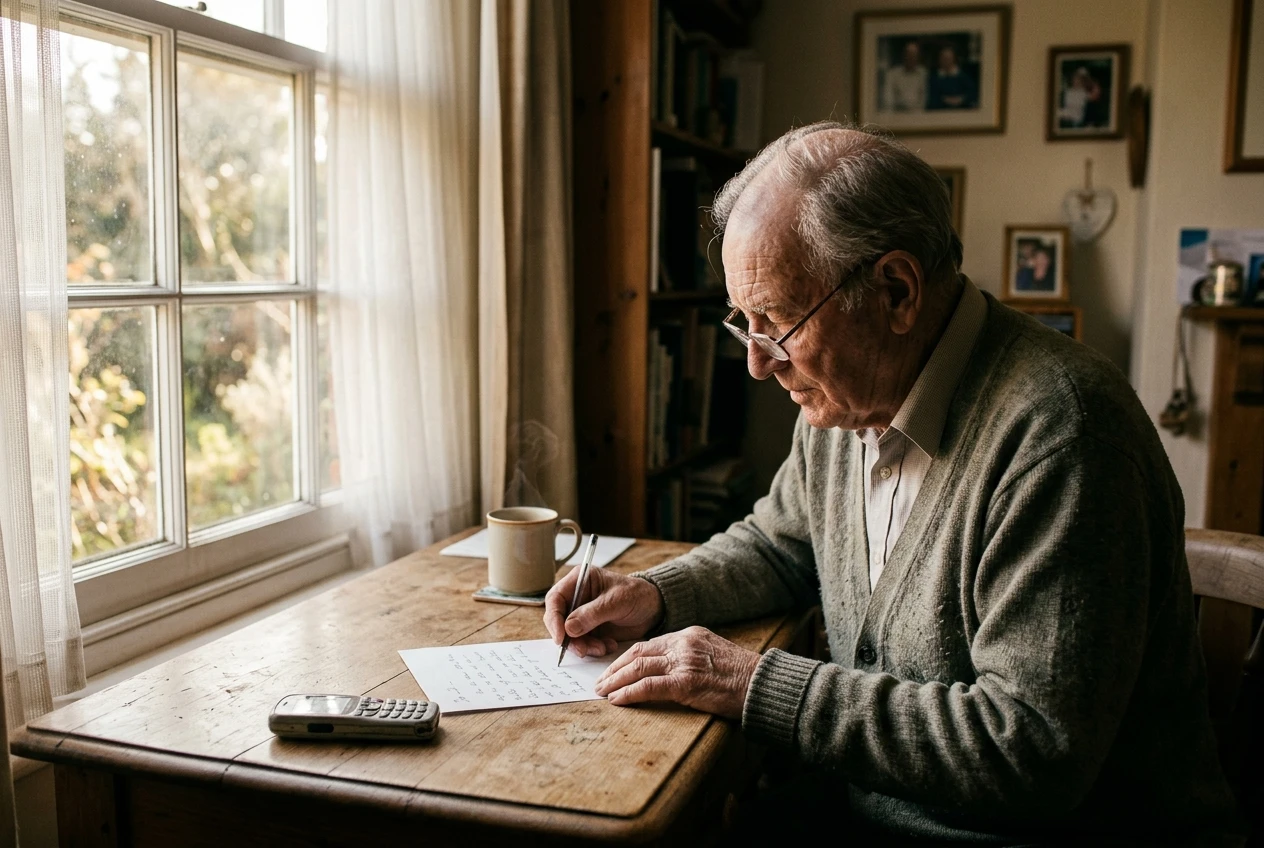
    An elderly man seated at a simple desk by a window, writing a short letter by hand in soft afternoon light, an old mobile phone resting next to the paper and a mug of tea at his elbow.

    Dear Brother, I must tell you that a member of my family has become seriously ill and I need to stay at their side. I am sorry that I cannot keep my appointment with you on Sunday. I will do what I can to suggest someone who may take my place, and I will pray for the congregation that day.

    Keep the message to these elements:

    • The plain fact that someone in your family is ill.
    • The appointment you cannot keep, named by date.
    • An offer to help find a replacement.
    • A word of prayer for the congregation.

    You need not describe the illness in detail, and you need not apologize repeatedly. One sincere expression of regret is honest. Several begin to sound as though you are asking for a judgment, and the host is more likely to respond with sympathy than with criticism.

    If a telephone call suits the host better than a written message, make the call. Many older congregations prefer to hear a voice.

    Who Can Stand in Your Place, and How to Hand Over Your Notes

    Paul told Timothy, “the same commit thou to faithful men, who shall be able to teach others also” (2 Timothy 2:2, KJV). Preparing others to teach is part of the work, and this is a time to do it in a small way.

    Think of the fellow believers you already know who can teach: another volunteer preacher, an elder of the congregation, a deacon, or a mature brother or sister who has spoken before. Choose one or two whose handling of Scripture you trust, and ask them directly. The host may also have a preference, so offer your suggestion and let the host decide.

    If you have already prepared a message, you can hand it over in a way that helps the person receiving it:

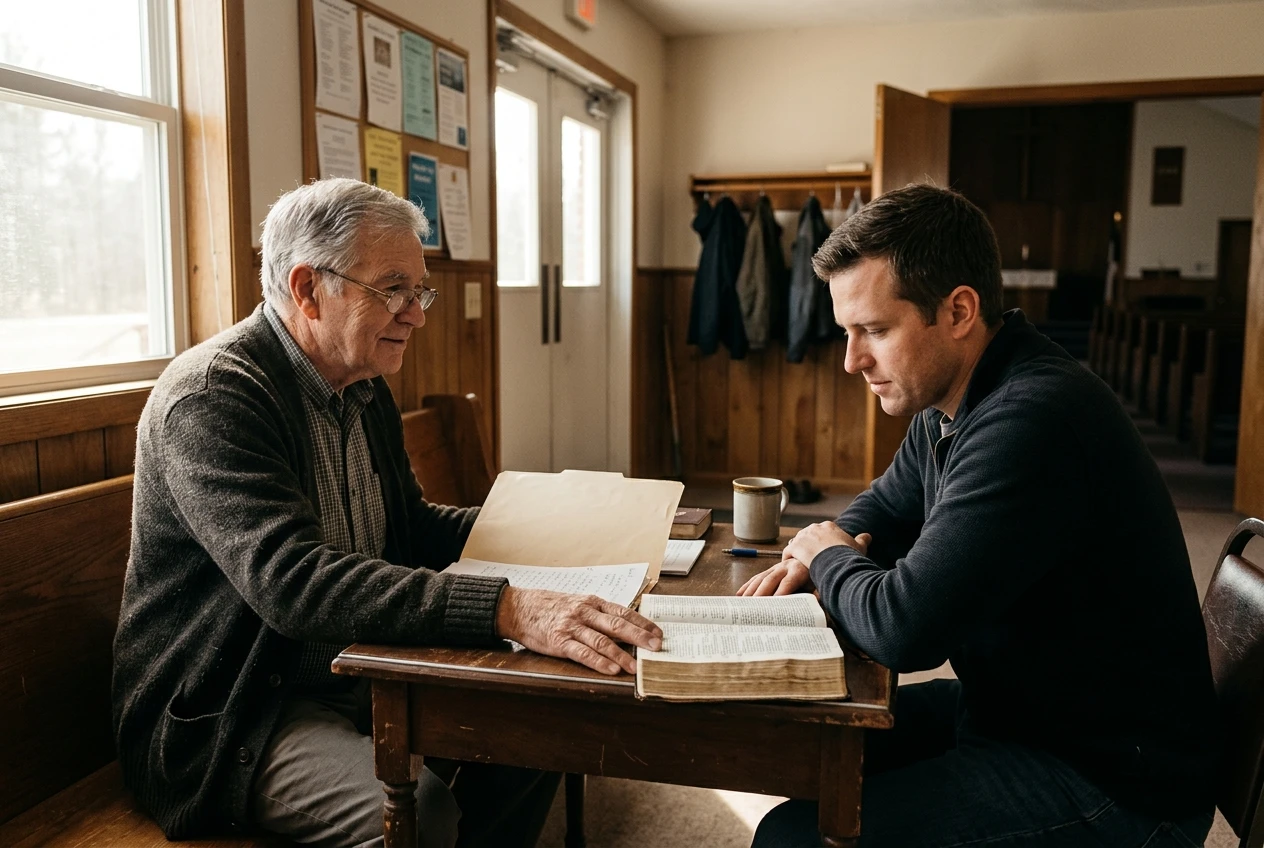
    Two men at a small table in a modest church vestibule, one older and one younger, with the older man passing a folder of handwritten sermon notes and an open Bible across the table, warm light from a side window.
    1. Write out the main text and the central point in two or three sentences.
    2. List the supporting passages in the order you intended to use them.
    3. Note any illustration you planned and whether it is yours alone to tell.
    4. Say plainly that the person may change anything to suit his own voice.

    The last point matters. A substitute who tries to preach another man’s sermon word for word often preaches poorly. Give him the material and the freedom to teach it as he understands it. If he prefers to bring his own message, let him.

    Do not feel that your preparation has been wasted. The text you studied remains in your mind, and the Lord may use it at the bedside or on a later Sunday.

    Keeping a Small Daily Rhythm of Prayer and Scripture at the Bedside

    Caring for a sick relative fills the day with interruptions. A long, fixed hour of study may not be possible, so a short and steady rhythm serves better than an ambitious plan.

    A quiet bedroom at dawn with a chair pulled close to the bed, an open Bible on a folded blanket, a glass of water and a medicine spoon on the nightstand, pale golden light through thin curtains, a blanketed sleeping figure in the background.

    A rhythm that fits around nursing might be as simple as this:

    • Morning: read one short passage aloud, perhaps a psalm, before the day’s duties begin. The sick person may listen, if he or she is able.
    • Midday: pause for a brief prayer while preparing food or medicine.
    • Evening: read a few verses again and pray for the family, the host you disappointed and the person who took your place.

    Peter writes, “Casting all your care upon him; for he careth for you” (1 Peter 5:7, KJV). A bedside is a fitting place to do exactly that, in plain words and without ceremony. If you wish for a prayer written for this situation, the daily prayer linked below was written for a preacher who is also keeping watch at a sickbed.

    Because you live on a pension, you may also be worrying about food, medicine or the cost of travel to the clinic. Name these needs to God in the same prayers. He knows them already, and the Lord’s own instruction to pray for daily bread does not exclude them.

    When the Crisis Passes: Returning to the Pulpit and Receiving What God Taught You at the Sickbed

    Illness at home ends in one of several ways, and not all of them are a recovery. Whatever the outcome, there will come a time when you consider returning to your appointments.

    Return in stages. Contact the host who was inconvenienced, thank him for his patience, and ask whether the congregation would still welcome you. Begin with one appointment rather than the whole schedule. Strength lost in nursing returns slowly, particularly at an older age, and a gentle return protects both your health and your preaching.

    Consider also what the sickbed has taught you. Most preachers who have sat for days beside someone in pain speak afterward with greater gentleness about suffering, about prayer when no answer is visible, and about the dependence of every person on God. Paul wrote of “the God of all comfort; who comforteth us in all our tribulation, that we may be able to comfort them which are in any trouble” (2 Corinthians 1:3-4, KJV). The comfort you received while caring for your relative is something you can now offer to others who are in trouble.

    Do not look on the cancelled appointment as lost ground. The Lord who saw Epaphroditus in his sickness, and Trophimus left behind at Miletus, sees you at your relative’s side. The labor you give there is seen by Him, and the reward He has promised does not depend on a perfect record of dates kept.

    Two Things to Do Today

    Send one short, honest message to the host of your next appointment, and name one fellow believer who could stand in for you if needed. Then read the daily prayer written for a preacher who also keeps watch at a sickbed: A Daily Prayer for the Preacher Who Also Keeps Watch at a Sickbed.

  • A Packed Bag Is Half the Sermon: How a Volunteer Preacher Keeps His Traveling Kit Ready on a Small Budget

    A Packed Bag Is Half the Sermon: How a Volunteer Preacher Keeps His Traveling Kit Ready on a Small Budget

    Invitations to preach rarely arrive with a long warning. A pastor in another town falls ill, a small congregation has no one for Sunday, or a village asks for a teacher of the word. A preacher who must first find a bag, wash a shirt, count his fare and search for his medicine may still say yes, but he says it with worry. A bag that is already packed lets him answer at once.

    Why a bag kept ready lets you say yes when the invitation comes

    When Jesus sent out the seventy, He told them to carry no purse, no bag and no sandals (Luke 10:4). Near the end of His ministry He asked the disciples whether they had lacked anything on that earlier mission, and they answered, “Nothing” (Luke 22:35). He then told them that whoever had a purse should take it, and a bag likewise (Luke 22:36). The Lord who provided for the first journeys also allowed His servants to prepare for later ones.

    Preparing does not replace trust in God. A traveling kit for volunteer preachers is a way of being faithful with what God has already placed in the preacher’s hands, so that when the call comes there is nothing to hold him back except God’s own leading.

    Choose one bag that you can carry yourself without strain, and keep it in the same place in the house every day. Relatives who help you prepare should know where it is. The rest of this article describes what goes inside.

    The Scripture and the pen: what to keep for the preaching itself

    Paul, in prison and near the end of his life, asked Timothy to bring “the books, especially the parchments” (2 Timothy 4:13). A preacher’s tools matter even when everything else is spare. Keep these in the bag at all times:

    A worn, softly creased Bible wrapped in a clear plastic cover, lying open on a wooden table beside a notebook, two pens, a pencil, a pair of reading glasses and a few sermon outline pages in a plastic sleeve, lit by warm morning window light.
    • Your own Bible, the one you know best, with a small cloth or plastic cover against rain.
    • A notebook with plenty of blank pages.
    • Two pens and a pencil, since a pencil still writes when a pen dries out or the weather is wet.
    • A spare pair of reading glasses, if you need them to read.
    • Two or three sermon outlines you know well, written out or printed, with the passages marked.

    The outlines matter most. If the invitation comes with a day’s notice, you do not want to compose a sermon from nothing in a strange place. A prepared outline on a passage you have prayed over many times lets you speak plainly and with confidence. Keep these papers in a plastic sleeve so that damp does not ruin them.

    Food and water for the road when no meal is promised

    The Lord said that the worker is worthy of his food (Matthew 10:10), and He has often provided that food through the hospitality of believers. Hospitality is not always ready, however. A bus may be late, a host may be away, or the meeting may run long. When Elijah lay exhausted in the wilderness, God sent him bread and a jar of water, and Elijah went in the strength of that food for a long journey (1 Kings 19:6-8).

    Keep a small supply of food that stays good in a closed bag:

    • Plain biscuits or dry bread rolls, sealed in a tin or bag.
    • Dried fruit, groundnuts or similar nuts, if your health allows them.
    • A small container for rice or other cooked food, if a relative has prepared some on the morning of the journey.
    • An empty water bottle with a tight lid, filled from a safe source just before you leave.

    If a doctor has given you instructions about what you may or may not eat, follow them above everything written here. A preacher who falls ill on the road helps no one. Rotate the dry food each month so that it is eaten and replaced before it goes stale; the monthly check described below explains how.

    One change of clothing, a cloak and a pair of sound shoes

    Jesus told the twelve not to take two tunics (Luke 9:3), and the bag should reflect that spirit of simplicity. A single change of clean clothing is enough: a shirt or blouse, trousers or a skirt, and underclothes, folded flat. Its purpose is that a preacher who has traveled all day can stand before a congregation clean and respectful of the word he carries.

    Paul also asked Timothy for the cloak he had left behind at Troas (2 Timothy 4:13). Nights are cold and rain comes without notice, so a coat, a warm outer cloth or a light rain cover belongs in the bag. The warmer garment may be one you already own and wear less often.

    A pair of sturdy, well-broken-in brown leather shoes with freshly mended soles on a cobbler's workbench, next to a neatly folded shirt and a grey wool cloak, with small tools and thread in the soft light of a small shop.

    Shoes deserve the most attention. A preacher who walks to a meeting place needs shoes that are sound and already broken in. Take them to a cobbler before they are needed, and have worn soles or loose stitching mended. New shoes worn for the first time on a long journey will blister the feet. Wash and dry the clothing as soon as you return, and put it back in the bag the same day.

    Travel money set aside in small portions, and how to keep it separate

    Jesus said that a man planning to build a tower first sits down and counts the cost (Luke 14:28). The same sense applies to a journey. On a small pension, the money for a trip will not appear at the last hour unless it was put aside earlier.

    Use envelopes, each marked in plain writing:

    Four plain paper envelopes in a row on a kitchen table, each holding a modest fold of coins and notes and labeled in hand-written ink, with an elderly man's hand resting beside them and a cup of tea in the background, in warm afternoon light.
    1. Fare there. The cost of the usual route to the nearest places that invite you.
    2. Fare back. Set aside before anything else, so that you can always return home.
    3. Food on the road. A modest sum for water or bread if your supplies run out.
    4. A small reserve. For a delayed bus or a sudden change of plan.

    Keep these envelopes apart from the money for the household, and never borrow from them for other needs without writing down what was taken and putting it back as soon as you can. When you travel, carry the money in two places, not all in one pocket. Add to the envelopes in small amounts whenever you can, and if a gift is placed in your hand, consider setting a portion of it here. The article What a Volunteer Preacher Should Do With the Small Gifts Placed in His Hands discusses how to treat such gifts faithfully.

    Medicine, a small first-aid supply and the paper that names who to call

    Paul advised Timothy to take a little wine for his stomach and his frequent illnesses (1 Timothy 5:23). Scripture does not treat care for the body as a lack of faith. If you take medicine daily, keep a few days’ extra supply in the bag, in its original labeled container, so that a delayed return does not leave you without it. Ask your doctor or pharmacist how much extra is sensible.

    A small first-aid supply is enough:

    • Adhesive plasters of different sizes.
    • A clean cloth or bandage.
    • An antiseptic wipe or cream.
    • Any pain reliever that your pharmacist has confirmed is safe for you.

    Then add one sheet of paper written in clear, large letters and kept in an inside pocket. It should give your full name, your home address, the name and telephone number of a relative to call, any illness you live with, any allergy, and the list of your medicines. If you become unwell among strangers, this page speaks for you. Leave a copy with your family as well, and tell them where you are going and when you expect to return.

    A monthly ten-minute check: restocking without spending more than you must

    A bag that is packed once and forgotten will fail you in time. Food goes stale, ink dries, medicine passes its date and clothing no longer fits. Choose one day each month, perhaps the first of the month or the first Monday, and give the bag ten minutes.

    A small travel bag emptied onto a table: a water bottle, a tin of biscuits, dried fruit in a bag, a folded cloak, a pill container, plasters and a card checklist, with an older man's hands sorting them in calm daylight.
    1. Empty the bag onto a table.
    2. Read through the list you keep inside the lid or on a card.
    3. Check the food, and eat anything old that is still good, replacing it with fresh.
    4. Check medicine dates and the amount left.
    5. Check the pens, the notebook pages, the shoes and the clothing.
    6. Replace only what is used up or spoiled.

    Look through what you already own before you buy anything. A spare scarf, a bottle, an old notebook or a pair of reading glasses may already be in the house. Whatever you must buy, buy the cheapest item that does the work. Since the check runs monthly, you can spread purchases across several months and keep the cost small. The piece on how to stretch a pension while serving in ministry may help you plan these small costs inside the month’s budget.

    Letting family and congregation help fill the bag, and thanking God for what is given

    Many relatives and fellow believers would gladly help but do not know what to give. A general offer to help is hard to answer, while a particular need is easy to meet. Show your family the checklist and say, “This is what is still missing.” One person may supply a water bottle, another a warm cloth, another a packet of dried fruit. Children and grandchildren can copy the checklist in large letters and tick the items as they are added.

    Paul wrote to the Philippians that their gift was “a sweet-smelling aroma, an acceptable sacrifice, well pleasing to God,” and promised that his God would supply all their need according to His riches in glory by Christ Jesus (Philippians 4:18-19). A gift given for the preacher’s journey is received by God as given to Him. Thank the giver by name, and tell them when the bag was used, so that they know their part in the preaching.

    Each month, as you restock the bag, thank God for every item in it, even the smallest. What was supplied came from His hand, through the hands of others.

    Take one bag this week

    This week, take one bag and a sheet of paper. Write down every item from the checklist above that you already own, and put those items in the bag. Then write a second list of what is still missing, and pray over each item by name, trusting God to supply it as He has supplied His servants before. When something arrives, cross it off and thank Him.

    For the biblical foundation of this work, read Bread, Cloak, Rest and Road: The Bodily Needs of the Preacher in Scripture. It shows from the word of God why the preacher’s body, and the bag that serves it, are not a small matter in His sight.

  • The Lonely Road of the Volunteer Preacher Is a Road Christ Has Already Walked

    The Lonely Road of the Volunteer Preacher Is a Road Christ Has Already Walked

    An elderly man in a worn tweed jacket sits alone on a long-distance bus at dusk, a small black Bible and a battered leather satchel on his lap, looking out the window at a pale amber sky over empty fields and distant village lights.

    Loneliness is one of the hardest parts of unpaid preaching, and it is seldom spoken about. A volunteer preacher often travels alone, prepares alone and returns home to a quiet house after the sermon is finished. Many are retired and live on a pension, and the hall may empty quickly once they have spoken.

    This article is about how to deal with loneliness in ministry by looking at what Scripture says about it. The Bible does not treat the lonely preacher as a failure. It shows prophets, apostles and Christ Himself walking the same road, and it records what God said to each of them there.

    Why the Preacher Who Serves Without Pay Often Serves Without Company

    Several ordinary circumstances produce solitude in a volunteer preacher. A salaried minister usually has a congregation, a board and colleagues around him. The volunteer often has none of these, because he goes where the invitation sends him, sometimes a long way from home.

    Age adds to it. Friends of earlier years have moved away or have died. Invitations may be fewer than they were. Relatives are busy with their own work and children and may not fully understand why a pensioner spends his small means on travel to preach.

    None of this shows that God has withdrawn from the work. These are plain facts about a calling carried out without a salary or a staff. Scripture is clear that the road of a sent servant was often walked with few people beside him, and that the absence of company did not mean the absence of God.

    What Scripture Says Plainly: Elijah, Paul and Others Who Stood Alone

    Elijah, after the contest on Mount Carmel, fled into the wilderness and said to the LORD: “I, even I only, am left; and they seek my life, to take it away” (1 Kings 19:10, KJV). He felt completely alone. God did not rebuke him for feeling so. He fed him, let him rest, spoke to him in “a still small voice,” and then told him that He had seven thousand in Israel who had not bowed to Baal (1 Kings 19:12, 18). Elijah was less alone than he believed, though he could not see it.

    A rocky wilderness slope at dawn with a lone juniper tree, a flat loaf of bread and a clay jar of water resting on a stone beside it, soft golden light breaking over the hills and a single cave mouth in the shadows behind.

    Jeremiah wrote: “I sat alone because of thy hand” (Jeremiah 15:17). He understood his solitude as part of the burden of the word he carried. He did not hide it, and the Scripture does not hide it either.

    Paul writes from prison near the end of his life: “Demas hath forsaken me, having loved this present world… only Luke is with me” (2 Timothy 4:10-11). The great apostle names those who left him. Scripture records it without embarrassment, and it is written for our instruction.

    These men were not poor preachers. They were chosen servants, and loneliness found them anyway. A volunteer preacher who feels alone is standing where they stood.

    Christ Was Forsaken Too, and Said He Was Not Alone

    The Lord Jesus went further than any of them. He told His disciples beforehand: “Behold, the hour cometh, yea, is now come, that ye shall be scattered, every man to his own, and shall leave me alone: and yet I am not alone, because the Father is with me” (John 16:32).

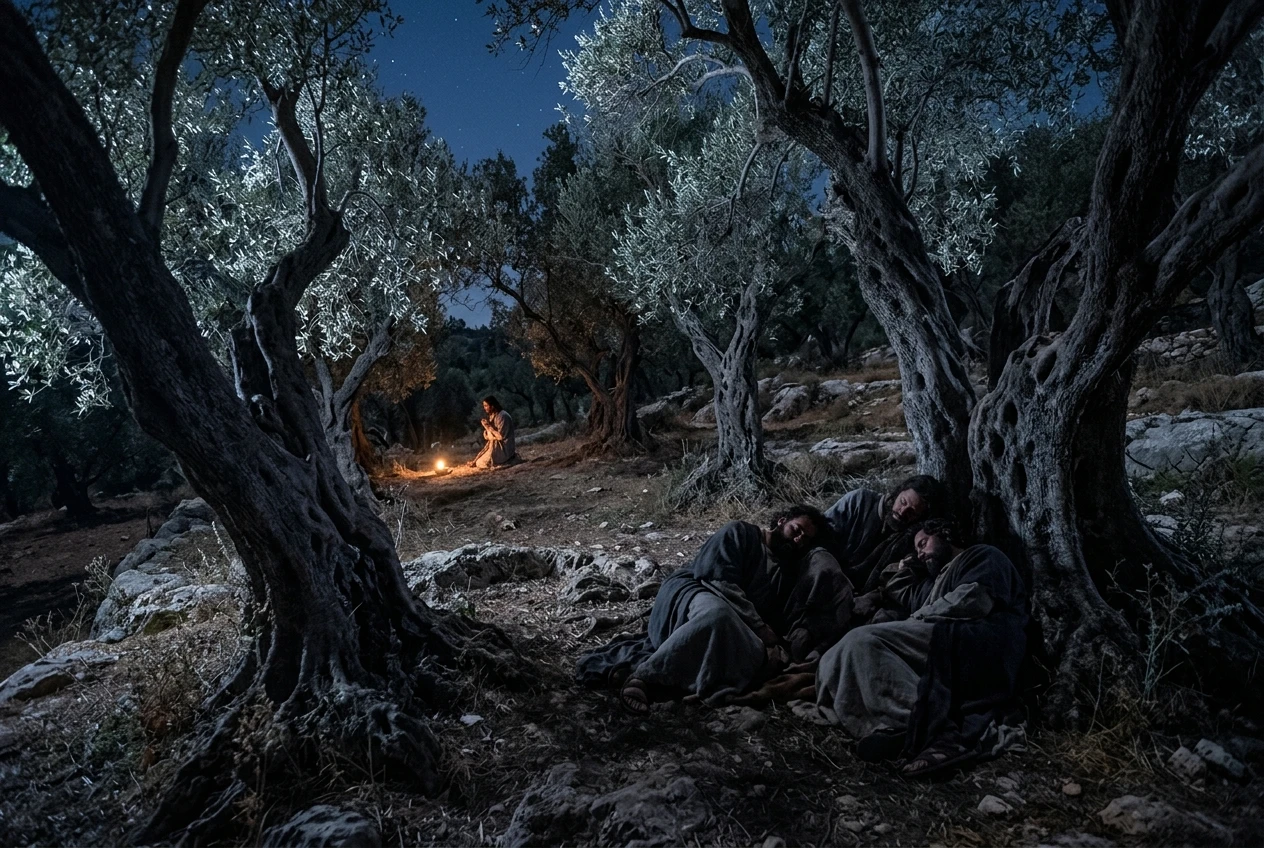
    Then it happened. In Gethsemane He asked three disciples to watch with Him, and He found them sleeping (Matthew 26:40). When He was arrested, “all the disciples forsook him, and fled” (Matthew 26:56). Before Pilate and on the cross He was without a single follower at His side among the men who had walked with Him.

    A moonlit olive grove at Gethsemane, three robed figures asleep on the ground beneath gnarled silvery trees, while farther off a single lamp-lit figure kneels in prayer, deep blue night tones with a warm glow around him.

    Two things in His words belong together. He was truly left alone by men. He was also truly not alone, because the Father was with Him. The preacher can hold both of these as well. The empty pew and the silent drive home are real, and so is the presence of God in them.

    Paul found the same thing. Of his first defense before the court he writes: “At my first answer no man stood with me, but all men forsook me: I pray God that it may not be laid to their charge. Notwithstanding the Lord stood with me, and strengthened me; that by me the preaching might be fully known, and that all the Gentiles might hear” (2 Timothy 4:16-17). Notice that the Lord stood with him for a purpose: that the preaching might be fully known. The solitude did not stop the word from going out. It was the place where the Lord strengthened His servant to proclaim it.

    Notice too that Paul prayed for those who left him: “I pray God that it may not be laid to their charge.” Bitterness toward people who did not come is a temptation of the lonely, and Paul’s example shows how to meet it.

    The Promise Attached to the Sending: “I Am With You Always”

    The Great Commission ends with a promise, and the promise is bound to the command. The Lord says, “Go ye therefore, and teach all nations… and, lo, I am with you alway, even unto the end of the world” (Matthew 28:19-20). He gave the promise to those He was sending. It was not a general comfort offered to people who stayed at home.

    This means the preacher who goes out has a claim on the presence of Christ that rests on Christ’s own word. It does not depend on how he feels at the time, on the size of the audience, or on whether anyone thanks him.

    Hebrews 13:5 gives the same assurance in a setting that fits the volunteer preacher closely: “Let your conversation be without covetousness; and be content with such things as ye have: for he hath said, I will never leave thee, nor forsake thee.” The promise is placed right beside the matter of daily needs. The God who says He will not leave also says He knows what His servant has and lacks. A preacher who relies on Him for food and travel can rely on Him for company in the same way.

    If you have wondered whether your unpaid labor is seen, the piece on what the Bible means by eternal reward when no one pays the preacher takes up that question directly.

    How to Walk the Road With Christ: Prayer, the Word and the Quiet Hours

    Knowing the promise is one thing, and living in it on a long journey is another. Scripture gives ordinary means for this.

    Pray aloud while you travel. The Lord Himself withdrew to quiet places: “And he withdrew himself into the wilderness, and prayed” (Luke 5:16). A long bus ride or an evening walk to the next village can become a time of speaking to God as to a person who is present, because He is.

    Read the Psalms. The psalmists write often of solitude. “Turn thee unto me, and have mercy upon me; for I am desolate and afflicted” (Psalm 25:16). Psalm 23:4 says, “I will fear no evil: for thou art with me.” Reading these slowly, and praying them back, gives words to feelings that are hard to name.

    A modest kitchen table in the evening, a lamp casting warm light on an open Bible with a pair of reading glasses, a small notebook with a pen and a cup of tea, dark window behind and a worn travel bag by the chair.

    Use the quiet hours for the Word. The evenings that feel emptiest can be the best time for steady reading. Take one passage, such as John 16 or 2 Timothy 4, and read it each night for a week. Write down each statement about God’s presence. The loneliness remains, but it is met each time with something God has actually said.

    Keep a short record of answered prayer. A few lines in a notebook, dated and plain, remind the preacher on a low day that the Lord has stood with him before. This is memory, which Scripture commands again and again, and it needs no embellishment.

    Be honest with God. Elijah told Him exactly how he felt. A preacher does not need to hide weariness from the One who already knows it.

    Where God Often Sends Companions: Faithful Believers and Family Who Pray

    The presence of Christ does not exclude human company. It is often how that company arrives. The Lord sent out His disciples two by two (Luke 10:1), and the church at Antioch sent Barnabas and Saul together (Acts 13:2-3). Even in prison Paul had Luke, and he remembered Onesiphorus, who “oft refreshed me, and was not ashamed of my chain” (2 Timothy 1:16).

    Psalm 68:6 says, “God setteth the solitary in families.” For the preacher this may mean a relative who prays for him by name, a believer in the congregation who asks after his health, or a younger man who is glad to travel with him now and then. A preacher can ask for such company honestly. Asking a brother to pray, or to accompany him on a journey, is a reasonable request, and many believers are willing to give it.

    Family deserves particular care. Those at home carry a share of the sacrifice, and they can also carry a share of the prayer. The article on teaching your family to treasure what you do in the pulpit speaks to that. A household that prays for the preacher is a real companion, even when it stays at home.

    Where fruit seems slow to appear, keep sowing anyway. Elijah could not see the seven thousand, and yet they were there.

    A Short Prayer for the Preacher Who Is Alone Tonight

    Lord Jesus Christ, You were forsaken by those who had walked with You, and You said that You were not alone, because the Father was with You. I come to You tonight in the same quiet.

    You have said, “Lo, I am with you alway,” and “I will never leave thee, nor forsake thee.” I hold You to Your word. Stand with me as You stood with Paul, and strengthen me that the gospel may be fully known through my preaching.

    Forgive me for any bitterness toward those who did not come. Give me faithful brothers and sisters to pray with me, and bless my family at home. Provide my daily bread and my road, as You have promised.

    Let me sleep in peace, knowing that You are near. In Your name I pray. Amen.

  • When the Invitations Slow Down, God’s Provision for the Aging Preacher Has Not Stopped

    When the Invitations Slow Down, God’s Provision for the Aging Preacher Has Not Stopped

    Many older preachers notice the change before anyone speaks of it. The telephone rings less on Saturday evenings. A younger man is asked to take the Sunday appointment. The preacher still has the same Bible, the same convictions and a lifetime of sermons, but the invitations are fewer, and a hard question follows: does anyone still need what I carry?

    This article offers encouragement for aging preachers, and for the families who watch them go quiet. Scripture does not treat old age as a retirement from usefulness. It shows God providing for his aging servants in three ways: daily bread, faithful people and work that remains to be done.

    Why the Quiet Years Feel Like Being Set Aside

    A preacher’s sense of worth is tied to being called upon. When the calls diminish, he may conclude that God has moved on without him. That conclusion is natural, but it does not follow from the facts. Fewer invitations can come from failing strength, from a younger congregation’s preferences, from distance and the cost of travel, or from a church that has simply grown and reorganised. None of these is a verdict from heaven.

    The writer of Hebrews gives the reverse assurance: “God is not unrighteous to forget your work and labour of love, which ye have shewed toward his name” (Hebrews 6:10). God’s memory of a man’s service does not depend on how recently anyone asked him to preach.

    Families can help here. A son or daughter who says, “Father, your years of teaching still matter,” does more good than one who quietly hopes the old man will rest. The preacher needs to hear that his labor is remembered, and that he is still wanted at the table.

    Simeon and Anna: Faithful Servants Who Were Kept Until the Promise Arrived

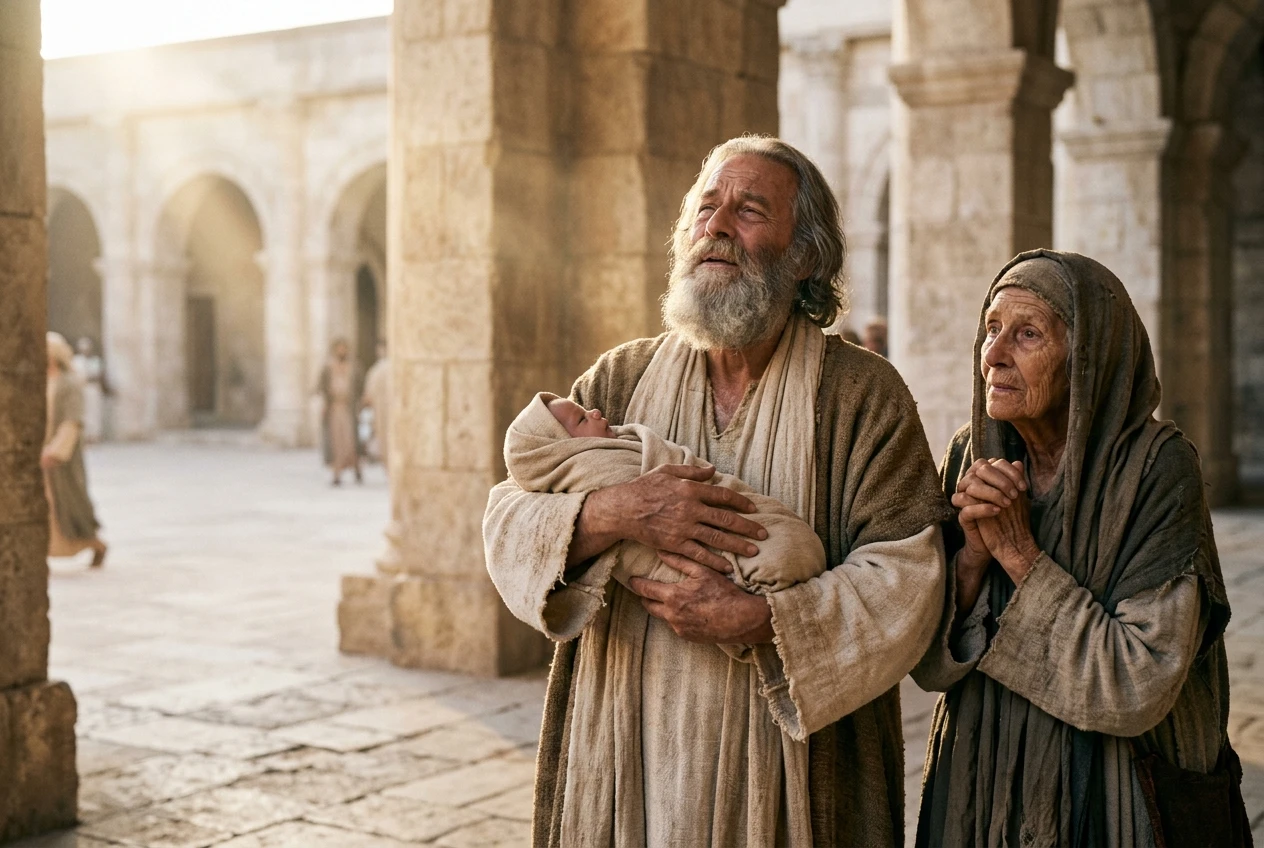
    Luke gives two portraits of devoted waiting. Simeon was “just and devout, waiting for the consolation of Israel,” and the Holy Spirit had revealed to him that he would not see death before he had seen the Lord’s Christ (Luke 2:25-26). He was not preaching to crowds. He was waiting, and the waiting was his service. When Mary and Joseph brought the child into the temple, he took him in his arms and blessed God.

    Inside the Jerusalem temple court in soft morning light, an elderly bearded man in a plain woven robe holds a swaddled infant in his arms, his face lifted in quiet thanksgiving, while a very old woman with a head covering stands close beside him with clasped hands. Warm limestone pillars and golden

    was a prophetess, “a widow of about fourscore and four years, which departed not from the temple, but served God with fastings and prayers night and day” (Luke 2:36-37). Scripture does not record any sermon of hers before that day. It records her presence, her prayers and her fasting. When the moment came she gave thanks and “spake of him to all them that looked for redemption in Jerusalem” (Luke 2:38).

    Both were kept by God until the promise arrived, and both were given the privilege of speaking at the right hour. An aging preacher may not know which hour is still ahead of him. Scripture shows that God does not waste the years of faithful waiting, and that a word spoken in old age can reach the very people who were looking for it.

    Psalm 71 and Psalm 92: What an Old Man May Ask of God and What God Says He Will Do

    An old man is permitted to pray about his age. The psalmist does: “Cast me not off in the time of old age; forsake me not when my strength faileth” (Psalm 71:9). The fear of being set aside is spoken aloud to God, and Scripture preserves it as a proper prayer.

    The same psalm continues with a request that gives the quiet years a purpose: “Now also when I am old and greyheaded, O God, forsake me not; until I have shewed thy strength unto this generation, and thy power to every one that is to come” (Psalm 71:18). The old servant asks to be kept in order to testify to the generation after him. That testimony does not require a pulpit. It can be given at a kitchen table, in a letter or beside a hospital bed.

    Psalm 92 states what God says of the righteous: “They shall still bring forth fruit in old age; they shall be fat and flourishing; to shew that the LORD is upright” (Psalm 92:14-15). Isaiah adds the promise of the Lord himself: “Even to your old age I am he; and even to hoar hairs will I carry you” (Isaiah 46:4). God does not merely tolerate the old preacher. He carries him.

    Caleb is a reminder that strength differs from man to man. At eighty-five he asked for the hill country that had been promised to him (Joshua 14:10-12). Some preachers retain energy into great age and should not be discouraged from using it. Others must preach less. Both are in God’s hand, and neither has been forgotten.

    Paul at the End: The Cloak, the Books and the Companions He Still Needed

    Paul’s last letter shows the greatest of the apostles in his final imprisonment, and it is strikingly practical. He writes to Timothy, “Do thy diligence to come shortly unto me,” and tells him that Demas has forsaken him and that “only Luke is with me” (2 Timothy 4:9-11). He asks for Mark, “for he is profitable to me for the ministry.” He also asks for the cloak he left at Troas with Carpus, and for “the books, but especially the parchments” (2 Timothy 4:13).

    A dim stone prison cell lit by a single shaft of lamplight, where an aged man with grey hair sits on a bench, a heavy travel cloak folded beside him and a few parchment scrolls spread on a rough wooden table. Earth browns and muted ochres, a quiet and solitary mood.

    An apostle in his last season asked for a coat, for something to read and for the company of friends. This is no embarrassment to his ministry. It shows that old servants of God have bodily and human needs, and that asking for them is honest. The topic is explored further in Bread, Cloak, Rest and Road: The Bodily Needs of the Preacher in Scripture.

    Paul also records a loneliness: “At my first answer no man stood with me, but all men forsook me.” Yet he continues, “Notwithstanding the Lord stood with me, and strengthened me” (2 Timothy 4:16-17). The Lord’s nearness did not remove the need for Timothy, Luke and Mark. It stood alongside it.

    The Provision of Bread and the Provision of People: Seeing Both in Your Present Season

    A preacher who relies on God for his daily needs usually watches for bread: food on the table, the fare for a journey, a coat for winter. Those matter, and God supplies them, often through a pension, a neighbour or a relative. For a preacher living on a fixed income, the retired preacher on a pension still has a pulpit, and the same God who gave the pension is attentive to the man.

    Paul’s last letter shows a second provision that is easier to overlook: people. Luke stayed. Mark was useful. Timothy was asked to come. God supplied the apostle with companions as surely as he supplied him with a cloak.

    An evening kitchen table in warm lamplight where an elderly man with white hair and a worn open Bible sits beside a young grandchild who leans in to listen. A covered dish of food and a neighbour's casserole with a cloth sit nearby, and a cup of tea steams between them.

    In your own quiet season, it is worth asking plainly who God has placed near you:

    • A grandchild who sits with you after the evening meal and asks about the Scriptures.
    • A younger preacher who telephones to ask how you handled a certain passage.
    • A neighbour who brings food and stays to talk.
    • A relative who drives you to the assembly when you cannot walk there.

    These are not accidents. They are part of the provision, and receiving them gratefully honours the God who sent them.

    The Work That Remains: Teaching the Young, Praying for the Church, Counselling the Sick

    Preaching from a pulpit is one form of the work. It is not the whole of it. Paul tells Titus that the older men and women are to teach what is good, so that the younger may learn (Titus 2:2-5). That instruction is addressed to the aged specifically, and it assumes they have something to give.

    Three kinds of work remain open to the aging preacher, whatever his strength.

    Teaching the young. A younger man who is learning to preach needs someone to read his outline and correct a misreading of a text. The older preacher can do this from a chair. He can also teach children the foundations of the faith, as Timothy was taught from his grandmother and mother (2 Timothy 1:5).

    Praying for the church. Anna’s whole ministry, as Luke records it, was prayer and fasting. The elder who prays by name for the congregation, for the sick and for the preachers who now stand where he once stood does work that no one else can see and that God does not overlook.

    Counselling the sick and the grieving. Many people in distress cannot be helped by a sermon. They need a patient visitor who has himself known sickness and loss. A preacher who is also caring for a sick relative will find that caring for a relative is part of your ministry, not a break from it.

    A Daily Practice for the Preacher in His Quiet Years

    A fixed daily order helps a man who no longer has a preaching calendar to shape his week. The following is offered as a simple pattern, to be adjusted to strength and circumstance.

    An elderly man in a cardigan sits by a sunlit window at dawn with an open Bible, reading glasses and a handwritten list of names beside a mug. Soft golden light falls across the pages, and a green garden is visible outside the glass.
    1. Morning: read and pray a psalm. Psalm 71 and Psalm 92 suit this season well. Read slowly, and pray the words of Psalm 71:18 as your own request.
    2. Midday: name those who are owed prayer. Pray for one person from the congregation, one younger preacher and one sick person each day, by name.
    3. Afternoon: one act of teaching or encouragement. Write a letter, telephone a younger preacher, or explain a passage to a child or grandchild.
    4. Evening: give thanks for bread and for people. Name the food, the clothing and the companions God supplied that day. This trains the eye to see provision where it is.
    5. Before sleep: commit your labor to God. Remember Paul’s confidence: “I know whom I have believed, and am persuaded that he is able to keep that which I have committed unto him against that day” (2 Timothy 1:12).

    The quiet years are not outside the ministry. They are a part of it, with their own tasks and their own provision. A man who prays, teaches, receives help with thanks and waits on the Lord, as Simeon and Anna did, is still serving. For the longer view of what God has set aside for such servants, see what the Bible means by eternal reward when no one pays the preacher.

    Share this with an older preacher you know who may be wondering whether his labor is still seen by God, and pray for him by name this week.

  • What a Volunteer Preacher Should Do With the Small Gifts Placed in His Hands

    What a Volunteer Preacher Should Do With the Small Gifts Placed in His Hands

    A preacher who lives on very little, or a family that walks beside him through sickness and school fees, still receives gifts. A bag of rice, a few coins pressed into the hand after a service, a lift on the road, a borrowed text book. Learning how to be a good steward with little money begins with how these gifts are received, recorded, used and shared, and Scripture gives a clear pattern for each of those.

    This article sets out that pattern as a discipline a household can follow every week, whatever the size of the gift.

    Why the Lord Measures the Gift by the Giver and Not by the Size

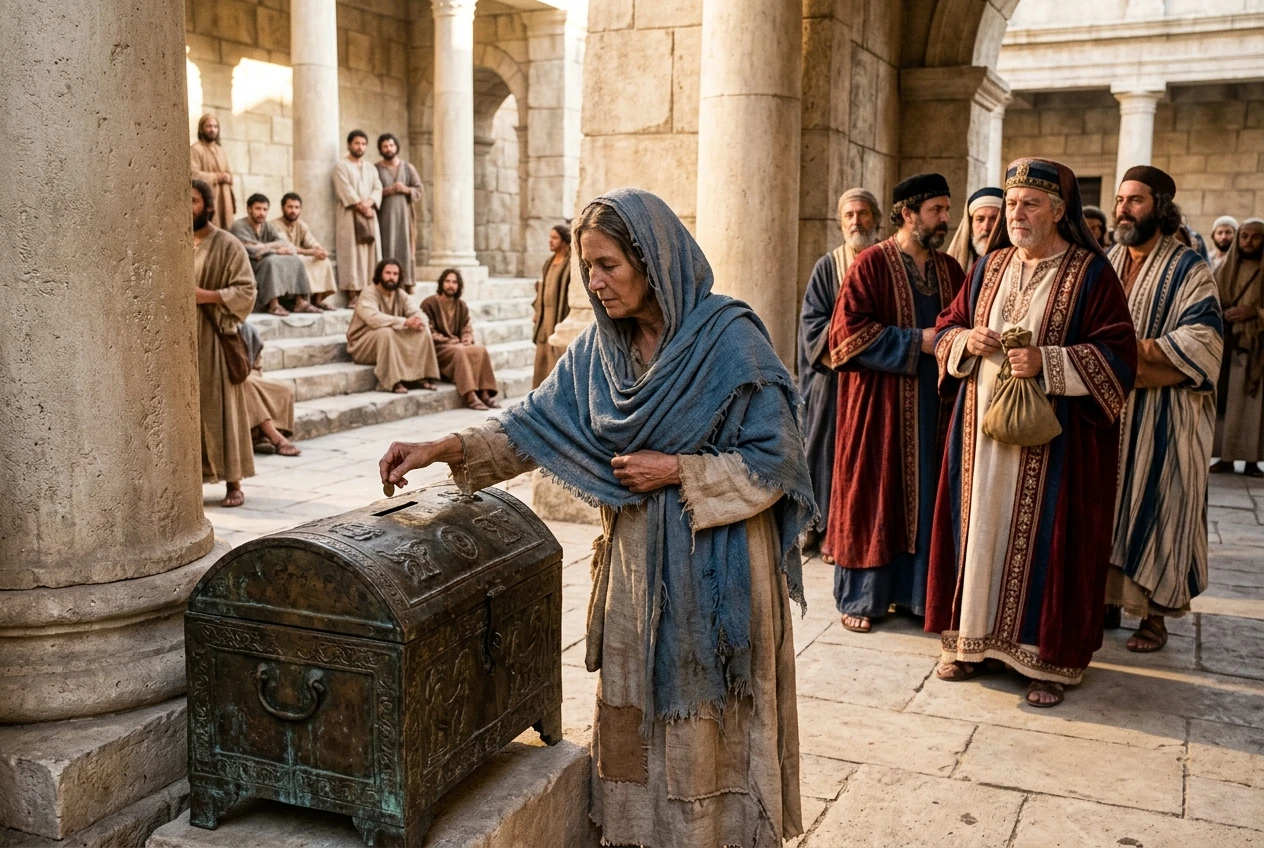
    In the temple Jesus watched the people put money into the treasury. Many rich men gave large sums, and a poor widow dropped in two small coins. He told His disciples that she had given more than all the others, because they gave out of their abundance and she gave out of her poverty, all that she had to live on (Mark 12:41-44).

    Inside an old stone temple court in warm afternoon light, a poor widow in a faded blue shawl drops two tiny copper coins into a large bronze collection chest, while wealthy men in rich robes stand behind her with heavy purses; a few watching disciples sit on the steps in the background.

    The Lord looked at what the gift cost the giver and what was in the giver’s heart. The same standard applies to the one who receives and uses a gift. A small sum handled faithfully is weighed in heaven differently from a large sum handled carelessly.

    This is why a household with little has no reason to postpone stewardship until there is more. The discipline is the same at every size, and it is formed in the small gifts.

    Receive Every Gift as From God Before You Decide What to Do With It

    Before a gift is spent, it should be received. Scripture says that every good gift and every perfect gift is from above (James 1:17). The person who handed over the food or the coins was the instrument, and God was the giver.

    When Jesus took the five barley loaves and two fish from a boy in the crowd, He gave thanks before He distributed anything (John 6:9-11). The food was small and the crowd was large, and thanksgiving still came first.

    On a green grassy hillside at golden hour, a young boy holds out a small woven basket with five round barley loaves and two small fish, while a robed figure's hands receive it and lift it upward in thanksgiving; a large seated crowd fills the slope behind.

    Follow that order in the home:

    • Name the gift plainly, aloud or on paper, so that it is not treated as a vague piece of luck.
    • Give thanks to God for it in prayer, and thank the giver as well.
    • Wait to decide its use until the prayer is finished, even if the need is pressing. A short delay keeps the gift from being spent in anxiety.

    A gift received with thanks is easier to use wisely, because the one holding it remembers that it was entrusted to him.

    Faithful in Little: What Scripture Says a Steward Is Required to Be

    A steward manages what belongs to another. Paul states the one requirement directly: “it is required in stewards, that a man be found faithful” (1 Corinthians 4:2). Skill, wealth and quick results are not named.

    Jesus teaches that faithfulness is tested at small scale: “He that is faithful in that which is least is faithful also in much” (Luke 16:10). In the parable of the talents, the servants who traded faithfully with what they were given heard the same words from their master: “Well done, good and faithful servant; thou hast been faithful over a few things” (Matthew 25:21). The one who buried his talent was not condemned for having received little. He was condemned for doing nothing with it.

    Faithfulness here means three things: the gift is not wasted, it is not hidden away from the need it was meant for, and it is not claimed as one’s own achievement.

    Keep an Honest Account of What Has Been Given and What Has Been Used

    A steward gives account. The master in Jesus’ parable says, “Give an account of thy stewardship” (Luke 16:2). Paul, when he carried a collection for the poor, took care to provide “for honest things, not only in the sight of the Lord, but also in the sight of men” (2 Corinthians 8:21).

    A preacher or a family can do this with one notebook kept in a safe place. For each gift, write:

    On a rough wooden table in a modest home lit by soft window light, a worn school exercise notebook lies open with hand-written lines, a stub of pencil beside it, next to a small cloth bag of rice and a few coins, with a well-used Bible at the edge.
    1. The date, and who gave it, or that it was given anonymously.
    2. What it was: food, coins, clothing, transport, medicine, school items.
    3. What it was used for, and when.
    4. What remains.
    Such a record is ordinary, and it protects both the household and the congregation. If anyone asks how a gift was used, the answer is already written. It also guards the steward against the quiet temptation to let a gift drift into something it was not meant for.

    The same notebook shows over time how God has been supplying. A person who reads back through its pages has evidence in his own hand, which is a help to faith when a week is hard. For readers who are managing a regular monthly income as well, the article on making a fixed pension last the month without dropping your ministry covers the budgeting side, which this article leaves aside.

    Put the Gift Where the Need Is Nearest: Food, School Uniforms, the Sickbed, the Road

    A gift is used best on the need that is in front of the household now. James writes that if a brother or sister is naked and destitute of daily food, and one says “be warmed and filled” without giving the things needed for the body, it profits nothing (James 2:15-16). The need that is visible and close has the first claim.

    For a preacher’s household, the near needs usually fall in four places:

    A simple village home doorway in morning light: a folded white-and-blue school uniform with a pair of small black shoes, a bag of rice, a bottle of clean water and a bundle of medicine laid out together on a woven mat, with a dirt road stretching away behind.
    • Food. Bread for the table, and for the relative who is too weak to prepare it.
    • School. Uniforms, shoes, books and fees, so that a child is not kept at home for lack of them.
    • The sickbed. Medicine, clean water, cloth, and the cost of reaching a clinic.
    • The road. Fare to reach the people the preacher has been sent to teach.

    Decide between these by asking which need would cause the most harm if it went unmet this week. Then write the decision in the account book beside the gift.

    Where a need is larger than one household can meet, neighbours can work together. The piece on how a small community can gather uniforms and school supplies for children who have none describes how that can be organized.

    Pass a Portion Onward, Because the Poor Can Still Give

    Poverty does not cancel the call to give. Paul wrote of the churches of Macedonia that “in a great trial of affliction the abundance of their joy and their deep poverty abounded unto the riches of their liberality” (2 Corinthians 8:2). They gave beyond what anyone expected of them.

    After the crowd of five thousand had eaten, Jesus told the disciples to gather up the fragments that remained, so that nothing was lost (John 6:12). What was left over was kept for further use and was not discarded.

    A household can follow both examples. When a gift is received, consider whether a portion can go to someone whose need is greater: a neighbour, a widow, a sick relative in another village. It may be a handful of food or a few words of prayer and a visit. Jesus said that even a cup of cold water given in His name will not lose its reward (Matthew 10:42), and Paul reminds the elders of Ephesus of the Lord’s saying, “It is more blessed to give than to receive” (Acts 20:35).

    Passing a portion onward also keeps the heart from closing around what it has been given.

    What God Promises the Faithful Steward, and What He Does Not

    God’s promises must be stated as He made them. Paul told the Philippians, who had supported him in his need, “my God shall supply all your need according to his riches in glory by Christ Jesus” (Philippians 4:19). He told the Corinthians that God is able to make all grace abound toward those who give, so that having sufficiency in all things they may abound to every good work (2 Corinthians 9:8). Jesus promised that those who seek first the kingdom of God and His righteousness will have food and clothing added to them (Matthew 6:33). The Letter to the Hebrews adds that God is not unjust to forget the work and labour of love shown toward His name (Hebrews 6:10).

    These promises concern need and sufficiency. They are not a promise of wealth, and they do not guarantee that every request will be answered on the day or in the form we expect. Paul himself said he had learned to be content, knowing both how to be abased and how to abound (Philippians 4:11-12), and he wrote that godliness with contentment is great gain, and that having food and raiment we should be content (1 Timothy 6:6-8).

    The final reward of the faithful steward is not measured in this life. It is the Master’s own word: “Enter thou into the joy of thy lord.” A steward who has been faithful in little can wait for that word with confidence.

    One Small Step for This Week

    Take one small gift you have received this week. Give thanks for it in prayer, naming it before God and thanking the person who gave it. Then write down in your notebook how it will be used, and keep to that decision.

    When you have done this, read the related piece on what the Lord has actually said about provision: God has promised to provide for the preacher, and here is what He actually promised.

  • When the Whole Household Pays for the Pulpit, Tell Them So and Share the Reward

    When the Whole Household Pays for the Pulpit, Tell Them So and Share the Reward

    An unpaid ministry has a cost, and the cost has to be paid by someone. For a retired or volunteer preacher living on a fixed pension, the preacher is seldom the only one who pays. Spouses, children, grandchildren and relatives under the same roof give up time, money and company so that the gospel can be preached. This article explains how to talk to your family about the sacrifices of ministry: say plainly what they carry, thank them for it, and show them from Scripture that they share in the work and in its reward.

    What Your Household Is Actually Giving Up So You Can Preach

    Begin by listing the cost honestly, because a cost that has not been named cannot be thanked. It usually falls under three headings.

    Time. Evenings go to preparing sermons. Weekends go to travel, to meetings and to visiting the sick. Whatever the household might have done with those hours, it has done without you.

    Money. A fixed pension has to cover bus fares, food on the road, paper and printing, and the hospitality a visitor expects, as well as ordinary household needs. Whatever the ministry spends is not available for school fees, uniforms, medicine or a better meal.

    A modest kitchen table at dusk, lit by one warm lamp: an older man's open Bible and handwritten sermon notes sit at one end beside a worn bus ticket and a few coins, while at the other end a covered dinner plate waits and an empty chair is pushed back, suggesting the family's time and company given

    Presence. A spouse sits alone at the service, or stays home to keep the house and nurse a sick relative while you are away. A child waits for attention that is going into a sermon. Even when you are at home, your mind may be in the text.

    These headings are a starting point only. Your own household will know its particular list better than anyone, so write it down before you speak, and write it from their side of the table, not yours.

    Why Silence About the Cost Turns Sacrifice Into Resentment

    A cost that is never mentioned does not disappear. The people paying it keep their own private account, and the longer it goes unspoken, the more it looks to them like something taken without asking.

    Scripture shows the better way. Paul wrote to the Philippians, “it was kind of you to share my trouble” (Philippians 4:14), and he named what they had given. In Romans 16:3-4 he thanked Priscilla and Aquila by name for risking their necks for his life. He did not treat their help as something owed to him.

    The warning to fathers in Colossians 3:21 applies here: “Fathers, do not provoke your children, lest they become discouraged.” A household that is asked to give without being thanked can become discouraged, and discouragement of that kind often shows as silence, irritation or distance from the church. Speaking first removes the cause. If you want help in making your family treasure what you do in the pulpit, the article Your Family Did Not Choose the Pulpit, So Teach Them to Treasure What You Do There covers that side of the matter. The subject here is the cost they bear and the thanks they are owed.

    1 Samuel 30:24 and the Principle That Those Who Stay Share Alike

    In 1 Samuel 30, the Amalekites had burned Ziklag and carried off the families of David and his men. David pursued them with six hundred men. At the brook Besor, two hundred of them were too exhausted to cross, and they stayed behind with the supplies (verses 9 and 10). The text does not call them idle. It says they were faint.

    When the others returned with the recovered goods and the spoil, some of the men with David objected. They wanted the two hundred who had stayed to receive only their wives and children and nothing of the plunder (verse 22). David refused: “You shall not do so, my brothers, with what the LORD has given us” (verse 23). Then he gave the principle: “As his share is who goes down to the battle, so shall his share be who stays by the baggage. They shall share alike” (verse 24). Verse 25 adds that David made this a statute and ordinance for Israel from that day.

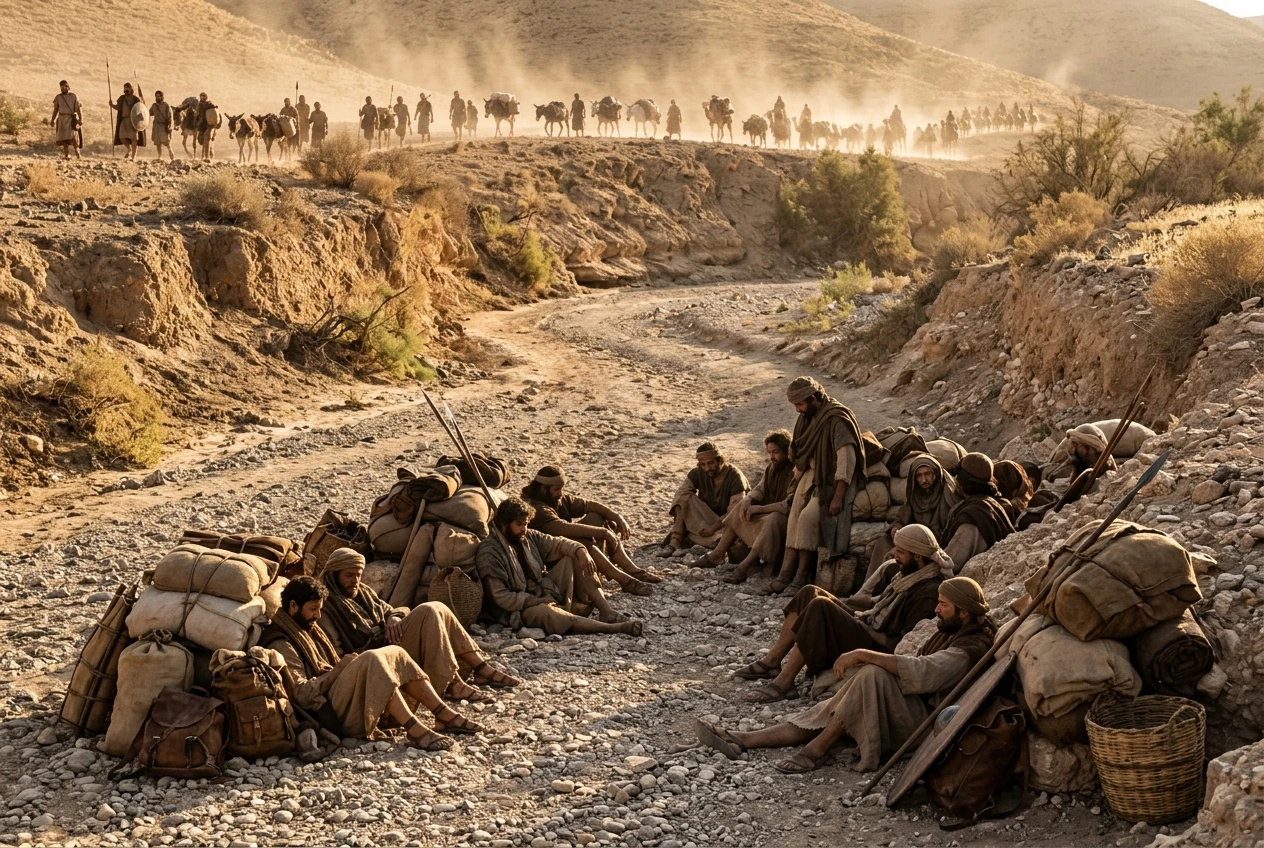
    A dry ancient riverbed at the brook Besor in late afternoon gold light: a group of exhausted men rest on the stony bank beside piled baggage and supply bundles, while in the distance dusty warriors with spoil return across the ridge toward them.

    Three things in the passage bear on your household.

    • The reward is described as what “the LORD has given us,” not as wages earned by the strongest. That is why it was not kept by those who went to battle.
    • The ones who stayed were not spectators. They kept the supplies the others needed.
    • David set the rule down as a lasting law, which shows that he regarded it as a matter of justice.

    The passage does not speak about preachers directly, so it should not be quoted as though it did. It does state a principle that agrees with the rest of Scripture: those who support the work share in it. Paul expresses the same truth in Philippians 1:5, where he gives thanks for the Philippians’ “partnership in the gospel.” Your household stays with the supplies, and God is able to count them as partners in what is done.

    Naming the Sacrifice at the Table: What to Say and What Not to Promise

    Choose a time with no hurry, and preferably a meal, since that is where the household already gathers. Speak in plain sentences, and be specific. For example:

    A multigenerational family seated around a simple meal of rice, vegetables and bread in a plain home, an elderly grey-haired man leaning toward his wife with open hands, a teenager and a small child listening, soft window daylight and warm earth tones.
    • “You have given up many evenings so that I could prepare to preach, and I want to thank you for that.”
    • “The fares and the food on the road come out of money that this house also needs. I know that, and I am grateful.”
    • “When I am away, you carry the house. That is part of this work, and it is yours as much as mine.”

    Then ask a question and listen to the whole answer: “What has this cost you that I have not noticed?” Do not defend yourself while they answer. Their reply is information you need.

    Be careful with promises. Some things should not be promised, because you cannot guarantee them.

    • Do not promise that the pension will increase or that hardship will end soon.
    • Do not promise a particular earthly reward for their sacrifice. Scripture promises that God is not unjust to overlook the work and love shown for His name (Hebrews 6:10), but it does not tell us the form or the timing, and the judging belongs to Him.
    • Do not promise more time at home than you can actually give.
    • Do not use 1 Samuel 30:24 as an argument that they must be content. The verse is a reason to thank them, not a reason to silence them.

    Giving Each Member a Real Share in the Work, From Prayer to Practical Help

    A share that exists only in words will not satisfy anyone. Offer each person a real part, and let them choose it. A few possibilities:

    • Prayer. Paul asked the Corinthians to help him “by your prayers” (2 Corinthians 1:11), and he asked the Romans to strive together with him in prayer (Romans 15:30). A family member who prays for a sermon by name has a share in it.
    • Listening. A spouse or an older child can hear you read a sermon aloud and say where it is unclear.
    • Practical help. Someone may prepare food for the journey, write out a Scripture reference clearly, or keep a record of the people you have visited.
    • Company. Where the distance and the occasion allow, a family member may come along, so that your presence at the pulpit is not always their absence from you.

    A sick relative or a young child may only be able to pray, and that is a full share. Never rank the contributions against one another. In 1 Samuel 30, the man at the brook and the man in the battle received the same.

    A living-room scene in soft morning light: a grandmother with folded hands praying over a sermon page, a child beside her carefully copying a Scripture reference in a notebook, and a wrapped parcel of food for a journey on the table nearby.

    Honouring Your Duty to Provide Without Placing the Ministry Above Your Own Home

    Paul writes, “If anyone does not provide for his relatives, and especially for members of his own household, he has denied the faith and is worse than an unbeliever” (1 Timothy 5:8). Preaching does not cancel this duty. A sermon that is prepared while the household lacks food, school fees or medicine has not been offered rightly.

    Paul himself worked with his hands so that he would not be a burden to the people he taught (Acts 18:3; 1 Thessalonians 2:9). He also defended the right of those who preach to be supported (1 Corinthians 9:7-14), so Scripture does not teach that the preacher must neglect his own needs. The two truths stand together: the ministry is real, and so is the home.

    A practical test is useful. If the ministry’s cost in money or time is causing a basic need in the house to go unmet, the household comes first, and the ministry adjusts. Caring for a sick relative is not a pause in service, as the article When a Relative Falls Sick, Caring for Them Is Part of Your Ministry, Not a Break From It explains from Scripture. Invite your family to tell you when the balance has gone wrong, and then act on what they say.

    When a Family Member Is Weary or Doubts: Answering Them Truthfully and Gently

    Someone in the household may eventually say, “I am tired of this,” or “Is it worth it?” Treat the question as a serious one. Listen first, and let them finish before you answer.

    Then answer truthfully. You can agree that the cost is real, because it is. You can say what you believe: that God sees the labour and love shown for His name, and that Paul wrote, “Let us not grow weary of doing good, for in due season we will reap, if we do not give up” (Galatians 6:9). You cannot honestly say that you know how or when the reward will come, so do not pretend to. The article What the Bible Means by Eternal Reward When No One Pays the Preacher sets out what Scripture does and does not say about it.

    Do not quote a verse as a rebuke. “A soft answer turns away wrath” (Proverbs 15:1), and a tired person who is answered with a verse thrown like a stone will usually stop speaking. If the doubt goes beyond the burden of the work and reaches faith itself, pray with that person and consider asking a trusted elder or fellow believer to speak with them.

    This week, gather your household for one unhurried conversation. Thank each person by name for what they carry, and close it together in prayer.

  • When You Never See the Fruit of Your Preaching, Keep Sowing Anyway

    When You Never See the Fruit of Your Preaching, Keep Sowing Anyway

    Some preachers teach for twenty years and can name only a few people who ever told them the word had reached them. The pulpit is filled, the lesson is given, the people greet him at the door, and then he goes home not knowing whether anything he said was taken in. If you are in that situation, Scripture speaks to it directly. It also tells you how to stay faithful in ministry when you see no results.

    This article is written for the volunteer preacher who receives no wage and little report, and for the relatives who stand beside him and wonder whether his labor counts for anything.

    Why God Allows Some Labor to Stay Hidden From the One Who Does It

    Scripture does not promise that the worker will see the harvest. Jesus said to His disciples, “One soweth, and another reapeth” (John 4:37), and He told them they had entered into the labors of others. Some of the men who sowed before them never saw what grew.

    The prophet Isaiah gives words to the feeling that many preachers carry quietly. In Isaiah 49:4 the servant says that he has labored in vain and spent his strength for nothing. He does not stop there. He continues: “yet surely my judgment is with the LORD, and my work with my God.” He hands the verdict on his work to God, who alone can give it.

    There are several reasons the labor may be hidden, and Scripture gives us some of them:

    A freshly sown field at early morning with the soil still bare, only a faint line of green shoots pushing up in one corner, a few seeds visible in the dark earth in the foreground, soft golden light across the furrows.
    • The word often works slowly, as seed does under the soil before anything shows above it (Mark 4:26 to 28).
    • The hearer may take the word home and act on it years later, in a place the preacher will never visit.
    • God keeps the final accounting for Himself, so that the preacher serves for the Lord’s sake and not for the praise of men.

    A preacher who never hears the result is not, for that reason, a preacher whose work has failed. He is working under the same arrangement as the prophets and apostles.

    The Sower’s Task: What Scripture Asks of You and What It Keeps for God

    The parable of the sower in Mark 4 describes four kinds of ground. Seed fell on the path and the birds took it. It fell on stony ground and withered under the sun. It fell among thorns and was choked. Only on good ground did it bear fruit. In the parable the sower is not blamed for the three failures. His work is to sow, and the condition of the soil is not in his hands.

    A farmer's hand scattering seed across four kinds of ground in one sweep: a hard path with a bird pecking at it, a patch of stones, a tangle of thorns, and dark rich soil with young green growth, under warm afternoon sun.

    Paul says the same thing to the Corinthians. “I have planted, Apollos watered; but God gave the increase” (1 Corinthians 3:6). He continues that neither the one who plants nor the one who waters is anything, but God who gives the increase. Then he adds a sentence that every unpaid preacher should keep: “every man shall receive his own reward according to his own labour” (verse 8). The reward is set according to the labor, and not according to the increase.

    Isaiah 55:11 completes the picture. God says of His word that it will not return to Him empty, but will accomplish what He pleases and prosper in the thing for which He sent it. The promise concerns the word, and the word is God’s. The preacher who has spoken what Scripture says has put into the world something that God has pledged to use.

    The division of work is plain:

    • Yours: to prepare, to speak the word truthfully, to pray, to love the hearers, and to come again.
    • God’s: to open the heart, to give growth, to decide the time of harvest, and to know who has truly heard.

    When a preacher takes up God’s part, he becomes anxious. When he does his own part and leaves the rest, he can work with a quiet mind.

    Measuring the Week by Faithfulness

    Without any sign from the hearers, a preacher needs another measure for his week. Scripture supplies one: “it is required in stewards, that a man be found faithful” (1 Corinthians 4:2). A steward is judged by whether he managed what was entrusted to him. He is not judged by how the master’s other servants responded.

    Paul also charged Timothy to “preach the word; be instant in season, out of season” (2 Timothy 4:2). The charge names the duty, and it does not name an outcome. At the end of a week you may ask yourself plain questions drawn from these texts:

    1. Did I read the passage carefully and teach what it says, and not what I wished it said?
    2. Did I pray for the people who would hear me, by name where I could?
    3. Did I speak with patience and love, even to those who seemed inattentive?
    4. Did I keep the appointment I had made, in spite of weariness, weather or the cost of travel?
    5. Did I leave the outcome with God?

    If the answers are yes, the week was faithful, and a faithful week is a complete week in the sight of God. Attendance, comments and visible change are still worth noticing with thanks when they come. They are not the standard by which the week is judged.

    This measure suits the older preacher especially. Strength and travel may be limited and the congregation may be small, but faithfulness can be done at any age and on any income. Those who want to read more on this may turn to the retired preacher on a pension, who still has a pulpit.

    When Silence Feels Like Failure: Answering Discouraging Thoughts With God’s Word

    Silence from the hearers produces thoughts that sound reasonable. They say that nobody is listening, that the years have been wasted, that a better-trained man would have done more. It is wise to answer such thoughts with Scripture, one verse at a time, as Jesus answered the tempter in the wilderness.

    The thought: “I am growing tired and nothing has come of it.” Paul writes in Galatians 6:9, “let us not be weary in well doing: for in due season we shall reap, if we faint not.” The harvest has a season, and the season is God’s. Weariness is acknowledged in the verse itself, and the remedy it gives is to continue.

    The thought: “My work has made no difference.” Paul closes his great chapter on the resurrection with this charge: “be ye stedfast, unmoveable, always abounding in the work of the Lord, forasmuch as ye know that your labour is not in vain in the Lord” (1 Corinthians 15:58). The phrase “in the Lord” matters. The labor is secure because of whom it is done for, whatever may be seen of it.

    The thought: “Perhaps I should stop.” Ecclesiastes 11:6 says, “In the morning sow thy seed, and in the evening withhold not thine hand: for thou knowest not whether shall prosper either this or that, or whether they both shall be alike good.” Ignorance of which seed will grow is given as the reason to keep sowing, and not as a reason to stop.

    A worn open Bible on a plain wooden table beside a small handwritten index card tucked under the cover, lit by a single lamp in the evening, a cup of tea and reading glasses nearby, dark window behind.

    It helps to write these verses on a card and keep it with your Bible. A thought of failure that arrives on a hard evening can then be met with the exact words of Scripture, which are steadier than memory.

    God Sees What No Congregation Records

    No congregation keeps a full record of what a preacher has done: the evenings of preparation, the walks to distant villages, the meals given up, the prayers said for people who never knew. God keeps that record. Hebrews 6:10 says, “God is not unrighteous to forget your work and labour of love, which ye have shewed toward his name, in that ye have ministered to the saints, and do minister.”

    The verse names God’s righteousness as the ground of the promise. For God to forget such labor would be unjust, and God cannot be unjust. The preacher’s hope therefore rests on God’s character, and does not depend on the memory or gratitude of men.

    Jesus gave the same assurance about the Father who “seeth in secret” and “shall reward thee openly” (Matthew 6:4). The reward, as the Bible describes it, is kept by God, and it includes the eternal life promised to those who endure in faithful service. The post on what the Bible means by eternal reward when no one pays the preacher treats that promise in full.

    A word to the relatives who support him: when you bring a meal, pay for a journey, or simply listen to him after he has preached, you share in this labor. Hebrews 6:10 speaks of ministering to the saints, and that is the work you are doing. It is not forgotten either.

    A Short Evening Practice for the Preacher Who Needs Reminding

    This practice takes about ten minutes and can be done at the end of any day on which you taught, prepared, or visited. It needs only your Bible and a quiet place.

    An elderly man seated by a window at dusk in a modest room, an open Bible on his knees and his hands resting quietly on the page, the last orange light fading over a distant field outside.
    1. Read one verse aloud. Choose from 1 Corinthians 15:58, Galatians 6:9 or Hebrews 6:10. Read it slowly, twice. Let it be God’s word spoken to you, whatever the day has been like.
    2. Name the day’s faithful acts. Say to yourself what you did: the passage you studied, the person you greeted, the prayer you offered. Use the five questions above if they help.
    3. Name the people. Pray for those who heard you, by name where you can. Ask God to give the growth, as Paul says He alone can.
    4. Give back what is not yours. Say plainly to God that the result belongs to Him. Thank Him that His word will not return empty.
    5. Give thanks and rest. Thank Him for the day’s bread and for the strength to serve. Then sleep, since the field is the Lord’s and He does not sleep.

    Done each evening, this practice sets a different measure in your mind from the one that silence tries to impose. After some weeks you may find that the question “Did anyone respond?” has given way to “Was I faithful today?”, and that the second question can always be answered.

    Keep Sowing

    The preacher who sows without seeing the harvest is in the company of the prophets, the apostles and the Lord Himself, who sowed the word among people who often did not receive it. Their labor was not in vain, and neither is yours. God has said so, and He does not forget.

    If this encouraged you, read next “What the Bible Means by Eternal Reward When No One Pays the Preacher” and share this word with another preacher who is growing weary.

  • What a Volunteer Preacher Can Honestly Say to His Congregation When He Is in Need

    What a Volunteer Preacher Can Honestly Say to His Congregation When He Is in Need

    A preacher who serves without pay may need to tell his congregation that food is short, that the fare for the next journey is not in hand, or that a relative’s needs have grown. The difficulty is knowing what to say to your church when you need financial help, and what to leave unsaid. Scripture gives a pattern in the way Paul spoke to the churches. This article sets out that pattern in practical order: who to tell first, which words to use, which to avoid, and how to give thanks afterward.

    The reasoning for why asking is not greed is given in the article on asking your community for help honestly. This piece supplies the words themselves.

    Before You Speak: Pray First and Examine Your Motive

    Bring the need to God before you bring it to men. Paul wrote to the Philippians, “Be careful for nothing; but in every thing by prayer and supplication with thanksgiving let your requests be made known unto God” (Philippians 4:6). He wrote this to a church, and the same letter later records that he received their gifts. Prayer comes first, and the church comes second.

    An elderly man in a plain cotton shirt kneels beside a simple wooden chair in a small bare room at dawn, his open Bible resting on the seat, soft gold light from a single window falling across his folded hands and a modest bag of rice on a table behind him.

    Then examine your motive, in the presence of God, with a few plain questions:

    • Is the need real, and can you name it exactly: a bag of rice, a bus fare, a child’s school fees?
    • Would you still be willing to serve if the answer were silence?
    • Are you hoping to be praised for your sacrifice, or to make someone feel guilty?
    • Have you first done what you can with your own pension and your own hands?

    Paul said he had learned to be content in whatever state he was in (Philippians 4:11). That contentment is not a refusal to speak of need. It is the condition in which a man can speak of need without bitterness, because his trust does not depend on the answer. If you find resentment in your heart, wait, and pray until it is gone. Words spoken in resentment will carry it to the congregation, however carefully they are chosen.

    If the need is pressing and you want help praying about it first, the article on how a preacher can pray when the bread is running short may serve you.

    Tell the Elders or Trusted Brethren Before You Tell the Whole Church

    Speak first to one or two mature brethren whom you trust, ideally the elders if your congregation has them. There are three reasons for this.

    First, they may know of a way to meet the need that you do not. A congregation often has a benevolent arrangement, or a member who has been waiting for a way to help. Second, they can advise you on whether a public word is needed at all. Many needs are met quietly, and a quiet gift spares everyone embarrassment. Third, if a public word is appropriate, it will not come as a surprise. The brethren will understand it, and some may speak in support of it.

    Three men of different ages sit close together on plain benches at the side of a simple village church after a service, the grey-haired preacher speaking quietly while two elders listen with grave, kind attention, warm afternoon light coming through open doorway shutters.

    Scripture shows Paul taking care over how gifts were received and carried. He mentions Epaphroditus, who brought to him what the Philippians had sent (Philippians 4:18). The gift travelled through a trusted man, in the open, and Paul acknowledged it plainly. Order and openness protect the preacher’s name and the church’s peace.

    When you speak to the elders, say what you would say to the whole church, only more fully. Tell them what the need is, how long it has lasted, and what you have already done about it. Ask them for counsel before you ask them for money.

    Three Plain Sentences: Naming the Need Without Complaint or Pressure

    If the elders agree that a word to the congregation is fitting, keep it short. Three sentences are enough, and each has one task.

    1. State your service and your situation. “Brethren, I serve in teaching the gospel without payment, and I live on a small pension.”
    2. Name the need exactly. “This month I am short of food, and I lack the fare to reach the places where I am asked to teach.”
    3. Leave the response with them and with God. “If the Lord moves any of you to help, I will receive it with thanks; if not, I will keep teaching and keep trusting Him.”

    These are an example of the form, and you should put your own true need into it. Do not enlarge the need to move people, and do not shrink it to appear humble. If the need concerns a sick relative or a child’s schooling, say so in the same manner: what is needed, in a single sentence, with no description of suffering meant to move pity.

    Each sentence carries something of Paul’s manner. He stated what he had received, and he stated what he lacked when it was true. He never demanded. The third sentence matters most, because it leaves the congregation free. A gift given under pressure is not the fruit Paul spoke of.

    What Not to Say: Guilt, Hints, Comparisons and Promises Made on God’s Behalf

    Some things are best left out entirely, even if they feel natural in the moment.

    Guilt. Do not say that the church has neglected you, or remind them of what you have given up. “After all I have done for you” turns a request into a debt. Paul did reprove churches when reproof was needed, but he did not use it to collect gifts.

    Hints. Remarks such as “the cupboard is bare this week” or “I do not know how I shall travel”, spoken with no request attached, ask for help while pretending not to. They leave the hearers uncertain what is wanted, and they put the burden on them to guess. If you have a need, say so once and plainly. If you will not say it plainly, do not say it.

    Comparisons. Do not compare your congregation with another that gives more, or your situation with that of preachers who are paid. Comparison breeds envy on your side and defensiveness on theirs.

    Promises on God’s behalf. Do not say, “God will bless you ten times over if you give,” or “Whoever helps me will never lack.” Scripture does not authorize a preacher to guarantee a return in his own name. Paul wrote, “my God shall supply all your need according to his riches in glory by Christ Jesus” (Philippians 4:19), but he wrote it to a church that had already given, as an expression of his confidence in God. He did not offer it in advance as the price of their giving. To promise what God has not promised is to speak falsely about Him, and a preacher above all must avoid that.

    Self-pity. A preacher may mention his need, but he should not describe his hardships at length. Long accounts of suffering invite pity, and pity is a poor motive for giving.

    How Paul Spoke of Gifts Received and Why He Called the Fruit Theirs, Not His

    Two passages show Paul’s pattern, and they should be read together.

    In 1 Corinthians 9 he sets out the right of those who preach. “Have we not power to eat and to drink?” he asks (verse 4). He argues that “if we have sown unto you spiritual things, is it a great thing if we shall reap your carnal things?” (verse 11), and he states that “the Lord ordained that they which preach the gospel should live of the gospel” (verse 14). So the preacher’s claim on the church for his bodily needs is grounded in the Lord’s own ordinance.

    Yet Paul adds that he had not used this right in Corinth, “lest we should hinder the gospel of Christ” (verse 12), and that he had not written so that it should be done in his own case (verse 15). He chose, in that place, to forgo what he was entitled to. This does not make asking wrong, since in Philippi he gladly received what they sent. It shows that a preacher judges, place by place, what will best serve the gospel, and that the right and its use are separate matters.

    A weathered table in a modest room holds a bundle of food wrapped in cloth, a small coin purse and a rolled letter, with an old open scroll beside them, lit by lamplight in warm amber and deep brown tones, evoking a gift carried by a trusted messenger.

    In Philippians 4 Paul thanks the church for sending to his need more than once, even when he was in Thessalonica (verses 15 and 16). Then he says something worth studying closely: “Not because I desire a gift: but I desire fruit that may abound to your account” (verse 17). He directs attention away from the gift and toward what it does for the givers. In his words, the fruit is credited to their account. He calls what they sent “an odour of a sweet smell, a sacrifice acceptable, wellpleasing to God” (verse 18). He also says, “I have all, and abound: I am full” (verse 18), which tells them plainly that their gift was enough.

    From this the preacher may take four practices. He should receive gifts with gratitude. He should say when the need has been met. He should remind the givers that their giving is an offering to God, not a payment to himself. And he should speak of the fruit as theirs.

    Thanking the Congregation and Giving the Matter Back to God

    When help comes, thank those who gave, and do it specifically. Name what was received and what it will be used for, in the same plain manner in which you named the need. If gifts were passed through the elders, thank them too, as Paul named Epaphroditus. Do not make the thanks long, and do not compare the givers.

    After a service, an older preacher in a worn jacket clasps the hand of a smiling woman at the church doorway, a basket of vegetables and bread at her feet, with other congregants lingering on the sunlit steps in the background.

    If help does not come, or comes only in part, say nothing that suggests disappointment. Paul’s contentment was not tied to what he received (Philippians 4:11), and a preacher who speaks once and then waits in peace shows the congregation the same trust he teaches them. Return to prayer and to the ordinary work of teaching. Other resources are also open: the article on stretching a fixed pension through the month addresses the practical side.

    After the matter is spoken, do not raise it again and again. One honest word, followed by trust, is the pattern. Whatever the congregation does, the Lord who sees the labor knows it, and He is the one who rewards it.

    A short prayer to close:

    Heavenly Father, You know what I need before I ask. Keep my heart free from shame, from complaint and from every desire to move men by anything but the truth. Let my words be few and honest. Bless those who give, and bless those who cannot, and let the fruit be counted to their account. I place this matter in Your hands and will go on teaching Your word, in the name of Jesus Christ our Lord. Amen.

    This week, write out your own three plain sentences: your service, your exact need, and the freedom you leave with the hearers. Pray over them each day, and change any word that carries guilt, hint or pressure. Before you speak to anyone, read the article on asking honestly as a volunteer preacher so that your motive is settled as well as your words.

  • A Daily Prayer for the Preacher Who Also Keeps Watch at a Sickbed

    A Daily Prayer for the Preacher Who Also Keeps Watch at a Sickbed

    The sickbed and the pulpit can seem to pull in opposite directions. A preacher who keeps watch over a sick relative serves one person through the night and then stands before a congregation on the Lord’s day. A daily prayer for a caregiver in ministry gives both kinds of work to the same Master, at the hours when each one actually happens.

    Why one prayer can hold both the sickbed and the pulpit

    Scripture does not divide the care of the body from the preaching of the Word. The Lord who sent out the twelve to preach also healed the sick, and He counts a visit to the sick as a service done to Himself. A preacher who washes a fevered brow and a preacher who opens the Scriptures answer to one Lord, and both can be brought to Him in prayer.

    The pattern below has five short prayers, each tied to one passage and one moment of an ordinary day: waking, the bedside, the midday meal, the evening preparation of the sermon, and the last hour of the night. Each is brief enough to pray with tired lips. You may pray them aloud, or read them from the page until the words are familiar.

    The prayers are written in the older form of address, with Thee and Thou, because many preachers have prayed that way all their lives. If plainer words come more easily to you, pray the same petitions in your own speech. The Lord does not grade the language.

    Morning: giving the whole day to the Lord before the first task

    The psalmist writes, “My voice shalt thou hear in the morning, O LORD; in the morning will I direct my prayer unto thee, and will look up” (Psalm 5:3). The verse names the order of the day: the prayer comes first, and the work follows.

    A modest bedroom at first light: a worn Bible resting on a wooden nightstand beside a glass of water and a small brown bottle of medicine, pale gold sunlight slipping through half-open curtains onto a folded quilt.

    A caregiver’s morning often starts with a need. A cough, a medicine to be given, a meal to prepare, a call to answer. Before the first of these, stand or sit for one minute and give the whole day to God, the sickbed and the sermon together. This is the one task that cannot be done well if it waits until the others are finished.

    O Lord, Thou hast brought me to the morning, and I lift up my voice to Thee. Hear me. This day is Thine, with everything in it: the one who is sick in my house, the Word I am to speak, and every small task between them. Give me strength for the body that needs my hands, and clearness for the Word that needs my mouth. Let me do nothing today that Thou hast not given me to do, and let me leave undone nothing that Thou hast. In the name of Jesus Christ, Amen.

    Pray this before you open the curtains or put the kettle on. It takes less than a minute.

    At the bedside: praying with the sick person, not only for them

    In the Lord’s own account of the last judgment, He says, “I was sick, and ye visited me” (Matthew 25:36). He does not say “ye prayed about me from another room.” A visit means presence, and presence at a sickbed can include prayer spoken aloud, together.

    Praying for a sick person means speaking to God about them. Praying with them means they are invited in. You may take their hand and say a short prayer in their hearing, or ask whether there is something they wish to bring to the Lord. Many sick people have no one who will pray with them in plain words, and they remain at the center of what is asked. If the person is weak or sleeping, pray quietly beside them anyway.

    Close view of an elderly caregiver's weathered hand holding the thin hand of a sick person lying under a crocheted blanket, warm lamplight, a cup of tea and a cloth on the bedside table, soft browns and creams.

    Lord Jesus, Thou who hast said that Thou wast sick and we visited Thee, be present in this room. Look upon Thy servant who lies here, and give rest where there is pain and patience where there is weariness. Let him [or her] hear that he is not alone, and let me serve him as one who serves Thee. Teach me when to speak and when to be silent. Receive the work of my hands at this bedside as a service to Thy name. Amen.

    Where the prayer says “him [or her],” say the name of the person in your care. Names matter to the sick, and God knows each one.

    Midday: asking for daily bread and thanking Him for what is on the table

    The Lord taught His disciples to pray, “Give us this day our daily bread” (Matthew 6:11). The request is for this day, and the table at midday is where that prayer is answered or tested. For a preacher who lives on a small pension and also feeds a sick household, the midday meal can be modest. It is still the answer to something asked at dawn.

    A plain kitchen table at noon with a single bowl of steaming soup, a loaf of bread on a board and two tin spoons, set on a faded cloth beside a window with soft white daylight.

    Pause over the meal before eating. Thank Him for what is actually set out, however plain, rather than for what you wish were there. Gratitude spoken over bread, rice or soup keeps the heart steady when the cupboard is thin. If the month is hard and the bread is running short, there is a fuller treatment in How a Preacher Can Pray When the Bread Is Running Short. This prayer is for the ordinary noon.

    Our Father, Thou hast given us this day our daily bread, and we thank Thee for what is on this table. Bless this food to the strength of the one who is sick and to the strength of the one who serves him. Provide for tomorrow as Thou hast provided today, and let us not be anxious, for Thou knowest what we need before we ask. Let every mouthful remind us that Thou art the giver. Amen.

    Where there is someone at the bedside too weak to come to the table, carry the prayer to them and say it there.

    Evening: praying over the sermon while the house is quiet

    Paul writes, “Be careful for nothing; but in every thing by prayer and supplication with thanksgiving let your requests be made known unto God” (Philippians 4:6). The evening, when the sick person has been settled and the house has gone quiet, is often the only time a volunteer preacher has to prepare the Word. It is also the hour when anxiety about the sermon is strongest.

    A small desk in a quiet house at night: an open Bible with a handwritten notebook of sermon notes, reading glasses laid on the page, lit by one amber desk lamp, with a dark doorway behind leading toward a sickroom with a faint glow.

    Begin the preparation with this prayer, before opening the Bible or a notebook. It places the sermon in God’s hands before you begin to work on it, and it admits openly that you are tired. Practical help for the hours themselves may be found in How to Pace a Sermon When You Only Have Evenings to Prepare.

    Heavenly Father, the house is quiet and I come to Thee with the Word I am to speak. I am weary, and I bring my weariness to Thee with my thanks. Open my eyes to see what Thy Scripture says, and keep me from speaking anything that Thou hast not given. Where my preparation is poor, let Thy truth be sufficient. Let the sermon serve the hearers and honor Thy Son. Make known my requests, and give me peace in place of fear. Amen.

    When the prayer is finished, begin the work. The sermon will be no less your own for having been prayed over first.

    Night: laying down weariness and trusting that the labor is not in vain

    Paul gives this exhortation to the Galatians: “And let us not be weary in well doing: for in due season we shall reap, if we faint not” (Galatians 6:9). The verse admits that weariness is real. It does not tell the worker to feel no tiredness. It promises a harvest in due season, which means a time appointed by God and not by us.

    The last hour of the night is the time to lay down what the day has left. Some of it was done well and some badly. Some of it is unfinished and will be there in the morning. A preacher who carries the sickbed and the sermon to bed without giving them to God will lie awake with both. The labor of the day belongs to the Lord, and He keeps its account.

    For a longer reflection on what the Lord promises to those whose service goes unpaid on earth, read What the Bible Means by Eternal Reward When No One Pays the Preacher.

    Lord, the day is ended and I lay it down before Thee. Forgive what I did poorly, and accept what I did in faith. I am weary, and Thou hast said that we shall not be weary in well doing, for in due season we shall reap if we faint not. Keep watch over the one who sleeps in my house, for I cannot keep watch every hour. Let me rest in the knowledge that my labor in Thee is not in vain. Into Thy hands I commit this night. Amen.

    How to keep this rhythm on days when you are too tired to pray at length

    Some days the full prayers will be too much. A night spent awake with a sick relative leaves little strength for words, and the Lord knows it. Scripture does not set a length for prayer, and a short prayer offered in faith is complete.

    On those days, keep only the first line of each prayer:

    • Morning: “O Lord, this day is Thine.”
    • Bedside: “Lord Jesus, be present in this room.”
    • Midday: “Our Father, we thank Thee for this bread.”
    • Evening: “Father, I bring Thee the Word and my weariness.”
    • Night: “Lord, I lay down this day, and my labor is in Thy hands.”

    Each line can be said in a breath, and each is tied to something you already do: opening your eyes, entering the sickroom, sitting at the table, opening the Bible, lying down. Fastening the prayer to the act makes it easier to remember than a fixed clock hour, because a sick household rarely keeps a fixed clock.

    If you miss a prayer, do not wait for the next day to begin again. Pray it at the next hour that comes, in whatever words you have.

    Begin tomorrow

    Choose one of the five prayers and pray it tomorrow at its hour. Then read When a Relative Falls Sick, Caring for Them Is Part of Your Ministry, Not a Break From It on this site, to see why this work is itself service to Christ.